AWS

Media sharing service architecture in AWS

CK CK 3788 
Created at  
10,367 0 0

Media sharing is one of the hottest markets on the Internet. Customers have a staggering appetite for placing photos and videos on social networking sites, and for sharing their media in custom online photo albums.

The growing popularity of media sharing means scaling problems for site owners, who face ever-increasing storage and bandwidth requirements and increased go-to-market pressure to deliver faster than the competition.

Since most businesses today have limited manpower, budget, and data center space, AWS offers a unique set of opportunities to compete and scale without having to invest in hardware, staff, or additional data center space. Utilizing AWS is not an all or nothing proposition. Depending on the project, different services can be used independently.

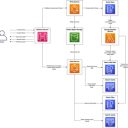
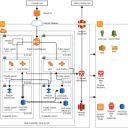
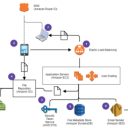
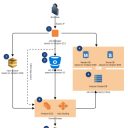
This diagram shows an example of a highly available, durable, and cost-effective media sharing and processing platform.

Media sharing service architecture in AWS


#

Description

1

Sharing content first involves uploading media files to the online service. In this configuration, an Elastic Load Balancer distributes incoming network traffic to upload servers, a dynamic fleet of Amazon Elastic Compute Cloud (Amazon EC2) instances. Amazon CloudWatch monitors these servers and an Auto Scaling group manages them, automatically scaling EC2 capacity up or down based on load. In this example, a separate endpoint to receive media uploads was created in order to off-load this task from the website's servers.

2Original uploaded files are stored in Amazon Simple Storage Service (Amazon S3), a highly available and durable storage service.
3To submit a new file to be processed, upload web servers push a message into an Amazon Simple Queue Service (Amazon SQS) queue. This queue acts as a communication pipeline between the file reception and file processing components.
4The processing pipeline is a dedicated group of Amazon EC2 instances used to execute any kind of post-processing task on the uploaded media files (video transcoding, image resizing, etc.). To automatically adjust the needed capacity, Auto Scaling manages this group. You can use Spot Instances to dynamically extend the capacity of the group and to significantly reduce the cost of file processing.
5Once processing is completed, Amazon S3 stores the output files. Original files can be stored with high durability. Processed files could use reduced redundancy.
6Media-related data can be put in a relational database like Amazon Relational Database Service (Amazon RDS) or in a key-value store like Amazon SimpleDB.
7A third fleet of EC2 instances is dedicated to host the website front-end of the media sharing service.
8Media files are distributed from Amazon S3 to the end user via Amazon CloudFront, a content delivery network. Amazon CloudFront offers low-latency delivery through a worldwide network of edge locations.


Tags AWS Architecture Amazon CloudFront Amazon RDS Amazon SQS Amazon Simple Queue Service Facebook X
Comments 0
Similar posts
  1. Enterprise Data Lake Architecture based on AWS
    10,407
  2. Ad Tech Multi-Tenancy: A Spectrum of Isolation Architectures on AWS
    331
  3. Measuring Ad Viewability: AWS Architectures for Programmatic Accountability
    476
  4. AWS System Design Example - Instagram Architecture
    1,918
  5. Predictable Ad Spend: Architecting Pacing at Hyperscale
    423
  6. Amagi CLOUDPORT Architecture based on AWS for FAST for channel playout on AWS
    1,318
  7. Product Marketing & Recommendation Architecture in AWS for e-commerce website
    10,737
  8. Teraform from the scratch
    1,357
  9. Web front-end architecture in AWS for e-commerce website
    365
  10. Web Application Hosting provides the reliable, scalable, secure, and high-performance infrastructure
    10,615
  11. Time series processing architecture in AWS
    10,559
  12. Synchronous online gaming architecutre in AWS - Highly Available, Scalable & Elastic to support Millions of Players
    10,417
  13. Secure and Scalable LAMP Service Architecture in AWS
    10,661
  14. Live streaming / Static Content & Media Service based on AWS
    10,656
  15. Large scale messenger service architecture in AWS - Slack case study
    11,674
  16. Large scale computing based on huge data sets in AWS
    10,610
  17. Image Moderation Chatbot - a serverless chatbot on AWS that monitors chat channels and removes images suggestive or explicit image
    10,426
  18. Financial services grid computing in AWS
    10,354
  19. File synchronization service architecture in AWS
    10,377
  20. Fault Tolerance & High Availability based on multi Availability zones in AWS
    10,809
  21. Disaster recovery solution in AWS for local applications
    11,179
  22. Content Distribution for VOD streaming services in AWS
    10,357
  23. Checkout service architecture in AWS for e-commerce website
    11,010
  24. Batch processing composed of job manager, job store and worker based on AWS
    10,450
  25. AWS Architecture for collecting Click-Through Events on Advertisement serving
    10,374
  26. Architecting for Resilience: AWS High Availability Components Including API Gateway
    139
  27. Designing Resilient Infrastructure to Prevent Order Data Loss During Kafka Failures
    157
  28. KMP String Matching Algorithm
    674
  1. How to change your AWS Credential Region in CLI?
    754
  2. Default Timeout for Amazon Bedrock invoke_model
    736
  3. When you face 504 Timeout Errors by Amazon ALB
    1,472
  4. When you face 504 Gateway Timeout while you wait a response from Bedrock in Fast API
    535
  5. How to overcome the prompt size limit when you use Claude via Bedrock - Chunking / Splitting the Input
    496
  6. Integrating VectorDB stored in S3 with Amazon Bedrock
    425
  7. When you need AWS_ACCESS_KEY_ID and AWS_SECRET_ACCESS_KEY for Amazon Bedrock
    534
  8. How Netflix Runs Recommendations for Hundreds of Millions of Users Using Amazon SageMaker & Metaflow
    175
  9. Why Amazon VPC satisfies with PCI-DSS and SOC 2 Type on Fintech Industry?
    645
  10. You shouldn't use Amazon CloudFront distribution as an origin
    634
  11. Creating a serverless Apache Kafka publisher using AWS Lambda
    564
  12. A Python script to create an EC2 Spot instance using boto3
    1,602
  13. A Python/PHP code to deregister anormalous instaces in Amazon ECS
    1,858
  14. Where to get AWS API Key at AWS Management Console?
    1,071
  15. Understanding Amazon Bedrock Agent for AI-based ChatBot
    644
  16. "502 Bad Gateway" Error easy to happen at the combination of nginx and node.js in AWS Elastic Beanstalk
    10,490
  17. How to Set Up and Deploy Containerized Applications with AWS ECS
    10,675
  18. Power of Containerized Deployment with AWS ECS
    10,597
  19. FAISS Already Does ANN... So Why Do Top Teams Still Pay for SageMaker?
    310
  20. Recommended Vector DB Structure for Amazon Bedrock Integration
    390
  21. What cause a 502 bad gateway error in AWS environment?
    444
  22. Building an AWS SAM(Serverless Application Model) Project
    899
  23. Check incomplete multipart uploads if AWS S3 storage size is abnormally big huge compared to the origin storage
    11,598
  24. Importing a wild card domain SSL certificate into AWS Certificate Manager
    10,348
  25. AWS Lambda Example based on Teraform
    900
  26. Simple AWS ECS example based on Teraform
    989
  27. Where to get AWS Access Key ?
    11,264
Recently updated
  1. Why 100% SEO Guarantees Better User Engagement and How to Achieve It in Your Service
    42
  2. Why SPF and DKIM Are Essential for Linux Email Servers?
    36
  3. How do I create animated background for Google Meet?
    21,028
  4. MaxMind GeoLite2 vs. DB-IP Lite vs. ip-api.com: Choosing the Right Free IP Geolocation Solution


    251
  5. Meet Valkey: Why Redis Changed Its License, Why Valkey is Better, and How to Use It as a Drop-in Replacement
    94
  6. How Rogue Web Scrapers Are Stealing My Content and Destroying My Server
    157
  7. Array of arguments passed to script in PHP
    90
  8. Invalid Auction Storms in Ad Tech
    98
  9. Building MRC-Compliant Instrumentation in Ad Tech: Implementation Steps and Key Challenges
    202
  10. The Two Clocks of Ad Server Architecture
    70
  11. Frequency Cap Architecture Overview
    515
  12. Collecting Proof-of-Play from 100,000 Screens
    146
  13. Vector Search in Relational Databases (RDBs): Trends & Usage Environments
    288
  14. What is RedisVL?
    109
  15. Designing a Skill Registry Architecture: Minimize Token Usage and Maximize AI Performance
    232
  16. TPU & GPU Cluster Management Tools
    245
  17. The Concept of Scaffolding in AI Agents
    234
  18. Beyond Static Pipelines: Architecting LLM Multi-Agent Systems for Autonomous Workflow Orchestration
    583
  19. AI-DLC vs. AI-SDLC: Model-Centric vs. System-Centric AI Development
    259
  20. Fine-Tuning Open-Weight LLMs: Training, Licensing, and Deploying Custom Models with Ollama
    339
  21. Inside the Next-Generation Streaming Architecture: Ultra-Low Latency, SGAI, and AI Codecs
    202
  22. Machine Learning: Training vs. Ranking
    222
  23. The Continuous Learning Machine: Designing a Loop That Actually Turns
    222
  24. The Next-Gen Low-Latency Standards: LL-HLS & MoQ
    195
  25. Designing a Data Curation System Around a Vector Database
    221
  26. Extracting Context from Live Video: The Architecture Got Simpler When We Stopped Building Features
    256
  27. The New Ad Stack Behind Live Sports Streaming: Inside SGAI, EABN, and the Standards Race to Fix Live Monetization
    656
  28. Designing MLOps Architectures to Handle Seasonal Data Drift in EV Fleet Models
    196
  29. From 15 to 40+ FPS: Accelerating PyTorch Object Detection on Automotive ECUs
    219
  30. Understanding Data Lineage
    263