Amagi CLOUDPORT Architecture based on AWS for FAST for channel playout on AWS | ||
| ||
| Amagi, a leading cloud broadcast and streaming TV technology provider with over 2,000 channels deployed globally, utilizes AWS to offer a range of playout service resiliency options through its CLOUDPORT SaaS platform. As an AWS Specialization Partner and Marketplace Seller, Amagi caters to diverse customer needs by leveraging multiple AWS Availability Zones and regions, offering solutions ranging from cost-effective single-AZ deployments to highly resilient multi-region setups. For clients demanding the ultimate in redundancy, Amagi provides a beyond multi-region option, incorporating on-premises automation and playout alongside its cloud-based infrastructure to ensure business continuity during unforeseen events.
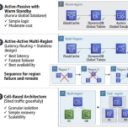
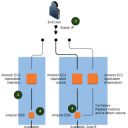
CLOUDPORT's Disaster Recovery Configuration ModesAmagi offers playout and automation deployments in hot, warm, and cold configurations to cater to varying business requirements for recovery time and cost. Hot configurations provide instant switching between active primary and secondary regions, ensuring high availability and serving as origins for CDNs. Warm configurations offer rapid recovery in minutes by keeping data in sync and activating playout processors only during failover, balancing cost and recovery speed. Cold configurations provide the lowest cost with minimal "rescue content" and recovery times of up to an hour, representing a degraded service continuity option. Amagi's distributed architecture guarantees instant control plane recovery with a sub-one-minute RTO in multi-AZ setups and a 10-minute RTO for regional failover, ensuring playout continuity.
Solution ArchitectureAmagi CLOUDPORT is a versatile playout platform that supports most industry-standard audio, video, and subtitle formats. It provides an intuitive interface with asset management, analytics, and configurable rules. Key features include automation for scheduling, quality control, and monitoring; multi-layered graphics support; and a wide range of input formats like MXF, MOV, MPG, TS, and output formats including MPEG-TS, HLS, SRT, Zixi, NDI, and RIST. The platform handles video codecs AVC and HEVC; audio codecs AAC, AC3, and EAC3; as well as captions in CC-608, CC-708, DVB subs, and DVB teletext.
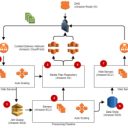
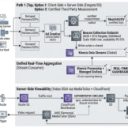
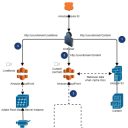
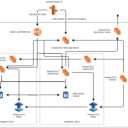
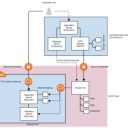
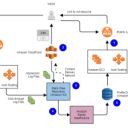
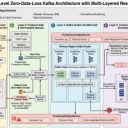
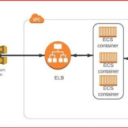
In the diagram above, the secondary region does not actively generate service 24×7. It remains in a warm (standby) state, prepared to take over transmission if issues arise in the primary region. If a switch from the primary to the secondary region is necessary, it is automatic through Amazon CloudFront, ensuring a seamless and swift transition and allowing uninterrupted service availability.
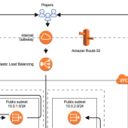
Design AspectsAmagi's CLOUDPORT SaaS platform leverages a robust AWS infrastructure for video transport and business functionalities. It utilizes AWS Elemental Media Services for resilient video processing and a microservices architecture on Amazon EKS for dynamic scaling. The platform depends on managed services like Amazon Aurora, ElastiCache, and S3 for database, caching, and storage, ensuring reliability. Multi-region networking through VPC peering and Amazon EKS's CNI enables communication between pods across regions. Amazon Route 53 facilitates DNS-based service discovery and implements readiness checks for fast failover and failback, ensuring business continuity and disaster recovery.
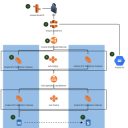
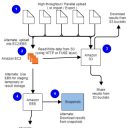
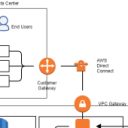
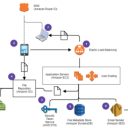
Seamless Cloud-Based Media Asset ManagementCLOUDPORT leverages AWS services to provide playout services for customers, ingesting live feeds via AWS Elemental MediaConnect over AWS Direct Connect and integrating on-premises content and schedules by uploading them to Amazon S3. S3 acts as the central repository for petabytes of video assets, with S3 Multi-Region Access Point ensuring regional redundancy for input files. Automated playout services retrieve and process data from S3, including transcoding and verification, using Amazon SNS for issue notifications, and ultimately storing transmission-ready assets back in S3.
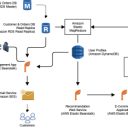
High Availability and Data RedundancyAmazon Aurora Global Database and Amazon ElastiCache Global Datastore both provide disaster recovery and high availability solutions by replicating data across regions and enabling automatic failover. Aurora Global Database replicates data at the storage layer for database failover, while ElastiCache Global Datastore offers an in-memory caching solution with region failover. Both services ensure minimal application disruption during outages by automatically promoting a secondary region to primary, employing DNS switchovers, and allowing for reversion to the original architecture once the primary region recovers.
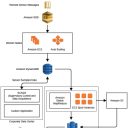
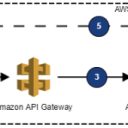
Multi-Region Redundancy with CLOUDPORT Switcher and Amagi LIVEThe CLOUDPORT Switcher microservice allows for seamless, frame-accurate video switching to AWS Elemental MediaLive, which writes content to MediaStore or S3. These services originate content for Amazon CloudFront, providing primary and failover CDN paths for continuous video delivery across regions. Amagi LIVE utilizes redundant contribution streams through separate MediaConnect direct connects to ensure network fault tolerance. MediaConnect streams are sent to multiple receive locations over separate direct connects, enhancing redundancy. This architecture withstands regional failures, ensuring reliable video delivery.
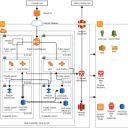
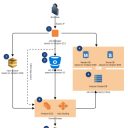
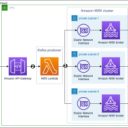
Dual-Region RedundancyAfter integrating all components, pods interconnect with storage services in the primary us-east-1 region. To ensure redundancy, these storage services are duplicated across the secondary us-west-1 region. In a regional failure event, the secondary storage services promote taking over so the control and video path continue without interruption despite the outage. This demonstrates failback reverting changes, returning the system to its initial state after regional failure. This swift recovery design maintains full operational capability, safeguarding service continuity and minimizing downtime.
Failover Strategies: Flexibility and CustomizationIn the event of a failover, the specific actions required by CLOUDPORT depend on the chosen failover solution. In a hot configuration with no traffic option, the connection to the headend will be established. In warm or cold modes, missing instances start automatically, and when the configuration completes, the service resumes. Users can also initiate a manual failover using the WebUI module. This triggers the CLOUDPORT reconfiguration process and activates the instances. Alternatively, the CLOUDPORT API can trigger failover after an integration with the customer’s end-to-end monitoring and control systems. This offers flexibility in implementing failover strategies that best suit the specific requirements and preferences of the customer.
Tuning and Testing for Disaster RecoveryCLOUDPORT rigorously tunes and tests its playout solution, encompassing configuration verification in realistic scenarios, optimization of infrastructure for channel types, and comprehensive testing of failover options, content handling, and schedule amendments, including end-to-end functionality and video quality. A key aspect of its disaster recovery strategy involves regular, predefined DR drills utilizing separate test endpoints and Lambda functions to validate the failover mechanism, identify weaknesses, and continuously improve DR preparedness, especially crucial with on-premises architecture modifications. This data then informs per-channel customization of failover options (hot, warm, or cold) based on channel criticality and business impact, ensuring alignment and compatibility with source systems and communication endpoints for a successful recovery.
ConclusionThis post outlines a robust cloud-based disaster recovery solution for channel playout on AWS using Amagi's CLOUDPORT SaaS product and an integration system, enabling hybrid operations and flexible configurations to meet specific RTO/RPO and cost requirements. The solution's efficacy is further enhanced through the emphasis on well-defined operational procedures and regular failover testing to guarantee its readiness and performance during actual disaster scenarios.
Original source: https://aws.amazon.com/blogs/apn/achieving-resilient-cloud-broadcasting-with-amagi-cloudport-on-aws/ | ||
| | ||
| |