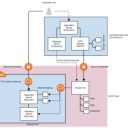
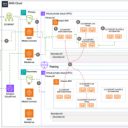
| Amazon VPC helps Fintech companies achieve PCI-DSS and SOC 2 Type compliance by providing a secure and isolated network environment where sensitive financial data and applications can reside. It offers robust security features like network access control lists (ACLs), security groups, subnet configurations, and encryption options to protect cardholder data and meet security requirements outlined in both standards. Amazon also provides detailed documentation and audit trails, facilitating compliance reporting and attestation processes. While VPC alone isn't enough for full compliance, it acts as a critical foundation by enabling organizations to implement the necessary security controls and operational procedures demanded by PCI-DSS and SOC 2 Type within their cloud infrastructure.
What is PCI-DSS?PCI-DSS stands for Payment Card Industry Data Security Standard. It's a set of security standards designed to protect cardholder data and reduce credit card fraud. Essentially, it's a list of requirements that any organization that handles credit card information (including merchants, processors, and service providers) must follow to keep that data secure.
Think of it like a security checklist for businesses that accept credit card payments. It covers a wide range of security practices, including: - Building and Maintaining a Secure Network: This includes things like firewalls, strong passwords, and regularly updating security software.
- Protecting Cardholder Data: This covers things like encrypting cardholder data at rest and in transit, and limiting access to that data.
- Maintaining a Vulnerability Management Program: This involves regularly scanning for vulnerabilities and patching systems.
- Implementing Strong Access Control Measures: This involves limiting access to cardholder data based on job function and using strong authentication methods.
- Regularly Monitoring and Testing Networks: This involves monitoring network traffic for suspicious activity and regularly testing security systems.
- Maintaining an Information Security Policy: This involves having a written security policy that is regularly reviewed and updated.
In simple terms: PCI-DSS is a set of rules designed to keep your credit card information safe when you use it to make a purchase. Businesses that don't follow these rules could be fined or even lose their ability to accept credit card payments.
What is SOC 2 Type?SOC 2 Type is a report that describes a service organization's systems and whether the design of specified controls meets the relevant Trust Services Criteria. There are two types: - SOC 2 Type I: This report describes a service organization's systems and the suitability of the design of controls as of a specified date. It's essentially a snapshot in time.
- SOC 2 Type II: This report describes a service organization's systems and the suitability of the design and operating effectiveness of controls throughout a specified period (typically 6-12 months). It assesses whether the controls are not only designed appropriately but also operating effectively over a period of time.
In essence, Type I is about *design* at a point in time, while Type II is about *design and operating effectiveness* over a period of time. Type II is generally considered more comprehensive and provides greater assurance to user entities.
What is Network Segmentation?Network segmentation is the practice of dividing a network into smaller, isolated segments or zones. The primary goal is to limit the blast radius of a security breach. If one segment is compromised, the attacker's access is contained within that segment, preventing them from easily moving laterally to other critical parts of the network. Think of it like having firewalls between rooms in a building; if a fire starts in one room, the firewalls help prevent it from spreading to the entire building.
Key Benefits of Network Segmentation: - Improved Security: The most significant benefit. Contains breaches and limits damage.
- Reduced Attack Surface: Makes it harder for attackers to find vulnerable systems.
- Compliance: Often required by regulations (e.g., PCI DSS, HIPAA, GDPR) that mandate separation of sensitive data.
- Simplified Management: Allows for more granular control over network traffic and security policies.
- Enhanced Monitoring: Easier to detect and respond to suspicious activity within specific segments.
- Improved Performance: Network traffic can be optimized for specific segments.
How to Implement Network Segmentation in a VPC?A VPC is an excellent environment for implementing network segmentation because it provides the necessary building blocks for creating isolated networks. Here's how you can do it:
1. Subnets: - Concept: VPCs are divided into subnets, which are logical subdivisions of the VPC's IP address range. Subnets reside within specific Availability Zones (AZs) for high availability.
- Implementation: Create separate subnets for different tiers of your application or for different security zones (e.g., a public-facing subnet for web servers, a private subnet for application servers, a database subnet). Crucially, these subnets should have different purposes and security requirements.
2. Security Groups: - Concept: Security groups act as virtual firewalls at the instance level (i.e., they control traffic to and from individual EC2 instances or other resources). They are stateful, meaning that if you allow inbound traffic on a port, the corresponding outbound traffic is automatically allowed.
- Implementation: Use security groups to define very specific rules about what traffic is allowed in and out of each instance. For example:
* Web servers in the public subnet might allow inbound HTTP (port 80) and HTTPS (port 443) traffic from anywhere (0.0.0.0/0). Outbound traffic might be restricted to only the application servers' private IP addresses.
* Application servers in the private subnet might only allow inbound traffic from the web servers' security group and outbound traffic to the database servers' security group.
* Database servers in the database subnet might only allow inbound traffic from the application servers' security group. - Principle of Least Privilege: Always grant the minimum necessary permissions.
3. Network Access Control Lists (NACLs): - Concept: NACLs are stateless virtual firewalls that operate at the subnet level. They control traffic entering and exiting the *entire* subnet.
- Implementation: NACLs provide an additional layer of security. Use them to define broader rules than security groups. For example, you might use a NACL to block all inbound SSH traffic (port 22) to your private subnets from the internet. Since NACLs are stateless, you need to explicitly define rules for both inbound and outbound traffic.
- Difference from Security Groups: Security Groups are stateful and operate at the *instance* level, while NACLs are stateless and operate at the *subnet* level.
4. Route Tables: - Concept: Route tables determine where network traffic is directed. Each subnet must be associated with a route table.
- Implementation: Use route tables to control the flow of traffic between subnets. For example:
* A public subnet will have a route to an Internet Gateway (IGW), allowing instances in that subnet to communicate with the internet.
* Private subnets will *not* have a route to an IGW, preventing direct internet access. They might have routes to a NAT Gateway (for outbound internet access) or to other private subnets.
5. NAT Gateway/NAT Instance: - Concept: Network Address Translation (NAT) allows instances in private subnets to initiate outbound connections to the internet (e.g., for software updates) without being directly exposed to inbound internet traffic.
- Implementation: Create a NAT Gateway in a public subnet. Configure the route table for the private subnets to route internet-bound traffic to the NAT Gateway.
6. VPC Peering/Transit Gateway: - Concept: VPC Peering allows you to connect two VPCs together, enabling resources in different VPCs to communicate with each other as if they were in the same network. Transit Gateway simplifies the connection of multiple VPCs and on-premises networks.
- Implementation: If you have multiple VPCs that need to communicate (e.g., a VPC for development and a VPC for production), use VPC Peering or Transit Gateway. You can then apply security group and NACL rules to control the traffic flow between the VPCs.
7. AWS PrivateLink: - Concept: Provides private connectivity to AWS services and your own services, without exposing traffic to the public internet.
- Implementation: Use PrivateLink to securely access AWS services like S3, DynamoDB, or services you host in other VPCs, without using public IP addresses.
8. Firewall Services (AWS Network Firewall, Third-Party Firewalls): - Concept: For more advanced network security, consider using a dedicated firewall service.
- Implementation: AWS Network Firewall provides centralized network firewall management for your VPCs. You can also use third-party firewall appliances from the AWS Marketplace. These firewalls can provide features like intrusion detection/prevention, deep packet inspection, and web filtering.
|