Observer Pattern

CK CK 3788 
Created at
Updated at  
2,394 0 0

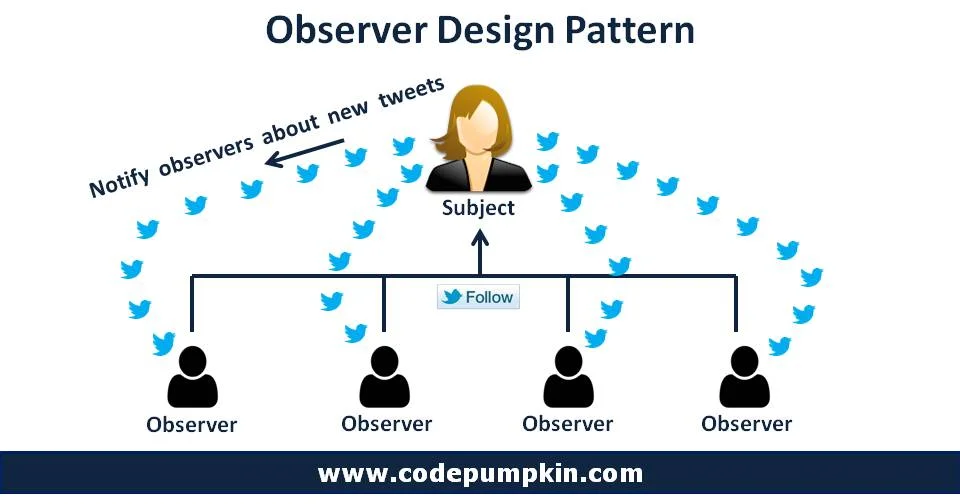
The Observer pattern is a behavioral design pattern where a subject maintains a list of its dependents (observers) and notifies them automatically of any state changes, usually by calling a method on each observer.

This allows for loose coupling between the subject and its observers, as the subject doesn't need to know the specific types or numbers of observers, promoting flexibility and maintainability.

Observers register themselves with the subject to receive notifications and can unregister at any time.

This pattern is useful for situations where multiple objects need to be updated in response to changes in a single object, such as in event handling, data synchronization, or GUI updates.
Observer Pattern

The Observer pattern is a powerful behavioral design pattern used in software to establish a one-to-many dependency between objects. Here are several use cases demonstrating its application:
1. Event Handling and Notifications:

  • GUI Frameworks: A common use case. Buttons, text fields, and other UI elements are "subjects" that notify "observers" (listeners) when events like clicks, key presses, or changes in value occur. Observers then react accordingly, updating the UI or performing other actions. This decouples the UI elements from the specific actions performed when an event occurs.
  • Real-time Data Updates: Applications displaying real-time data (stock tickers, sensor readings, chat applications) benefit greatly from the Observer pattern. A data source acts as the subject, notifying observers (e.g., charts, displays) whenever the data changes.
  • Logging and Auditing: Multiple logging or auditing components can observe events within a system. Whenever a significant event happens (e.g., user login, data modification), the subject notifies all observers, allowing them to record the event in their respective logs or audit trails.

2. Publish-Subscribe Systems:

  • Message Queues: In distributed systems, components can subscribe to specific events or messages published by other components. This facilitates asynchronous communication and loose coupling. The message queue acts as a subject, notifying subscribed observers when a matching message arrives.
  • Event Buses: Similar to message queues, event buses allow components to publish and subscribe to domain events. This is crucial for decoupling components and enabling event-driven architectures.

3. Model-View-Controller (MVC) Architectures:

  • Data Binding: The model (data) acts as the subject, notifying the views (observers) whenever the data changes. This ensures that the UI is always synchronized with the underlying data.
  • Controller-View Communication: While primarily using other patterns, the controller can leverage the Observer pattern to inform views of changes resulting from user interactions or other events.

4. Game Development:

  • Collision Detection: Game objects can be observers of collision events. When a collision occurs, the subject (collision detection system) notifies relevant objects, triggering appropriate responses like damage calculations or sound effects.
  • AI and NPC Behavior: Non-player characters (NPCs) can observe events in the game world (player actions, changes in environment). This allows for dynamic and reactive AI behavior.

5. Data Synchronization:

  • Distributed Caching: Multiple caches can observe changes in a central data store. When the data changes, the subject (data store) notifies all caches, allowing them to update their copies.
  • Version Control Systems: Observers can monitor changes to files in a repository, triggering actions like notifications, backups, or code analysis.

These use cases highlight the Observer pattern's ability to achieve loose coupling, improve code maintainability, and enable efficient communication in complex software systems. It promotes a clean separation of concerns, making the system more modular and adaptable to future changes.
 

Tags Behavioral Design Pattern Data Synchronization MVC Architecture Message Queues Observer Pattern Software Architecture Software Design Pattern Facebook X
Comments 0
Similar posts
  1. Learning about Firestore: Architecture, Pros, Cons, and Real-World Deployments
    167
  2. Coding Revolution with Claude Code & MoAI ADK(Agent Development Kit)
    733
  3. The Blueprint of Success: Why System Design and Architecture Matter?
    399
  4. System Requirements and Architecture: Intelligent Priority-Based Scheduler
    166
  5. Temporal Programming Model - Robust, Long-Running, Fault-Tolerant Applications as WorkFlows
    352
  6. Large-Scale Concurrency Control: Solving the DB Bottleneck from a Flood of “Likes”
    271
  7. Real-Time Inventory & WMS System Design
    243
  1. The Blueprint of Success: Why System Design and Architecture Matter?
    399
  2. Software Design Patterns Cheat Sheet
    3,322
  3. Various naming for the Software Architecture - I can't find Component-based Architecture, Functional Architecture
    3,332
  4. Builder Pattern - offering pre-defined Interfaces to set Individual Parts
    1,432
  5. Abstract Factory Pattern - Commonly Used for UI Themes or Objects
    1,466
  6. Software Design Patterns
    1,435
  7. Factory Method Pattern allows overriding to return different concrete object types
    1,528
  8. Optimize the performance of a search results page that experiences high traffic
    142
  9. System Design: High-Traffic Time-Deal Promotion System
    172
  10. Designing Resilient Infrastructure to Prevent Order Data Loss During Kafka Failures
    154
  11. Real-Time Inventory & WMS System Design
    243
  12. Enterprise-Scale 100k+ TPS Order Tracking System Architecture
    203
  13. Enterprise-Scale 100k+ TPS Order Processing System Architecture
    175
  14. Architecting Dynamic Scale-Out and Scale-In with Docker Containers
    133
  15. How to Design Redis Caching in Infrastructure Architecture
    156
  16. Architecture Design - Database Partitioning vs. Sharding
    152
Recently updated
  1. Why 100% SEO Guarantees Better User Engagement and How to Achieve It in Your Service
    39
  2. Why SPF and DKIM Are Essential for Linux Email Servers?
    34
  3. How do I create animated background for Google Meet?
    20,611
  4. MaxMind GeoLite2 vs. DB-IP Lite vs. ip-api.com: Choosing the Right Free IP Geolocation Solution
    244
  5. Meet Valkey: Why Redis Changed Its License, Why Valkey is Better, and How to Use It as a Drop-in Replacement
    94
  6. How Rogue Web Scrapers Are Stealing My Content and Destroying My Server
    157
  7. Array of arguments passed to script in PHP
    90
  8. Invalid Auction Storms in Ad Tech
    98
  9. Building MRC-Compliant Instrumentation in Ad Tech: Implementation Steps and Key Challenges
    202
  10. The Two Clocks of Ad Server Architecture
    70
  11. Frequency Cap Architecture Overview
    514
  12. Collecting Proof-of-Play from 100,000 Screens
    146
  13. Vector Search in Relational Databases (RDBs): Trends & Usage Environments
    287
  14. What is RedisVL?
    109
  15. Designing a Skill Registry Architecture: Minimize Token Usage and Maximize AI Performance
    230
  16. TPU & GPU Cluster Management Tools
    243
  17. The Concept of Scaffolding in AI Agents
    233
  18. Beyond Static Pipelines: Architecting LLM Multi-Agent Systems for Autonomous Workflow Orchestration
    582
  19. AI-DLC vs. AI-SDLC: Model-Centric vs. System-Centric AI Development
    258
  20. Fine-Tuning Open-Weight LLMs: Training, Licensing, and Deploying Custom Models with Ollama
    338
  21. Inside the Next-Generation Streaming Architecture: Ultra-Low Latency, SGAI, and AI Codecs
    202
  22. Machine Learning: Training vs. Ranking
    221
  23. The Continuous Learning Machine: Designing a Loop That Actually Turns
    222
  24. The Next-Gen Low-Latency Standards: LL-HLS & MoQ
    195
  25. Designing a Data Curation System Around a Vector Database
    220
  26. Extracting Context from Live Video: The Architecture Got Simpler When We Stopped Building Features
    256
  27. The New Ad Stack Behind Live Sports Streaming: Inside SGAI, EABN, and the Standards Race to Fix Live Monetization
    656
  28. Designing MLOps Architectures to Handle Seasonal Data Drift in EV Fleet Models
    195
  29. From 15 to 40+ FPS: Accelerating PyTorch Object Detection on Automotive ECUs
    216
  30. Understanding Data Lineage
    260