| The Builder pattern is a creational design pattern that separates the construction of a complex object from its representation, allowing the same construction process to create various representations of the object. It does this by using a separate builder object to construct the object step-by-step, offering a fluent interface to set individual parts, and finally returning a complete, immutable object. This promotes cleaner code, improves code readability, and allows for easier object creation with various configurations. The Builder pattern is a creational design pattern that separates the construction of a complex object from its representation. This allows the same construction process to create various representations of the object. Instead of creating the object directly with a constructor that takes many parameters (leading to potential problems with object mutability and constructor bloat), the Builder pattern uses a separate "builder" object to construct the object step-by-step. 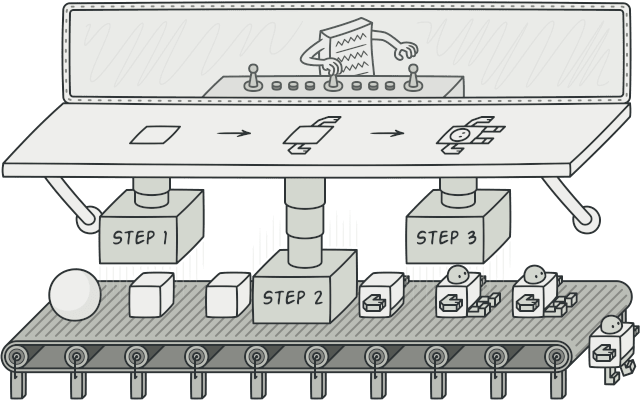
Here's a breakdown: - Problem: Creating complex objects with many attributes can lead to constructors with numerous parameters, making them difficult to read, use, and maintain. Also, it's hard to ensure that only valid combinations of attributes are used. Furthermore, it's difficult to create variations of the object with slight differences in attribute values.
- Solution: The Builder pattern solves this by:
- Decoupling object creation from its representation: The construction process is separate from the final object's structure.
- Providing a fluent interface: Builders often use method chaining to build the object step-by-step in a readable way.
- Supporting multiple representations: Different builder instances can create objects with different attribute combinations.
- Structure: A Builder pattern typically involves:
- Product: The complex object being built.
- Builder: An abstract interface defining methods to set the attributes of the product.
- Concrete Builders: Concrete implementations of the Builder interface, each responsible for building a specific variation of the product.
- Director (optional): A class that coordinates the building process, often using a Concrete Builder to construct the object according to a specific algorithm or configuration.
- Benefits:
- Improved readability and maintainability: The construction process is clearer and easier to understand.
- Reduced constructor bloat: Constructors are simplified, taking fewer arguments.
- Flexibility in object creation: Different variations of the object can be created easily.
- Immutability support: The built objects can be immutable, enhancing thread safety and predictability.
- Example (Conceptual): Imagine building a car. A Builder pattern could have a
CarBuilder interface with methods like setEngine(), setWheels(), setColor(), etc. You could then have concrete builders like SportsCarBuilder and TruckBuilder that implement CarBuilder and set attributes specific to their respective vehicle types. A Director might be used to manage the steps involved in assembling a complete car based on a specific configuration (e.g., a "luxury sports car" configuration might call specific methods on the SportsCarBuilder).
In essence, the Builder pattern is a powerful tool for creating complex objects in a controlled and flexible way, resulting in cleaner, more maintainable code. The Builder Pattern is a creational design pattern used to construct complex objects step by step. It separates the construction process from the representation, allowing the same construction process to create different representations. Here’s an example of the Builder Pattern in C++:
Example: Building a CarWe will create a Car object step by step, where each step specifies details such as engine, seats, and other features. 1. Product ClassThe object to be built. #include <iostream>
#include <string>
class Car {
private:
std::string engine;
int seats;
bool airConditioner;
public:
void setEngine(const std::string& engineType) { engine = engineType; }
void setSeats(int seatCount) { seats = seatCount; }
void setAirConditioner(bool hasAC) { airConditioner = hasAC; }
void showSpecifications() const {
std::cout << "Car Specifications:\n";
std::cout << "Engine: " << engine << "\n";
std::cout << "Seats: " << seats << "\n";
std::cout << "Air Conditioner: " << (airConditioner ? "Yes" : "No") << "\n";
}
};
2. Builder InterfaceDefines the steps for building the object. class CarBuilder {
public:
virtual ~CarBuilder() = default;
virtual void buildEngine() = 0;
virtual void buildSeats() = 0;
virtual void buildAirConditioner() = 0;
virtual Car* getCar() = 0;
};
3. Concrete BuilderImplements the steps to build a specific type of product. class SportsCarBuilder : public CarBuilder {
private:
Car* car;
public:
SportsCarBuilder() { car = new Car(); }
~SportsCarBuilder() { delete car; }
void buildEngine() override { car->setEngine("V8 Turbo Engine"); }
void buildSeats() override { car->setSeats(2); }
void buildAirConditioner() override { car->setAirConditioner(true); }
Car* getCar() override { return car; }
};
class SUVCarBuilder : public CarBuilder {
private:
Car* car;
public:
SUVCarBuilder() { car = new Car(); }
~SUVCarBuilder() { delete car; }
void buildEngine() override { car->setEngine("V6 Engine"); }
void buildSeats() override { car->setSeats(7); }
void buildAirConditioner() override { car->setAirConditioner(true); }
Car* getCar() override { return car; }
};
4. DirectorOrchestrates the building process. class CarDirector {
private:
CarBuilder* builder;
public:
void setBuilder(CarBuilder* b) { builder = b; }
Car* constructCar() {
builder->buildEngine();
builder->buildSeats();
builder->buildAirConditioner();
return builder->getCar();
}
};
5. Client CodeThe client uses the Director and a Builder to create objects. int main() {
CarDirector director;
// Building a sports car
SportsCarBuilder sportsCarBuilder;
director.setBuilder(&sportsCarBuilder);
Car* sportsCar = director.constructCar();
std::cout << "Sports Car:\n";
sportsCar->showSpecifications();
delete sportsCar;
// Building an SUV car
SUVCarBuilder suvCarBuilder;
director.setBuilder(&suvCarBuilder);
Car* suvCar = director.constructCar();
std::cout << "\nSUV Car:\n";
suvCar->showSpecifications();
delete suvCar;
return 0;
}
OutputSports Car:
Car Specifications:
Engine: V8 Turbo Engine
Seats: 2
Air Conditioner: Yes
SUV Car:
Car Specifications:
Engine: V6 Engine
Seats: 7
Air Conditioner: Yes
Key PointsBuilder Pattern provides flexibility in constructing complex objects by focusing on individual parts. The Director manages the overall construction process but is independent of the actual building logic. The Concrete Builders define how specific parts of the object are constructed.
|