Various naming for the Software Architecture - I can't find Component-based Architecture, Functional Architecture

CK CK 3788 
Created at  
3,342 0 0

There isn't a universally agreed-upon, exhaustive list of "types" of software architectures categorized solely by viewpoint and expression methods. The categorization is often overlapping and depends on the specific framework or methodology used. However, we can group architectural styles and descriptions based on how they are viewed and expressed:


Based on Viewpoints (Concerns):
Various naming for the Software Architecture - I can't find Component-based Architecture, Functional Architecture

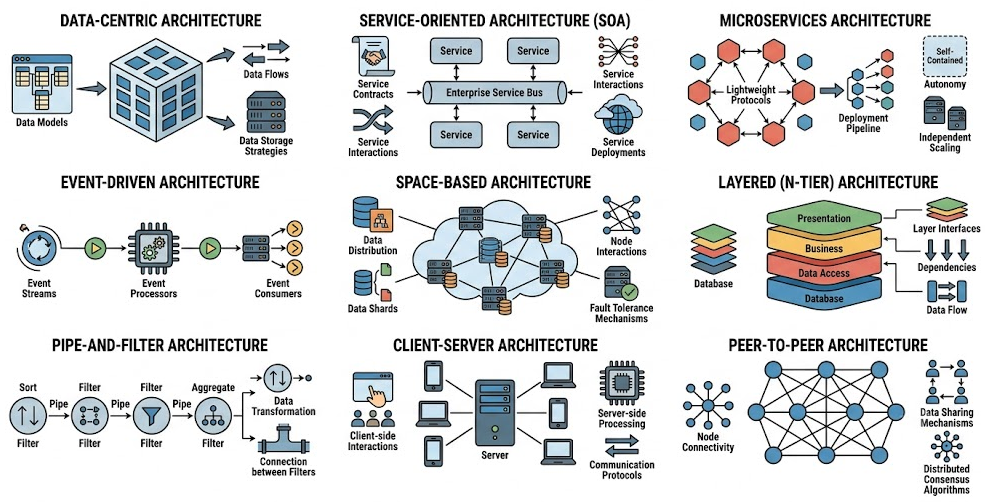
  • Data-centric architecture: Focuses on the structure and management of data. Viewpoints might include data models, data flows, and data storage strategies.
  • Service-oriented architecture (SOA): Emphasizes reusable services. Viewpoints might include service contracts, service interactions, and service deployments.
  • Microservices architecture: A specialized form of SOA with very small, independently deployable services. Viewpoints similar to SOA but with a strong emphasis on autonomy and independent scaling.
  • Event-driven architecture: Centers around the production, detection, and consumption of events. Viewpoints include event streams, event processors, and event consumers.
  • Space-based architecture: Distributes data and processing across a network of interconnected nodes. Viewpoints might include data distribution, node interactions, and fault tolerance mechanisms.
  • Layered architecture (n-tier architecture): Organizes the system into distinct layers with specific responsibilities. Viewpoints might include layer interfaces, dependencies between layers, and data flow between layers.
  • Pipe-and-filter architecture: Data flows through a series of processing stages (filters). Viewpoints focus on data transformation at each stage and the connection between filters.
  • Client-Server architecture: A classic model with clients requesting services from a central server. Viewpoints often include client-side interactions, server-side processing, and communication protocols.
  • Peer-to-Peer architecture: Nodes in the system act as both clients and servers. Viewpoints might include node connectivity, data sharing mechanisms, and distributed consensus algorithms.


Based on Expression Methods (Descriptions):
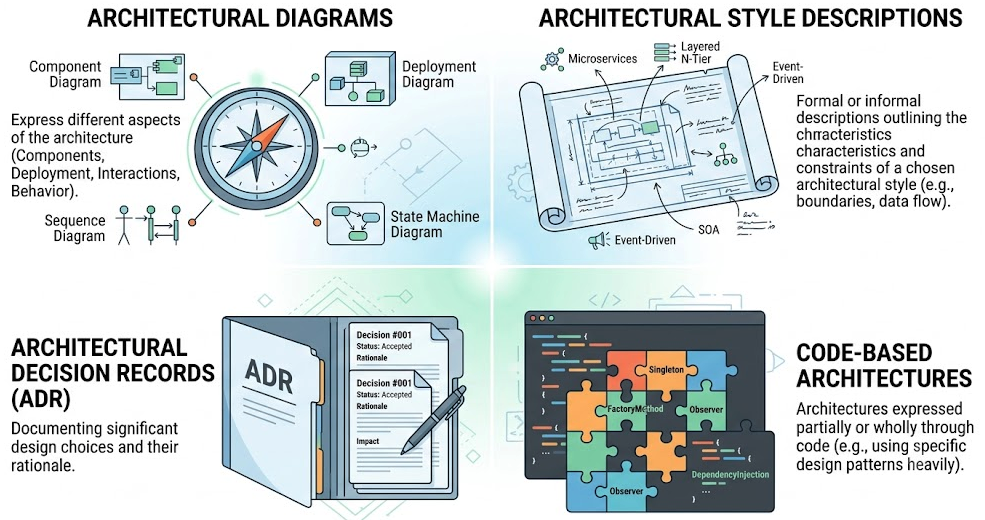
Various naming for the Software Architecture - I can't find Component-based Architecture, Functional Architecture

  • Architectural diagrams (various types): Component diagrams, deployment diagrams, sequence diagrams, state machine diagrams, etc., all express different aspects of the architecture.
  • Architectural style descriptions: Formal or informal descriptions outlining the characteristics and constraints of a chosen architectural style.
  • Architectural decision records (ADR): Documenting significant design choices and their rationale.
  • Code-based architectures: Architectures expressed partially or wholly through code (e.g., using specific design patterns heavily).

It's crucial to understand that many architectures combine aspects from multiple categories above. For instance, a microservices architecture might be described using component diagrams (expression method) and focus on independent services (viewpoint). The choice of viewpoint and expression method depends on the specific needs of the project and the audience.
 

There isn't a single, universally accepted name for an architecture explicitly describing entity relationships *and* their functions. However, terms like component-based architecture, functional architecture, or object-oriented architecture (if the entities are objects) come close, as they all address relationships between components and implicitly or explicitly incorporate functionality. More specific architectural styles, like microservices or layered architectures, might also incorporate this depending on how they are designed and documented.

Tags Architecture Client-Server Architecture Component-based Architecture Data-centric Architecture Event-Driven Architecture Functional Architecture Layered Architecture Microservices Architecture Peer-to-Peer Architecture Pipe-and-Filter Architecture SOA Service-Oriented Architecture Space-based Architecture Facebook X
Comments 0
Similar posts
  1. Frequency Cap Architecture Overview
    527
  2. Optimize the performance of a search results page that experiences high traffic
    147
  3. Architecting Dynamic Scale-Out and Scale-In with Docker Containers
    136
  1. The Blueprint of Success: Why System Design and Architecture Matter?
    409
  2. Software Design Patterns Cheat Sheet
    3,350
  3. Builder Pattern - offering pre-defined Interfaces to set Individual Parts
    1,438
  4. Abstract Factory Pattern - Commonly Used for UI Themes or Objects
    1,470
  5. Software Design Patterns
    1,445
  6. Observer Pattern
    2,401
  7. Factory Method Pattern allows overriding to return different concrete object types
    1,532
  8. System Design: High-Traffic Time-Deal Promotion System
    181
  9. Designing Resilient Infrastructure to Prevent Order Data Loss During Kafka Failures
    161
  10. Real-Time Inventory & WMS System Design
    250
  11. Enterprise-Scale 100k+ TPS Order Tracking System Architecture
    210
  12. Enterprise-Scale 100k+ TPS Order Processing System Architecture
    183
  13. How to Design Redis Caching in Infrastructure Architecture
    161
  14. Architecture Design - Database Partitioning vs. Sharding
    159
Recently updated
  1. Google OAuth Token Expiration: Causes and Solutions
    31
  2. Why 100% SEO Guarantees Better User Engagement and How to Achieve It in Your Service
    57
  3. Why SPF and DKIM Are Essential for Linux Email Servers?
    51
  4. How do I create animated background for Google Meet?
    23,256
  5. MaxMind GeoLite2 vs. DB-IP Lite vs. ip-api.com: Choosing the Right Free IP Geolocation Solution
    273
  6. Meet Valkey: Why Redis Changed Its License, Why Valkey is Better, and How to Use It as a Drop-in Replacement
    105
  7. How Rogue Web Scrapers Are Stealing My Content and Destroying My Server
    170
  8. Array of arguments passed to script in PHP
    99
  9. Invalid Auction Storms in Ad Tech
    108
  10. Building MRC-Compliant Instrumentation in Ad Tech: Implementation Steps and Key Challenges
    209
  11. The Two Clocks of Ad Server Architecture
    78
  12. Collecting Proof-of-Play from 100,000 Screens
    154
  13. Vector Search in Relational Databases (RDBs): Trends & Usage Environments
    303
  14. What is RedisVL?
    117
  15. Designing a Skill Registry Architecture: Minimize Token Usage and Maximize AI Performance
    247
  16. TPU & GPU Cluster Management Tools
    258
  17. The Concept of Scaffolding in AI Agents
    245
  18. Beyond Static Pipelines: Architecting LLM Multi-Agent Systems for Autonomous Workflow Orchestration
    599
  19. AI-DLC vs. AI-SDLC: Model-Centric vs. System-Centric AI Development
    269
  20. Fine-Tuning Open-Weight LLMs: Training, Licensing, and Deploying Custom Models with Ollama
    355
  21. Inside the Next-Generation Streaming Architecture: Ultra-Low Latency, SGAI, and AI Codecs
    207
  22. Machine Learning: Training vs. Ranking
    231
  23. The Continuous Learning Machine: Designing a Loop That Actually Turns
    229
  24. The Next-Gen Low-Latency Standards: LL-HLS & MoQ
    204
  25. Designing a Data Curation System Around a Vector Database
    230
  26. Extracting Context from Live Video: The Architecture Got Simpler When We Stopped Building Features
    263
  27. The New Ad Stack Behind Live Sports Streaming: Inside SGAI, EABN, and the Standards Race to Fix Live Monetization
    674
  28. Designing MLOps Architectures to Handle Seasonal Data Drift in EV Fleet Models
    201
  29. From 15 to 40+ FPS: Accelerating PyTorch Object Detection on Automotive ECUs
    233
  30. Understanding Data Lineage
    272