| Before drawing, you must establish the distinction between the two. When presenting to stakeholders or interviewers, define them as: - Database Partitioning (Horizontal/Vertical): Splitting a large table into smaller, more manageable pieces within a single database instance.
- Data Sharding: A type of horizontal partitioning where data is distributed across multiple physical database instances (nodes).
How to Draw Database Partitioning (Single Instance)This diagram focuses on how a single database engine logically divides data to improve query performance (e.g., partition pruning) and maintenance. 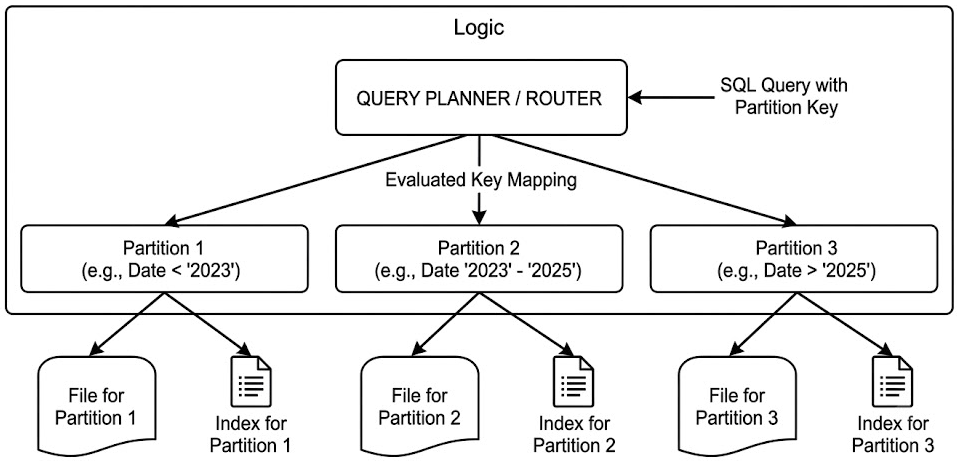
Key Elements to Draw & Explain:- Single DB Border: Draw a giant box representing one database server.
- The Partition Key: Explicitly label the column used to partition (e.g.,
created_at for Range, region for List, or id for Hash). - Storage Files: Draw separate physical storage files (tablespaces) pointing to each partition under the hood.
- Query Pruning: Draw an arrow from the query planner directly to only one partition to show that the system ignores the other partitions during a search.
How to Draw Data Sharding (Multi-Instance)This diagram focuses on horizontal scalability (Scale-Out). It must include a routing layer that decides which physical database node holds the requested data. 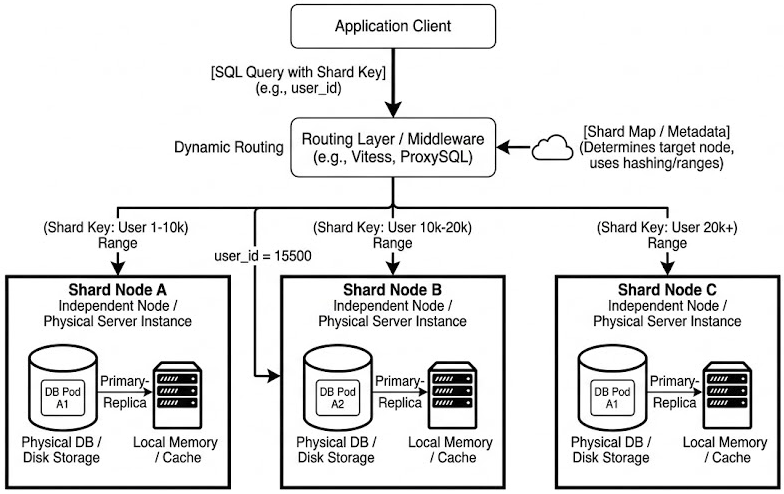
Key Elements to Draw & Explain:- The Routing Layer (Routing Proxy): This is the most critical element. You must draw a component (like a load balancer, proxy, or application-level router) that hashes or maps the Shard Key (e.g.,
user_id) to the correct destination. - Independent Nodes: Draw distinct boxes representing completely separate physical servers or cloud VM instances. They do not share memory or disks (Shared-Nothing Architecture).
- Shard Key Routing Logic: Draw how a request with
user_id = 15500 bypasses Node 1 and Node 3 to hit Node 2 directly.
The Advanced Hybrid Architecture (Sharding + Partitioning)In enterprise-level designs, Sharding and Partitioning are used together. First, data is sharded across multiple nodes, and then each node partitions its allocated data locally. 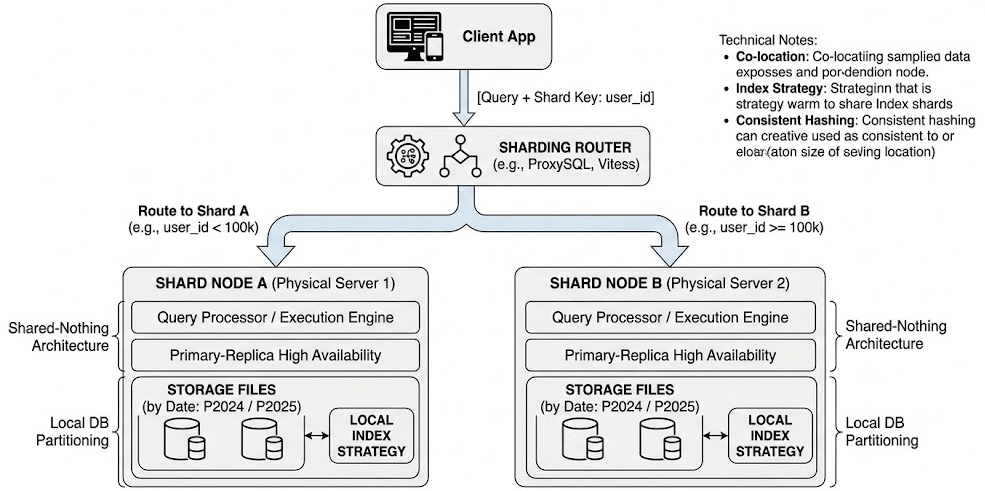
Technical Checklist to Discuss While Drawing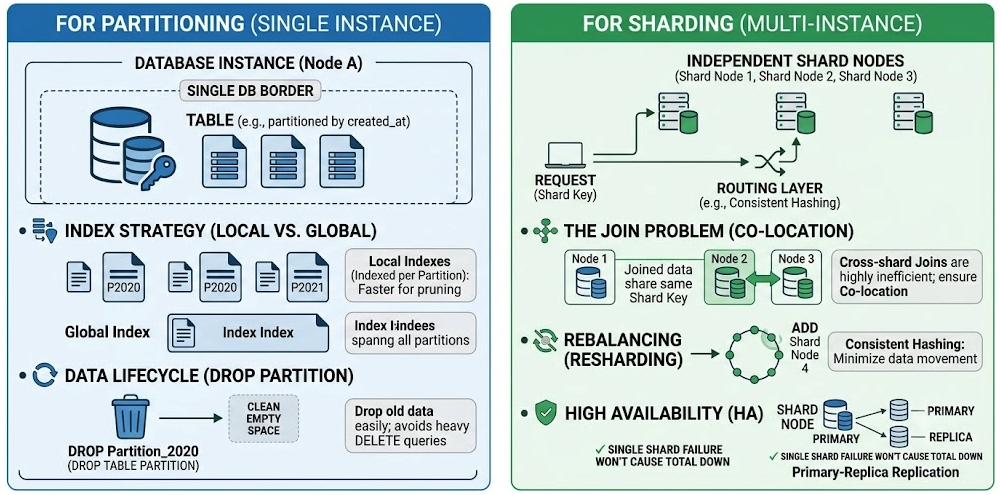
For Partitioning:- Index Strategy: Explain whether you will use Local Indexes (indexed per partition) or Global Indexes (one index spanning all partitions).
- Data Lifecycle: Mention how easy it is to drop old data by simply dropping a partition (e.g., dropping
Partition_2020) instead of running heavy DELETE queries.
For Sharding:- The Join Problem: Explain that cross-shard joins are highly inefficient. Thus, data that needs to be joined must share the same Shard Key so they reside on the same physical node (Co-location).
- Rebalancing (Resharding): Explain how the architecture handles a shard becoming full (e.g., using consistent hashing to minimize data movement when adding Shard Node 4).
- High Availability (HA): Draw Primary-Replica replication lines for each Shard Node to prove that a single shard failure won't cause total system downtime.
|