1. Architectural Foundation & CAP Theorem Trade-offs
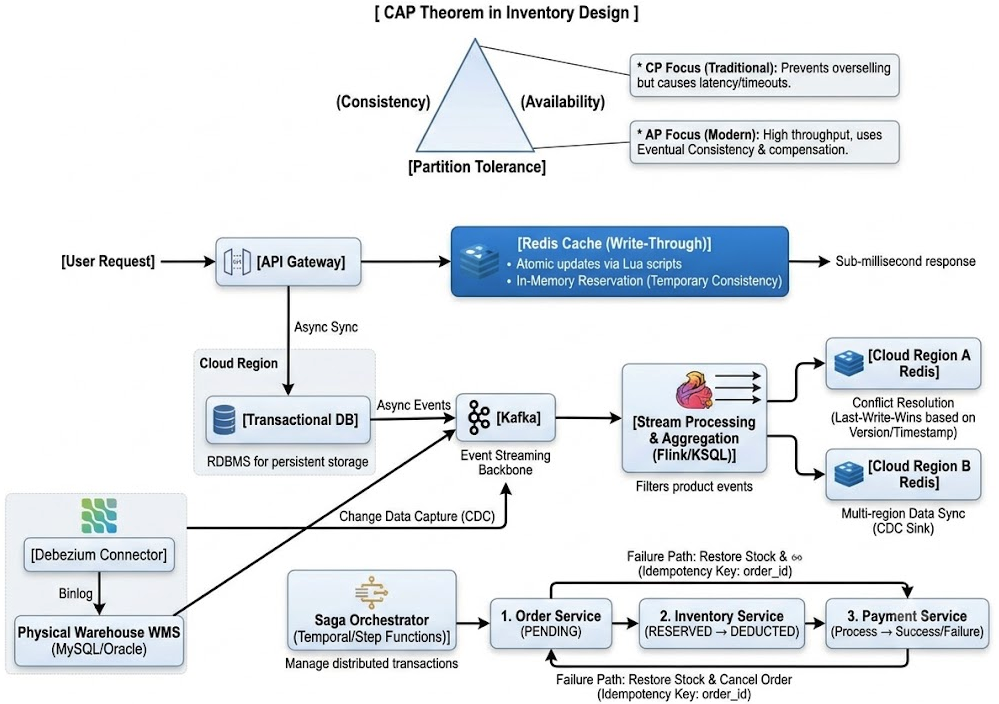
In a high-traffic e-commerce environment, a traditional monolithic database configuration faces severe bottlenecks. When designing a distributed inventory and Warehouse Management System (WMS), we must navigate the trade-offs defined by the CAP Theorem (Consistency, Availability, Partition Tolerance).
The Trade-off: AP over CP
While financial transactions require strict CP (Consistency & Partition Tolerance), real-time inventory systems for massive web traffic must prioritize AP (Availability & Partition Tolerance).
The Problem with Strong Consistency (CP): Utilizing distributed locks (e.g., Two-Phase Commit) to ensure physical warehouse stock matches the website stock in real-time results in high latency, database blocking, and potential system-wide cascading failures during peak traffic (e.g., flash sales).
The Solution (AP with Eventual Consistency): We decouple the front-end presentation inventory from the back-end physical WMS inventory. Users interact with a highly available, high-performance caching layer, while asynchronous processes reconcile the data in the background.
Hybrid Consistency Model Architecture
To balance user experience and data integrity, we implement a hybrid model:
1. In-Memory Reservation (Temporary Consistency):
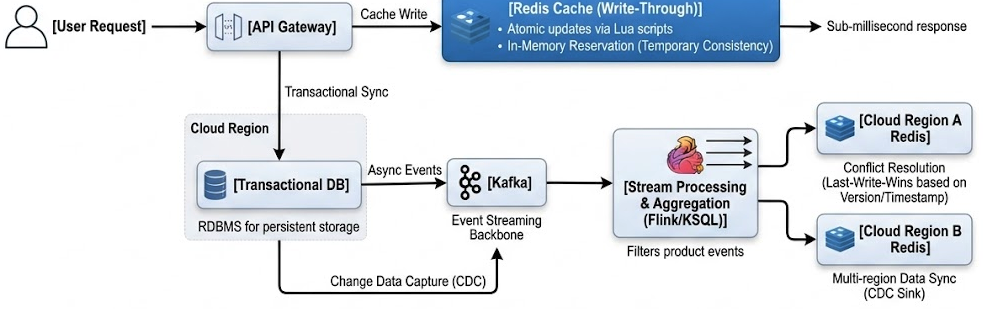
Redis is used as the first line of defense. Inventory deduction is executed atomically using Redis Lua scripts to prevent race conditions.
This provides sub-millisecond response times, ensuring high availability (A) and partition tolerance (P).
Once reserved in Redis, an event is published to a message queue (e.g., Apache Kafka) to update the persistent relational database (RDBMS) and notify the WMS asynchronously.
The physical warehouse inventory catch up with the logical online inventory within seconds, achieving Eventual Consistency.
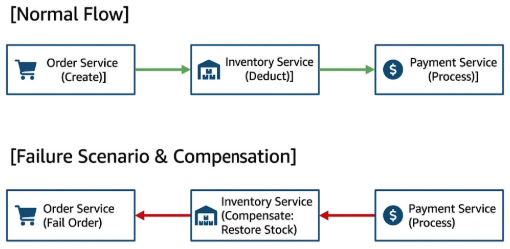
In a microservices architecture, a single customer order spans multiple services: Order Service, Inventory Service, and Payment Service. Since we cannot use blocking distributed transactions, we implement the Saga Pattern to manage distributed transactions and handle exceptions.
Orchestrator-Based Saga Design
We utilize an Orchestrator-based Saga (using tools like Temporal or AWS Step Functions) to centrally manage the transaction flow and execute compensating transactions if a failure occurs.
Step-by-Step Transaction Workflow
Order Created: The Orchestrator initiates the workflow and changes the order status to PENDING_PAYMENT.
Inventory Reserved: The Orchestrator calls the Inventory Service to reserve stock.
State change: Stock status becomes RESERVED (not yet permanently deducted).
Payment Processing: The Orchestrator calls the Payment Service.
Success Path: If payment succeeds, the Orchestrator notifies the Inventory Service to commit the reservation (RESERVED → DEDUCTED) and changes the order status to PAID.
Handling Exceptions via Compensating Transactions
If the payment fails (e.g., insufficient funds, network timeout), the Orchestrator initiates the Compensating (Reverse) Transactions:
Step
Executing Service
Primary Action
Compensating Action (On Failure)
1
Order Service
Create Order (PENDING)
Update Order Status to FAILED/CANCELLED
2
Inventory Service
Reserve Stock (RESERVED)
Release Reserved Stock (STOCK + 1)
3
Payment Service
Process Payment
N/A (Point of Failure)
Ensuring Idempotency
To prevent duplicate processing caused by network retries in a distributed system, all endpoints in the Saga flow must be idempotent.
Idempotency Key: Every request carries a unique Idempotency-Key (typically the order_id).
De-duplication Mechanism: The Inventory Service checks a distributed lock or a unique database constraint on the order_id before executing any stock reservation. If the key has already been processed, it returns the cached previous response without re-processing.
3. High-Performance Multi-Region Data Synchronization (CDC)
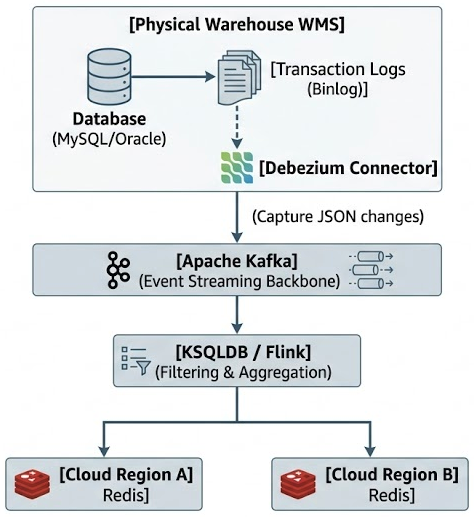
To synchronize inventory data between the physical WMS databases located in regional fulfillment centers and the global cloud-based web application, we implement a Change Data Capture (CDC) pipeline.
CDC Pipeline Architecture
Instead of resource-intensive batch queries (SELECT * FROM table WHERE updated_at > ...), the system captures low-level database transaction logs in real time.
1. Source Capture:
Debezium (running on Kafka Connect) monitors the transaction logs (e.g., MySQL Binlog, PostgreSQL WAL) of the local WMS databases.
Every INSERT, UPDATE, or DELETE on the inventory tables is immediately captured as an event document.
2. Event Streaming Backbone:
Captured events are streamed to Apache Kafka.
Topics are partitioned by product_id to guarantee that messages regarding the same item are processed in strict chronological order.
3. Stream Processing & Aggregation:
Apache Flink or KSQL processes the raw events to calculate aggregate stock levels across different regions.
4. Target Synchronization (Sink):
The processed inventory updates are consumed by multi-region synchronization workers, which update the localized Redis cache clusters in different cloud regions.
Conflict Resolution Strategy
In multi-region environments, network latency can lead to out-of-order data delivery. We implement conflict resolution mechanisms to prevent overwriting newer updates with older ones:
Version/Timestamp-based Ordering (Last-Write-Wins): Each DB update includes an incremental version number or a microsecond-precision physical timestamp. The sink workers only update the target cache if the incoming event's version is higher than the currently stored version.
Vector Clocks: For complex scenarios involving multi-master writes, vector clocks are implemented to detect and flag logical concurrent conflicts for human intervention or automated rule-based resolution.
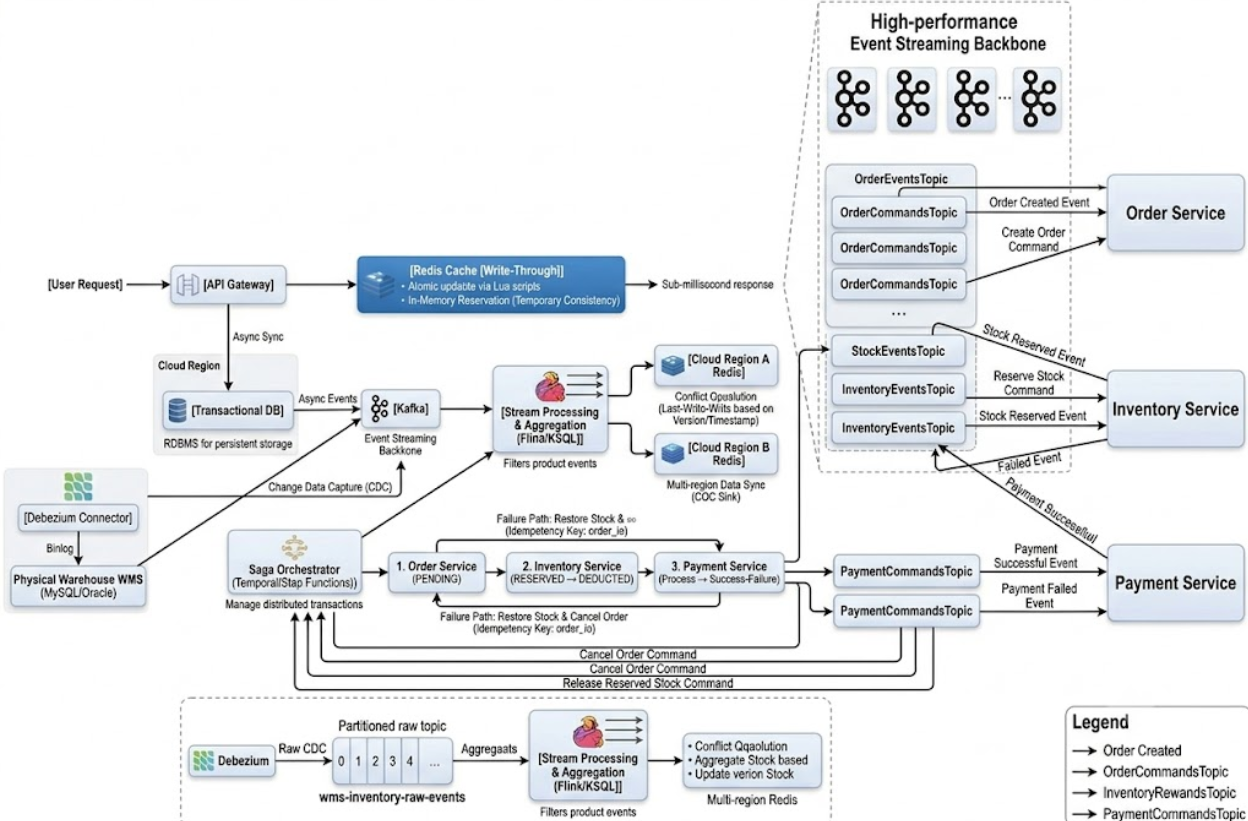
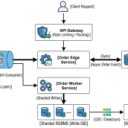
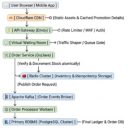
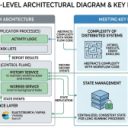
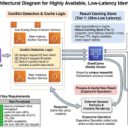
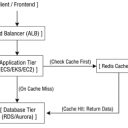
The overall architecture will be like:
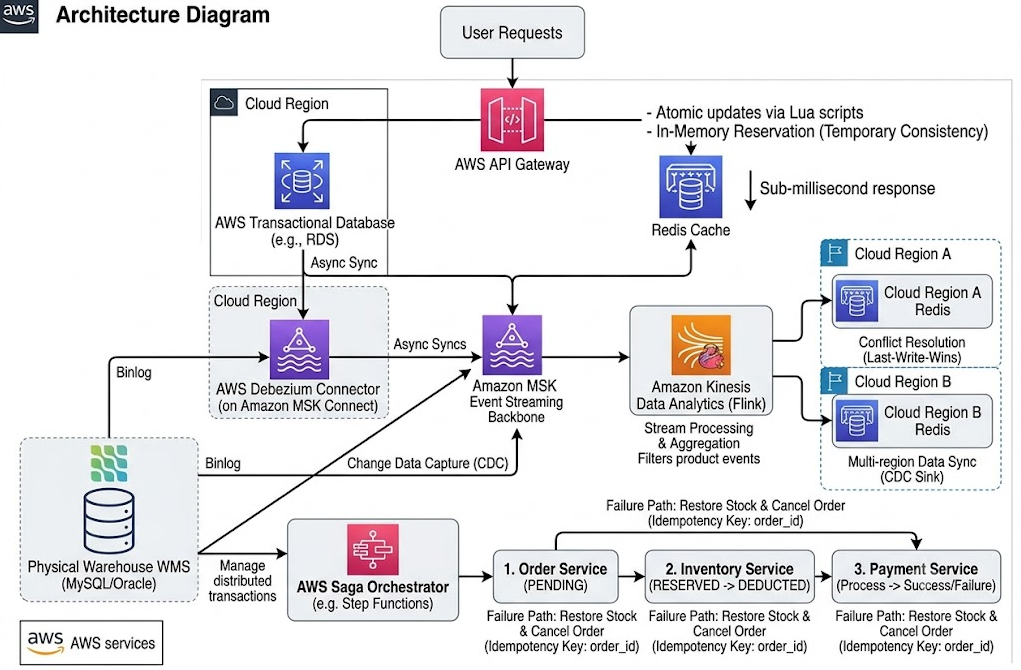
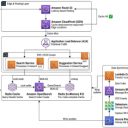
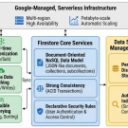
If we convert above diagram in AWS Architect style: