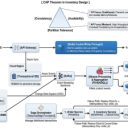
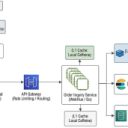
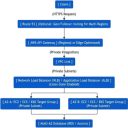
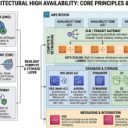
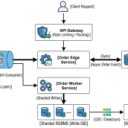
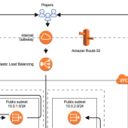
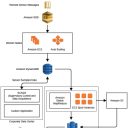
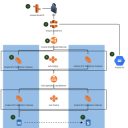
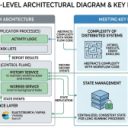
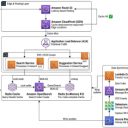
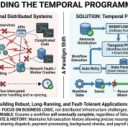
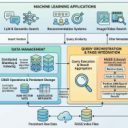
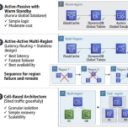
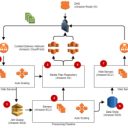
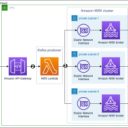
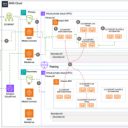
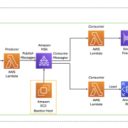
| To prevent order data loss during Kafka failures from an infrastructure design perspective, a multi-layered resilience strategy must be implemented. First, Kafka brokers should be deployed across multiple availability zones with a replication factor of three and a min.insync.replicas configuration of two, combined with producer settings configured to acks=all and idempotence enabled to guarantee zero-loss ingestion. Additionally, a transactional outbox pattern or a fallback storage mechanism, such as writing failed payloads to a highly available database or an alternative queuing service like Amazon SQS, must be established at the gateway level to buffer order data if the Kafka cluster becomes completely unreachable. Finally, active-passive cross-region replication and automated failover monitoring should be integrated to ensure continuous data availability and disaster recovery during catastrophic cluster-wide outages. 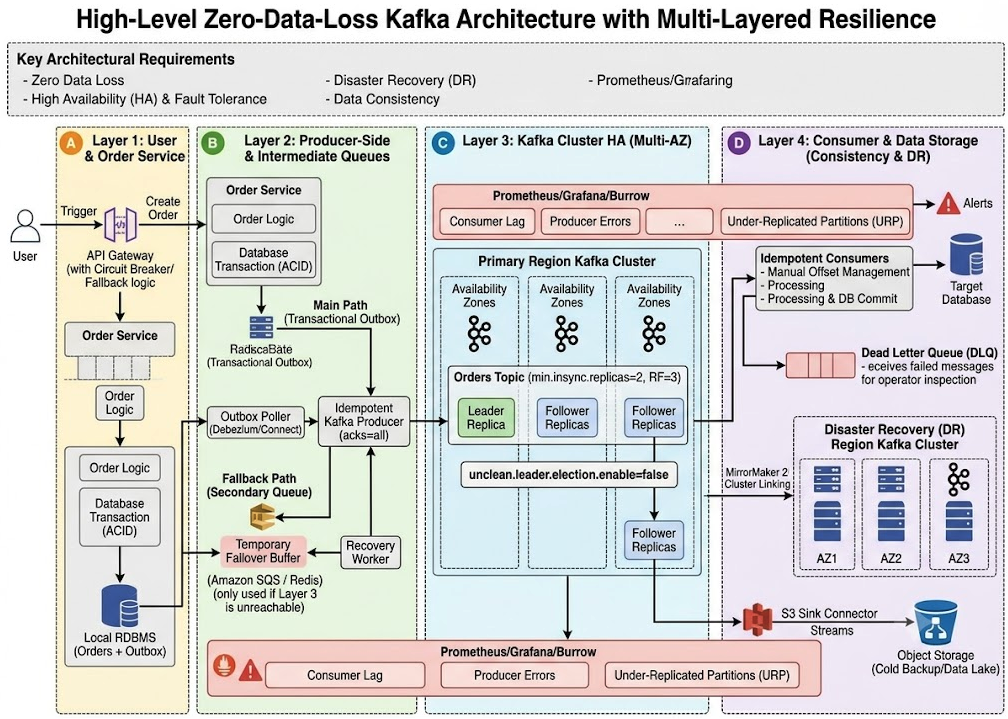
1. Kafka Cluster High Availability (HA) & ConfigurationTo prevent data loss (zero-data-loss architecture) at the infrastructure level, the Kafka cluster itself must be configured for high durability and fault tolerance across physical boundaries. 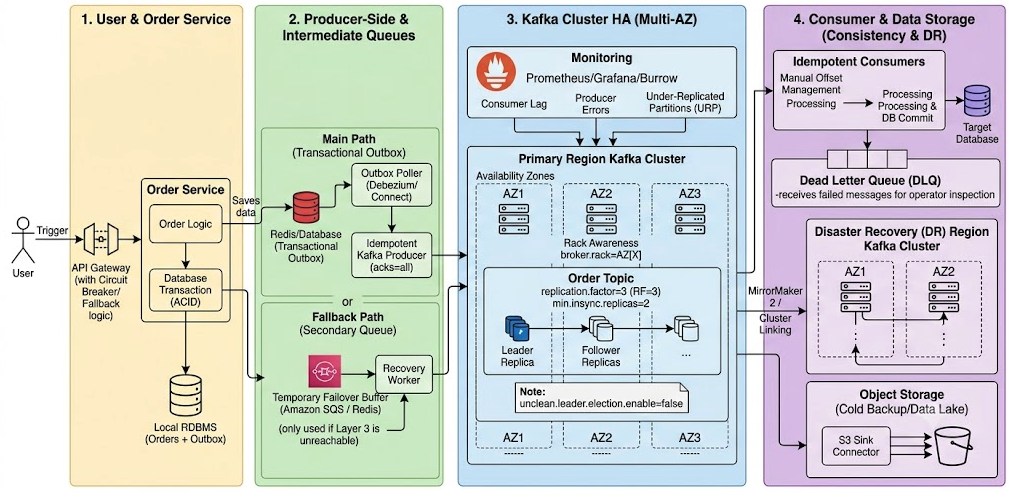
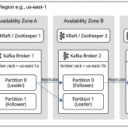
Multi-AZ (Availability Zone) Deployment- Broker Distribution: Deploy Kafka brokers across at least three distinct Availability Zones (AZs) within a cloud region.
- Rack Awareness: Configure
broker.rack to map to the respective AZ. Kafka will automatically distribute partition replicas across different physical racks (AZs), ensuring that even if an entire AZ goes down, the data remains accessible.
Topic & Broker Configurations for Durability- Replication Factor (RF): Set the replication factor for the
order topic to at least 3 (replication.factor=3). - Minimum In-Sync Replicas (min.insync.replicas): Set this value to
2. This ensures that a write is only considered successful if at least two replicas (the leader and one follower) have acknowledged the write. - Unclean Leader Election: Disable unclean leader election (
unclean.leader.election.enable=false). This prevents an out-of-sync follower from becoming the leader if the leader fails, avoiding data loss at the cost of temporary unavailability for that partition.
2. Producer-Side Reliability & Fallback ArchitectureIf Kafka suffers a complete outage, the producer (the Order Service) must have mechanisms to prevent order data from being lost in memory. 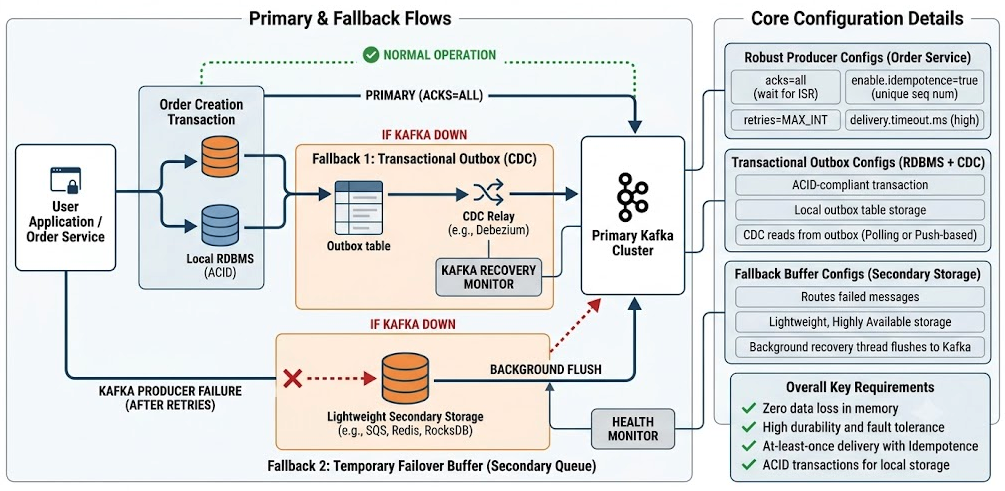
Robust Producer Configurations- Acks Configuration: Set
acks=all (or acks=-1). The producer will wait for the full set of in-sync replicas to acknowledge the record. - Idempotent Producer: Enable
enable.idempotence=true. This assigns a unique sequence number to each message, preventing duplicates in case of retries due to network timeouts. - Retries and Timeouts: Configure high retry limits (
retries=MAX_INT) and appropriate timeouts (delivery.timeout.ms) to allow the producer to recover from transient Kafka network blips.
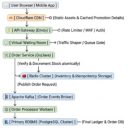
Transactional Outbox Pattern (Local Database Backup)- Design: Instead of sending the order directly to Kafka, the Order Service saves both the "Order Record" and an "Outbox Event Record" into its local Relational Database (RDBMS) within a single, ACID-compliant database transaction.
- Message Relay (CDC): A separate worker process (e.g., Debezium, Kafka Connect, or a custom polling publisher) reads the Outbox table and publishes the messages to Kafka.
- Kafka Down Scenario: If Kafka is down, the database transaction still succeeds. The orders are safely stored in the RDBMS. Once Kafka recovers, the publisher resumes sending messages from the Outbox table.
Temporary Failover Buffer (Secondary Queue)- Design: Implement an in-memory or secondary storage fallback mechanism in the producer application.
- Implementation: If the Kafka producer fails to send a message after retries, the application routes the message to a lightweight, highly available secondary storage such as AWS SQS, Redis, or a local RocksDB/disk file.
- Recovery: A background thread monitors Kafka's health and flushes the fallback storage back into Kafka once the cluster is healthy.
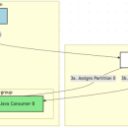
3. Consumer-Side Data ConsistencyPreventing data loss on the consumer side means ensuring that messages are not marked as "processed" if the consumer crashes mid-transaction. 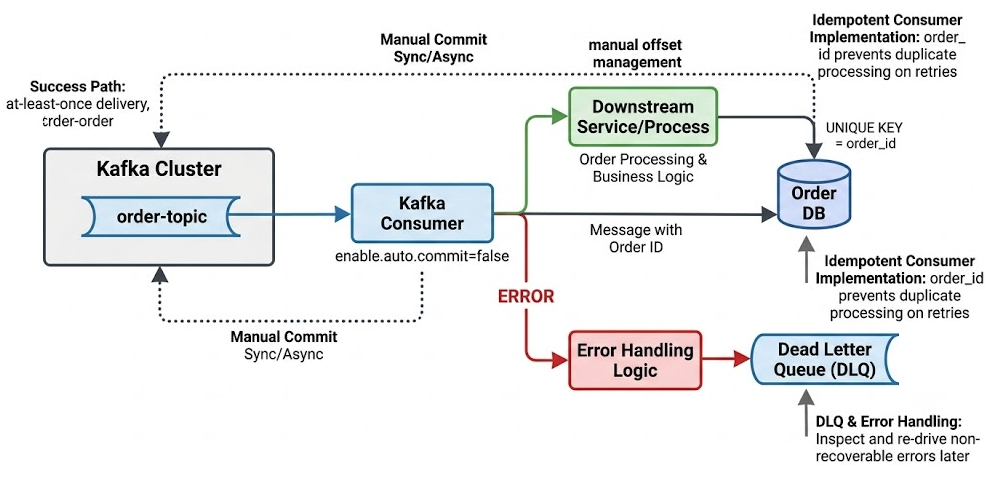
Manual Offset Management- Disable Auto-Commit: Set
enable.auto.commit=false. - Manual Commit Sync/Async: Commit the offsets only after the consumer has successfully processed the order data (e.g., writing to the database, invoking the payment gateway). This ensures "at-least-once" delivery.
Idempotent Consumers- Because manual commits can lead to duplicate message processing (e.g., if a consumer crashes after processing but before committing), the downstream services must be idempotent.
- Implementation: Use the
order_id as a unique key in the target database to prevent processing the same order multiple times.
Dead Letter Queue (DLQ) & Error Handling- If a consumer encounters a non-recoverable error (e.g., bad data format), it should send the message to a Dead Letter Queue (DLQ) rather than discarding it or halting the partition processing.
- This allows operators to inspect and re-drive failed order messages later.
4. Disaster Recovery (DR) & Monitoring InfrastructureFor catastrophic Kafka failures (e.g., regional outages), a multi-cluster disaster recovery plan is required. 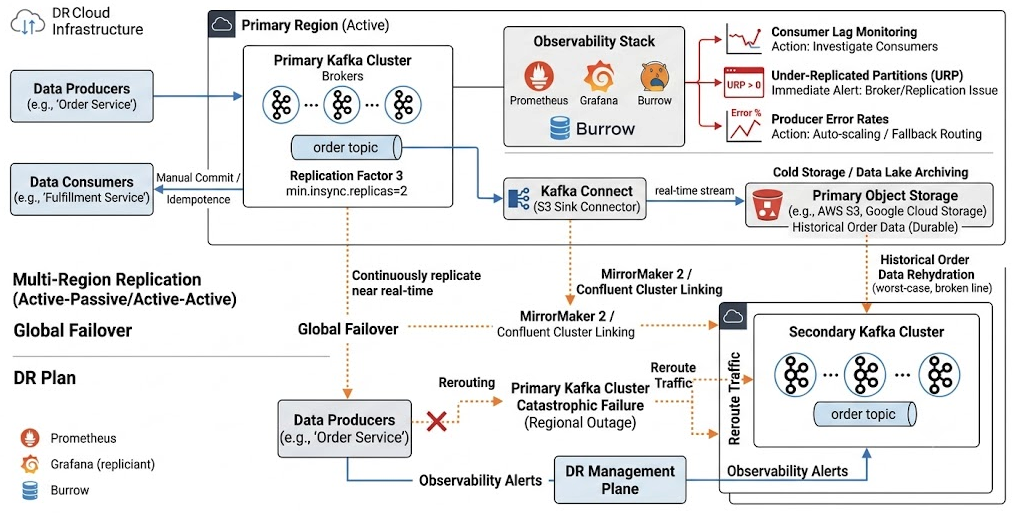
Multi-Region Replication (Active-Passive / Active-Active)- MirrorMaker 2 / Confluent Cluster Linking: Continuously replicate the
order topic from the primary region's Kafka cluster to a secondary region's Kafka cluster in near real-time. - Global Failover: If the primary Kafka cluster is unrecoverable, route the Producer/Consumer traffic to the secondary Kafka cluster.
Backup to Cold Storage (Data Lake archiving)- Use Kafka Connect (S3 Sink Connector) to stream all order messages from Kafka to highly durable object storage (e.g., AWS S3, Google Cloud Storage) in real-time.
- In a worst-case scenario where the Kafka cluster is completely lost without backup, the historical order data can be rehydrated from the object storage.
Observability and Alerting- Consumer Lag Monitoring: Monitor consumer lag using tools like Prometheus, Grafana, or Burrow. An increasing lag indicates consumer issues.
- Under-Replicated Partitions (URP): Set up immediate alerts for
UnderReplicatedPartitions > 0. This is the first indicator of broker failure or replication issues. - Producer Error Rates: Monitor producer retry rates and failed send rates to trigger auto-scaling or fallback routing.
|