Optimize the performance of a search results page that experiences high traffic | |||||||||||||||||||||||||||||||||||||||||||||||||||||||
| |||||||||||||||||||||||||||||||||||||||||||||||||||||||
| To optimize the performance of a high-traffic search results page, the primary focus must be on minimizing latency and maximizing system scalability to ensure a seamless, uninterrupted user experience under heavy load. The ultimate goal is to deliver highly relevant search results almost instantaneously, which requires implementing aggressive caching strategies for frequent queries, optimizing database indexing, and leveraging dedicated search engines like Elasticsearch or Solr. Additionally, it is crucial to minimize the frontend payload size through efficient pagination or lazy loading, utilize Content Delivery Networks to offload static assets, and implement robust load balancing alongside asynchronous processing to prevent server bottlenecks during traffic spikes.
Functional RequirementsThe search results page must deliver a rich, intuitive, and highly responsive user experience. The functional requirements define the core features that the system must support:
Non-Functional RequirementsTo handle high traffic volume without degrading user experience, the system must adhere to strict performance, scalability, and availability metrics:
API Specifications 1. Execute Search QueryRetrieves a list of search results based on keyword, filters, sorting, and pagination.
Request Parameters (Query Params):
Response ( |

| Parameter | Type | Required | Description | Example |
|---|---|---|---|---|
q | String | Yes | The partial query string typed by user | wire |
limit | Integer | No | Maximum number of suggestions (default: 5) | 5 |
Response (200 OK):
{
  "suggestions": [
    "wireless headphones",
    "wireless charger",
    "wire cutter",
    "wired earbuds"
  ]
}
AWS System Architecture
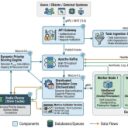
To achieve low-latency and high-throughput search, the architecture employs Read/Write separation, Multi-tier Caching, and an Event-Driven Data Pipeline to keep the search index updated asynchronously.
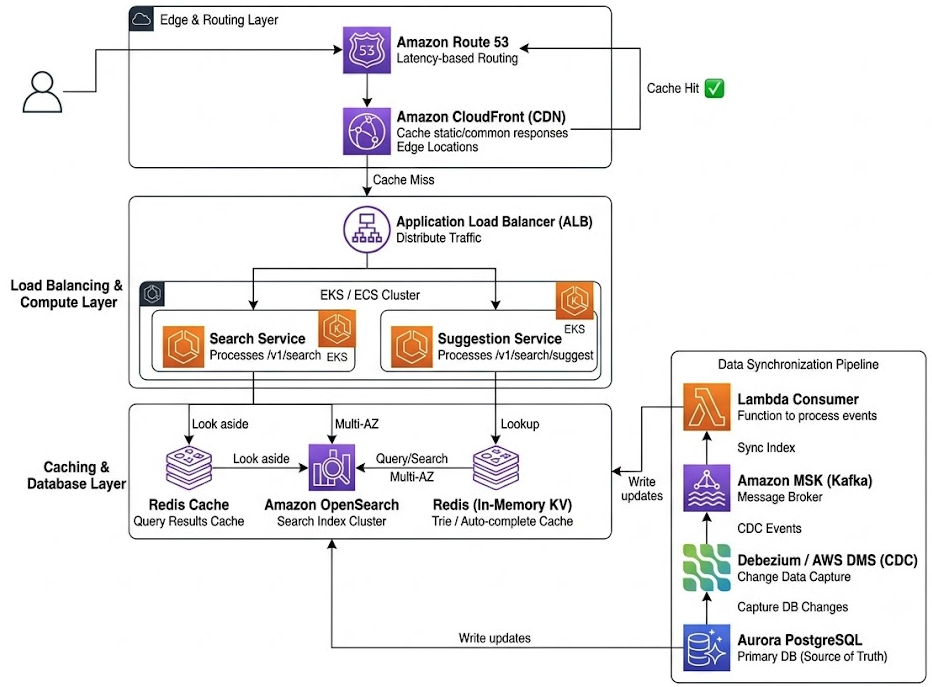
Architectural Components Detail
1. Edge & Routing Layer
- Amazon Route 53: Latency-based routing to direct global users to the nearest AWS Region.
- Amazon CloudFront (CDN): Caches popular and static search results (e.g., blank search results, top-level category pages) at edge locations close to users. This drastically reduces the load on the backend for repeating traffic.
2. Load Balancing & Compute Layer
- Application Load Balancer (ALB): Distributes incoming traffic across multiple instances of backend services.
- Amazon EKS (Elastic Kubernetes Service) / Amazon ECS:
- Hosts containerized, stateless microservices running on AWS Fargate for auto-scaling.
- Search Service: Handles
/v1/searchrequests, coordinate caching, and query translation to Amazon OpenSearch. - Suggestion Service: Handles
/v1/search/suggestrequests using high-performance in-memory lookups.
3. Caching Layer (High-Performance Read)
- Amazon ElastiCache for Redis:
- Search Result Cache: Stores JSON payloads of frequent queries (e.g., key:
md5(q=headphones&price_min=50), TTL: 5 to 10 minutes). - Suggestion Cache: Stores pre-computed prefix trees (Tries) or high-frequency search keywords to satisfy suggestions within $< 10\text{ms}$.
- Search Result Cache: Stores JSON payloads of frequent queries (e.g., key:
4. Search Index Engine
- Amazon OpenSearch Service:
- Serves as the core engine for full-text search, fuzzy matching, categorization (faceting), and ranking.
- Uses Read Replicas (Multi-AZ) to scale search query capacity horizontally.
- Uses dedicated master nodes to ensure cluster stability during massive traffic spikes.
5. Event-Driven Data Synchronization Pipeline (Write Path)
- Amazon Aurora PostgreSQL: The transactional primary database of record (source of truth) where products/items are modified.
- AWS DMS (Database Migration Service) or Debezium: Captures row-level changes (Insert/Update/Delete) from Aurora PostgreSQL's write-ahead logs (CDC - Change Data Capture) and streams them in real-time.
- Amazon MSK (Managed Streaming for Apache Kafka): Acts as a message broker to decouple the database from the search indexers, ensuring guarantee of delivery.
- AWS Lambda: Consumes change events from MSK and writes updates directly into the Amazon OpenSearch index. This keeps the data eventual-consistent with sub-second lag without degrading write performance on the main DB.