MaxMind GeoLite2 vs. DB-IP Lite vs. ip-api.com: Choosing the Right Free IP Geolocation Solution
CK 3788 Created at
21800
When evaluating these three IP geolocation solutions, each presents unique features, pros, cons, and architectural implementations for application integration. The ip-api.com free option features rich data fields—including location, ISP, ASN, and security flags—and requires no account setup, but its reliance on an external client-server architecture sending viewer IPs to a third-party over plain HTTP introduces drawbacks like a 45-request-per-minute rate limit and a restriction against commercial use. In contrast, DB-IP Lite .mmdb utilizes a local, in-process architecture reading from a local file, providing location and ASN data with the advantages of zero lookup rate limits, no mandatory API key, and permitted commercial use under CC BY 4.0 attribution, though it requires managing monthly database updates. Finally, MaxMind GeoLite2 also employs an in-process local file architecture for location and ASN lookups, offering the benefit of unrestricted local query performance for commercial applications, balanced against the requirement of creating a free account with a license key and a limit of roughly 30 database downloads per day.
1. ip-api.com (Free Tier)
Overview
ip-api.com provides a RESTful API endpoint returning JSON, XML, or other formats directly from their hosted infrastructure. The free tier requires no registration but comes with strict operational and legal limitations.
Features
Metadata Depth: Returns country, region, city, ISP, ASN, and specific security flags (proxy, hosting, mobile).
Zero Infrastructure Overhead: No local database storage or memory allocation required.
Batch Endpoint Support: Allows querying up to 100 IPs per batch call (max 15 batch calls/minute).
Format Versatility: Supports JSON, XML, CSV, Newline, and PHP serialized formats.
Pros & Cons
Pros
Instant Integration: No API keys, registration, or local file management required.
Rich Metadata: Includes context flags (e.g., detecting data center/proxy traffic) not present in basic free local databases.
No Local Storage Cost: Keeps application binaries and deployment footprints lightweight.
Cons
Non-Commercial Restrictions: Strictly limited to non-commercial use cases.
Security & Transport: Free tier is restricted to unencrypted HTTP (http://), posing a Security/Man-in-the-Middle (MitM) risk.
Data Privacy / Compliance: Transmits end-user IP addresses to a third-party server, creating GDPR/CCPA compliance risks.
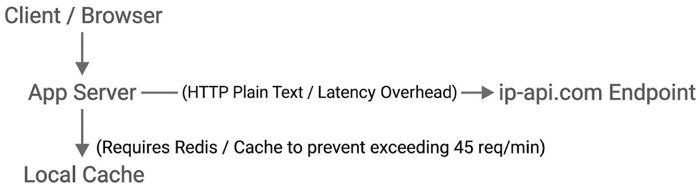
High Latency & Dependency: Introduces external network calls into the critical request path; vulnerable to third-party downtime.
Strict Rate Limits: Capped at 45 HTTP requests/minute (or 15 batch calls/minute); exceeding this results in IP bans.
Application Architecture
Integration Pattern: Asynchronous API Integration with Caching Strategy.
Implementation Details: Must be placed behind a local cache layer (e.g., Redis or Memcached) with a long Time-To-Live (TTL) to avoid reaching the 45 req/min threshold.
Best Used For: Low-volume internal tools, proof-of-concept projects, and non-commercial administrative scripts where encrypted data transport is not mandatory.
2. DB-IP Lite (.mmdb Format)
Overview
DB-IP Lite offers downloadable database files (.mmdb format) updated monthly. It provides a lightweight, locally executed lookup system governed by the Creative Commons Attribution 4.0 International License (CC BY 4.0).
Standard Format: Uses the MaxMind .mmdb binary format, making it compatible with existing MaxMind reader SDKs across all major languages.
Commercial Usage: Allowed for commercial projects provided proper attribution is rendered.
Separated Datasets: Offers distinct files for Location (City Lite) and ASN (ASN Lite).
Pros & Cons
Pros
High Performance: Sub-millisecond lookup speeds via in-memory access.
Data Privacy: IP addresses never leave your infrastructure, simplifying GDPR/CCPA compliance.
No Lookup Rate Limits: Unlimited queries per second; limited only by CPU and memory throughput.
Zero Third-Party Runtime Dependencies: System remains fully operational even during internet outages.
Cons
Attribution Requirement: Mandatory link back or textual credit (CC BY 4.0) in end-user applications.
Update Overhead: Requires building custom deployment pipelines to fetch monthly database updates.
Split Files: Location data and ASN data reside in separate .mmdb files, requiring double lookups per request if both are needed.
Accuracy Limits: Lower accuracy/granularity at the city level compared to commercial database tiers.
Application Architecture
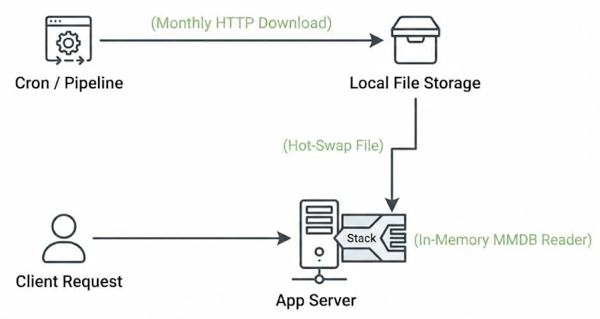
Integration Pattern: Embedded Database with Scheduled File Synchronization.
Implementation Details: A scheduled job (Cron/CI/CD) fetches the monthly download URL, replaces the file on disk, and signals the application process to reload the reader handle atomically without downtime.
Best Used For: High-throughput commercial services requiring embedded execution, low latency, and GDPR compliance, where displaying an attribution license is acceptable.
3. MaxMind GeoLite2 (Built/Local)
Overview
MaxMind GeoLite2 is the industry-standard free IP geolocation database. It requires a free account registration to obtain a license key for automated downloads. It executes locally in the .mmdb binary format under the GeoLite2 End User License Agreement.
Features
Ecosystem Support: Supported by native SDKs for Node.js, Python, Java, Go, C#, PHP, and WebServer modules (Nginx, Apache).
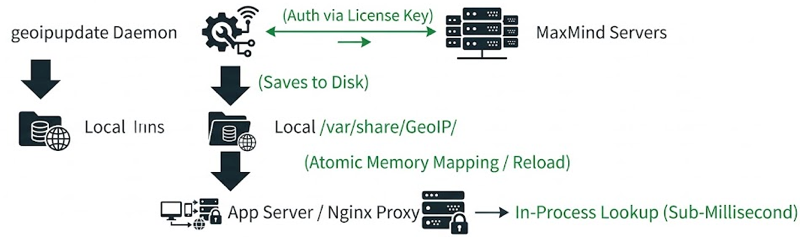
Automated Tooling: Official utility (geoipupdate) handles automated database sync via cron/systemd.
Data Granularity: Combines Country, Region, City, and Network information within standard schema formats.
Industry Standard: Widely supported across open-source middleware, reverse proxies (Nginx, Caddy), and frameworks.
Sub-Millisecond Performance: Extremely fast in-memory lookups.
Robust Update Pipeline: Supported by official tooling (geoipupdate) for automated, zero-touch maintenance.
Data Privacy: High privacy compliance; no user IPs are transmitted externally.
Cons
Account Management: Requires registering, generating, and securely storing MaxMind License Keys in application environments.
EULA Restrictions: Subject to MaxMind-specific license terms (including restrictions on redistributing the raw database and compliance requirements regarding consumer data privacy requests).
Download Rate Limits: Capped at approximately 30 downloads per day per key (sufficient for production deployments, but limits aggressive CI/CD integration testing).
Application Architecture
Integration Pattern: Embedded Native Engine with Sidecar/Daemon Update Manager.
Implementation Details:
Deploy the geoipupdate CLI tool alongside application containers (as a sidecar or cron job).
The application initializes an in-memory maxminddb reader using file-system watchers to reload the pointer atomically when geoipupdate modifies the .mmdb file.
Alternatively loaded directly at the reverse proxy layer (e.g., ngx_http_geoip2_module) to attach location headers to incoming requests before reaching the application code.
Best Used For: Production-grade commercial applications, microservice architectures, high-traffic web apps, and environments utilizing reverse proxies for geo-routing or rate-limiting.