Demystifying BGP and OSPF: A Complete Guide to Network Routing Protocols
CK 3828 Created at
58000
Both BGP (Border Gateway Protocol) and OSPF (Open Shortest Path First) are core routing protocols used in computer networks to determine the best path for data to travel from a source to a destination.
However, they serve very different purposes and operate at different scales. Here is a comprehensive breakdown of both protocols and how they compare.
1. OSPF (Open Shortest Path First)
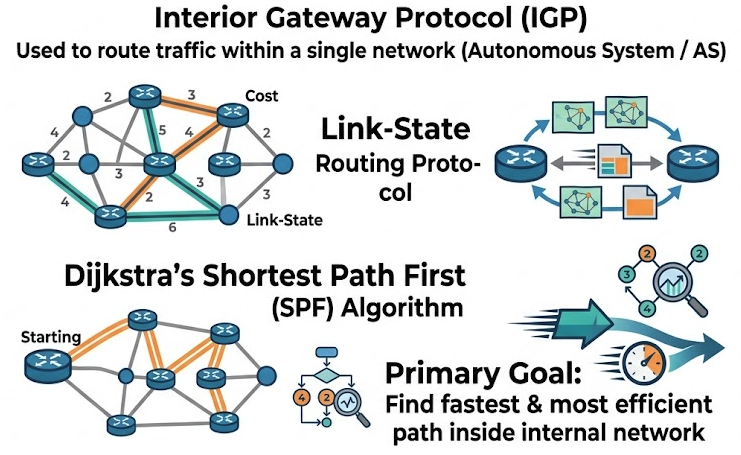
OSPF is an Interior Gateway Protocol (IGP). It is used to route traffic within a single network or organization (an Autonomous System, or AS).
Protocol Type: Link-State Routing Protocol.
Algorithm: Dijkstra’s Shortest Path First (SPF) algorithm.
Primary Goal: Find the fastest and most efficient path inside an internal network.
Key Features of OSPF:
Speed & Performance: It measures the best path based on Cost (which is calculated from bandwidth). It prefers high-speed links.
Fast Convergence: If a network link fails, OSPF updates its routing tables almost instantly.
Hierarchical Structure: OSPF networks are divided into Areas to manage scale. Area 0 (Backbone Area) connects all other areas together.
Full Topology Awareness: Every OSPF router has a complete map of the entire internal network.
Typical Use Case:
Used inside enterprise networks, university campuses, data centers, or within an Internet Service Provider's (ISP) internal infrastructure.
2. BGP (Border Gateway Protocol)
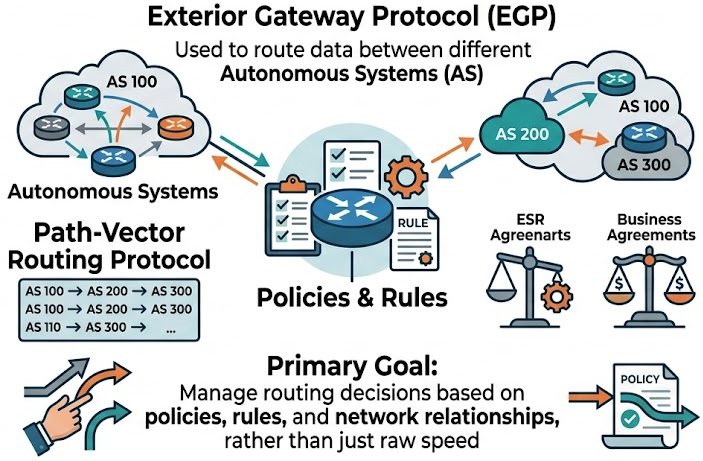
BGP is an Exterior Gateway Protocol (EGP). It is the fundamental protocol that makes the Internet work by routing data between different Autonomous Systems (AS)—such as between ISPs, cloud providers (like AWS, Google), and major corporations.
Protocol Type: Path-Vector Routing Protocol.
Primary Goal: Manage routing decisions based on policies, rules, and network relationships, rather than just raw speed.
Key Features of BGP:
Policy-Based Routing: BGP does not simply look for the "fastest" path; it looks for the most economical or compliant path based on business agreements between network providers (e.g., transit costs, security policies).
Massive Scalability: BGP handles the global Internet routing table, which contains over 900,000 network routes.
Reliability over Speed: Convergence in BGP is intentionally slower than OSPF to maintain global network stability and avoid flapping routes across the Internet.
Transport Protocol: BGP uses TCP (Port 179) to establish connections between neighboring routers (BGP peers).
Typical Use Case:
Used by ISPs, telecom companies, data centers, and multi-homed businesses that need to connect their internal network to the global Internet.
Key Differences at a Glance
Feature
OSPF
BGP
Category
Interior Gateway Protocol (IGP)
Exterior Gateway Protocol (EGP)
Scope
Internal (Inside a single AS)
External (Between different ASes)
Routing Basis
Speed / Bandwidth (Technical metric)
Policies / Rules (Business & path metrics)
Algorithm
Link-State (Dijkstra)
Path-Vector
Convergence
Very Fast
Slow to Moderate
Scale
Small to Large Internal Networks
Global Scale (The Internet)
Resource Usage
High Memory/CPU (calculates full maps)
High Memory (holds huge Internet tables)
How They Work Together (Real-World Example)
Imagine a large corporation with multiple offices:
Inside the Corporation (OSPF): All routers inside the company's offices use OSPF to quickly send data between employee computers, local servers, and internal databases.
Connecting to the World (BGP): The company’s edge router uses BGP to talk to Internet Service Providers (like Comcast, Verizon, or KT). When an employee accesses a website outside the company, OSPF routes the request to the company’s edge router, and BGP routes it across the Internet to its final destination.