| gRPC is a high-performance, open-source universal RPC (Remote Procedure Call) framework developed by Google and initially released in 2015. Its history traces back to Google's internal needs for efficient communication between services, evolving from their internal RPC system, Stubby. gRPC uses Protocol Buffers (protobuf) for efficient serialization, enabling cross-platform communication between services written in various languages. It's ideally suited for microservices architectures, streaming applications (like real-time data feeds), and scenarios demanding high performance and low latency, making it a powerful tool for building distributed systems and APIs. gRPC is a high-performance, open-source universal RPC (Remote Procedure Call) framework developed at Google. It allows you to define services with their methods and automatically generate client and server code in various languages. This makes it incredibly efficient for building distributed applications and microservices. 
HistorygRPC's roots lie within Google's internal infrastructure. For years, Google relied on its own internal RPC framework, called "Stubby," to handle communication between its massive distributed systems. Stubby's success demonstrated the power of RPC for building scalable and maintainable applications.
Recognizing the broader need for a robust and efficient RPC solution, Google open-sourced a significant evolution of Stubby as gRPC in 2015. This open-source release leveraged Protocol Buffers (protobuf), another Google technology, for defining service interfaces and data structures. This choice contributed significantly to gRPC's efficiency and language-agnostic capabilities.
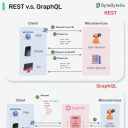
Since its open-source debut, gRPC has gained widespread adoption, boasting a large and active community contributing to its development and expanding its features and supported languages. It's now maintained by a collaborative community under the Cloud Native Computing Foundation (CNCF). Where to Use gRPCgRPC shines in situations where you need: - High Performance: Its use of Protocol Buffers for serialization and HTTP/2 for transport makes it significantly faster and more efficient than REST APIs, especially for frequent, small data exchanges.
- Microservices Architecture: gRPC is ideal for connecting different microservices within a distributed system, providing a robust and efficient communication layer.
- Client-Server Communication: It excels in building applications where clients need to interact with a server, such as mobile apps communicating with backend services or web applications interacting with APIs.
- Streaming Data: gRPC supports both unary (single request, single response) and bidirectional streaming, which are crucial for handling real-time data streams and long-lived connections.
- Language Interoperability: The ability to generate client and server code in multiple languages allows you to build polyglot applications effortlessly. Commonly supported languages include Java, Python, Go, C++, Node.js, Ruby, C#, and more.
- Strong Typing and Code Generation: Protobuf's strong typing system improves code reliability and reduces errors. Automatic code generation simplifies development and maintenance.
Examples of where gRPC is suitable:- Real-time chat applications
- Live data dashboards
- IoT device communication
- Microservices in cloud-native architectures
- Streaming video or audio applications
While gRPC offers significant advantages, it's not always the best choice. REST APIs might be preferred in situations where:- You need broad browser compatibility without requiring a specific client library.
- You prioritize ease of development and simpler setup over ultimate performance.
- You require easily human-readable communication.
In summary, gRPC is a powerful and efficient RPC framework ideally suited for high-performance distributed systems and microservices. Its strength lies in its speed, efficiency, and language interoperability, making it a compelling choice for many modern applications.
|