Difference between CPU and GPU - Why GPU is faster than CPU?

CK CK 3788 
Created at  
805 0 0

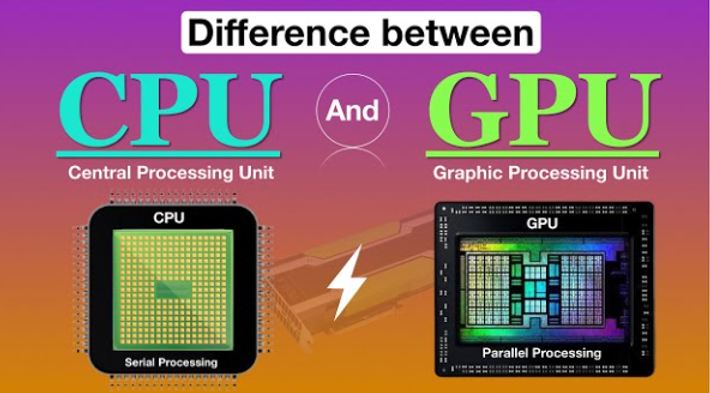
CPUs (Central Processing Units) are designed for general-purpose tasks, prioritizing sequential processing and complex instructions, while GPUs (Graphics Processing Units) are specialized for parallel processing of many simpler instructions simultaneously. GPUs achieve their speed advantage by having thousands of smaller, more efficient cores compared to the CPU's fewer, more powerful cores. This parallel architecture makes GPUs exceptionally fast at tasks that can be broken down into many smaller, independent operations, such as those found in graphics rendering and machine learning, but not necessarily faster for all tasks.
Difference between CPU and GPU - Why GPU is faster than CPU?


The CPU (Central Processing Unit) and GPU (Graphics Processing Unit) are both processors, but they are designed for different tasks and have fundamentally different architectures. This leads to GPUs being faster at *certain* tasks, not all.

Key Differences:

Difference between CPU and GPU - Why GPU is faster than CPU?


Why GPUs are faster for specific tasks?

GPUs excel at tasks that can be broken down into many smaller, independent calculations that can be performed simultaneously (parallel processing). This is because:

  • Massive Parallelism: GPUs have thousands of smaller, simpler cores working in parallel. While a CPU might have 8-16 powerful cores, a GPU can have thousands. Each core in a GPU handles a small piece of the overall task, allowing for significantly faster completion for parallelizable problems.
  • Specialized Instruction Set: GPU instructions are simpler and optimized for parallel operations like matrix multiplication and vector operations, which are common in graphics rendering and other parallel tasks (like deep learning).
  • High Memory Bandwidth: While individual memory access might be slower, GPUs often have a very high *overall* memory bandwidth due to their numerous cores accessing memory concurrently. This is crucial for keeping the cores fed with data.


Why CPUs are still important?

CPUs are still essential because:

  • General-Purpose Computing: They are designed for a wide variety of tasks, including complex calculations that don't lend themselves to parallelization. They excel at handling unpredictable instructions and managing the overall system.
  • Sequential Processing: Tasks that require complex logic and strict sequential execution are handled more efficiently by a CPU.
  • Lower Latency: Individual instructions on a CPU are generally executed much faster than on a GPU.

In summary, GPUs are not inherently "faster" than CPUs. They are faster at specific tasks that can be highly parallelized. CPUs remain superior for general-purpose computing and tasks requiring complex sequential operations and low latency. The increasing prevalence of hybrid architectures (using both CPUs and GPUs) highlights the strengths of both.
 

Tags CPU Centeral Processing Units GPU General-Purpose Computing Graphics Processing Units Facebook X
Comments 0
Similar posts
  1. Rust-GPU-tools for interacting with various GPU APIs
    755
  2. Technical Hierarchy of AI Agents
    817
  3. Getting Started with FAISS: A CentOS 7 Installation Guide
    281
  4. Building GPU Clusters on GCP, Azure, and AWS: A Practical Guide and Head-to-Head Comparison
    352
  5. GPU & LLM Cluster Infrastructure & Task Scheduling Architecture
    245
  6. NVIDIA CUDA library which can be integrated with C/C++
    376
  7. Apache server unstable detection and the related server(mysql, apache) restart automatically
    538
  1. How to Control External Monitor Brightness, Sound Volume on a Mac with MonitorControl (Even Over HDMI)
    2,399
  2. Building Multilingual Applications with i18n
    1,200
  3. Kiro versus Cursor AI - Spec-Driven? or Chat-Driven?
    403
  4. How to use multiple RSA (SSH) keys for GitHub
    330
  5. Key Metrics Track to Ensure the Health and Performance of a Distributed System
    176
  6. REST API Vs. GraphQL
    411
  7. Project Libre similar to MS Project
    529
  8. Learning about Firestore: Architecture, Pros, Cons, and Real-World Deployments
    168
  9. Building Privacy-First Infrastructure: Network Isolation + Zero Trust for GDPR Compliance
    293
  10. Why supabase is not safe for the Fintech project?
    857
  11. The Ultimate Data Engineering Roadmap
    1,073
  12. Nine Types of Testing while we develop APIs
    514
  13. Apache Kafka - a distributed, fault-tolerant, high-throughput streaming platform
    615
  14. Comprehensive Software Development Flow : How Companies Ship Code To Production
    2,314
  15. DeepSeek v3 offers of ChatGPT's performance at 1/10 the price!
    634
  16. gRPC - Open-source Universal RPC Framework developed by Google
    768
  17. Exploring the Depths of Data Transfer: sendfile vs. kTLS
    1,320
  18. How Netflix Ensures Smooth Streaming with Open Connect CDN
    2,130
  19. Public DNS (Domain Name Service) based on IPv4, IPv6 widely used
    1,244
  20. All Engineering Software Development How can you prioritize software design trade-offs when developing a new product?
    1,340
  21. MR(Mixed Reality) Game Programming based on Unity 3D
    1,360
  22. Temporal Programming Model - Robust, Long-Running, Fault-Tolerant Applications as WorkFlows
    358
  23. Cadence Programming Model - A Distributed, Fault-Tolerant, Stateful Workflow Orchestration Framework
    294
  24. Multi-AZ Kafka Architecture
    148
  25. Large-Scale Concurrency Control: Solving the DB Bottleneck from a Flood of “Likes”
    271
  26. Hybrid Methods for Recommendation Service
    218
  27. Model-Based CF: Matrix Factorization for Recommendation Service
    183
  28. Memory-Based Collaborative Filtering for Recommendation Service
    195
  29. Content-Based Filtering for Recommendation Service (aka User-based Model)
    192
  30. Stateful Databases: A Deep Dive with Cassandra & TiDB
    189
Recently updated
  1. Why 100% SEO Guarantees Better User Engagement and How to Achieve It in Your Service
    42
  2. Why SPF and DKIM Are Essential for Linux Email Servers?
    36
  3. How do I create animated background for Google Meet?
    21,018
  4. MaxMind GeoLite2 vs. DB-IP Lite vs. ip-api.com: Choosing the Right Free IP Geolocation Solution
    251
  5. Meet Valkey: Why Redis Changed Its License, Why Valkey is Better, and How to Use It as a Drop-in Replacement
    94
  6. How Rogue Web Scrapers Are Stealing My Content and Destroying My Server
    157
  7. Array of arguments passed to script in PHP
    90
  8. Invalid Auction Storms in Ad Tech
    98
  9. Building MRC-Compliant Instrumentation in Ad Tech: Implementation Steps and Key Challenges
    202
  10. The Two Clocks of Ad Server Architecture
    70
  11. Frequency Cap Architecture Overview
    515
  12. Collecting Proof-of-Play from 100,000 Screens
    146
  13. Vector Search in Relational Databases (RDBs): Trends & Usage Environments
    288
  14. What is RedisVL?
    109
  15. Designing a Skill Registry Architecture: Minimize Token Usage and Maximize AI Performance
    232
  16. TPU & GPU Cluster Management Tools
    245
  17. The Concept of Scaffolding in AI Agents
    234
  18. Beyond Static Pipelines: Architecting LLM Multi-Agent Systems for Autonomous Workflow Orchestration
    583
  19. AI-DLC vs. AI-SDLC: Model-Centric vs. System-Centric AI Development
    259
  20. Fine-Tuning Open-Weight LLMs: Training, Licensing, and Deploying Custom Models with Ollama
    339
  21. Inside the Next-Generation Streaming Architecture: Ultra-Low Latency, SGAI, and AI Codecs
    202
  22. Machine Learning: Training vs. Ranking
    222
  23. The Continuous Learning Machine: Designing a Loop That Actually Turns
    222
  24. The Next-Gen Low-Latency Standards: LL-HLS & MoQ
    195
  25. Designing a Data Curation System Around a Vector Database
    221
  26. Extracting Context from Live Video: The Architecture Got Simpler When We Stopped Building Features
    256
  27. The New Ad Stack Behind Live Sports Streaming: Inside SGAI, EABN, and the Standards Race to Fix Live Monetization
    656
  28. Designing MLOps Architectures to Handle Seasonal Data Drift in EV Fleet Models
    196
  29. From 15 to 40+ FPS: Accelerating PyTorch Object Detection on Automotive ECUs
    219
  30. Understanding Data Lineage
    262