| Below is from Alex Yu at ByteByteGo. Actually, all of the tools his company is using are not perfectly matched with my environment, but most of them make sense for common processes. How Do Companies Ship Code to Production?
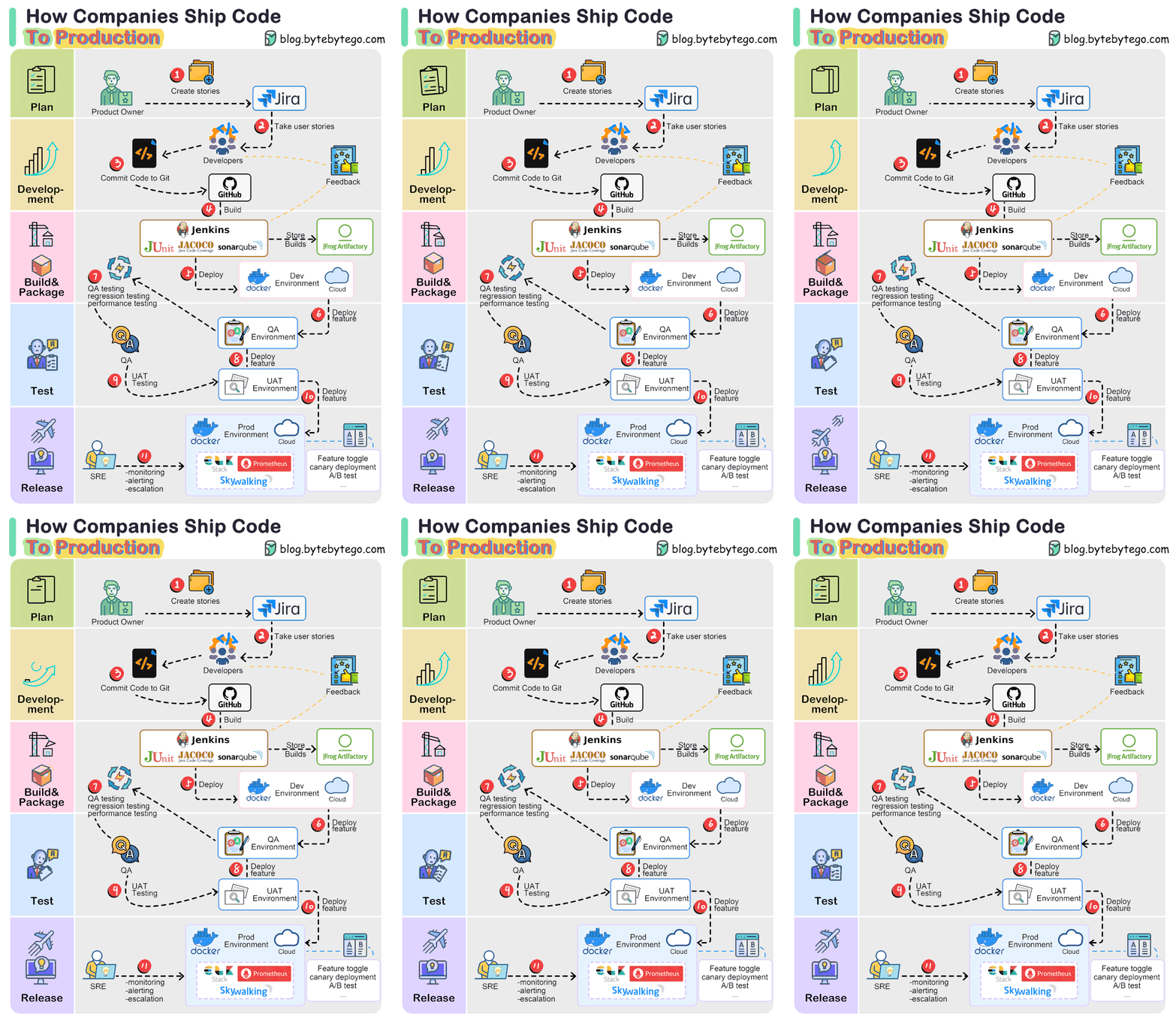
Here are 11 steps from planning to production:
1 - The Product Owner starts the entire process by creating user stories in a tool like Jira.
2 - The Developer Team performs Sprint Planning activity and adds the user stories to the sprint.
3 - Developers work on the assigned stories. Once a story is finished, they commit the code to Git and push it to GitHub.
4 - Jenkins builds and runs the code through testing and quality check tools such as JUnit, Jacoco, and SonarQube.
5 - If the build is successful, it is stored in the artifactory such as JFrog. Jenkins also deploys the build to the Dev Environment via Docker.
6 - Next up, the feature gets deployed to the QA environment. Since multiple teams may be working on the same code base, multiple QA environments will be created
7 - The QA team uses a particular QA environment and runs multiple test types such as QA, regression, and performance.
8 - Once the QA verification is complete, features are deployed to the UAT (User Acceptance Testing) environment.
9 - UAT testing verifies whether the feature satisfies the user’s requirements.
10 - Once the UAT testing is successful, the builds become release candidates. They are deployed to the production environment based on a specific schedule.
11 - The SRE team uses tools like ELK and Prometheus to monitor the production environment and handle alerts in case of issues.
Over to you: Will you add any other steps to the process?
|