REST API Vs. GraphQL

CK CK 3788 
Created at
Updated at  
414 0 0

GraphQL offers several advantages over REST APIs, including fetching only the data a client needs, reducing over-fetching and under-fetching issues prevalent in REST. This leads to improved performance, especially on mobile devices with limited bandwidth. GraphQL also provides strong typing and introspection capabilities, enabling better developer tooling and easier API exploration, while REST APIs often require multiple endpoints to retrieve related data, GraphQL can fetch all the necessary information with a single request. Finally, GraphQL's schema evolves more gracefully than REST, reducing the risk of breaking changes as the API evolves.
 

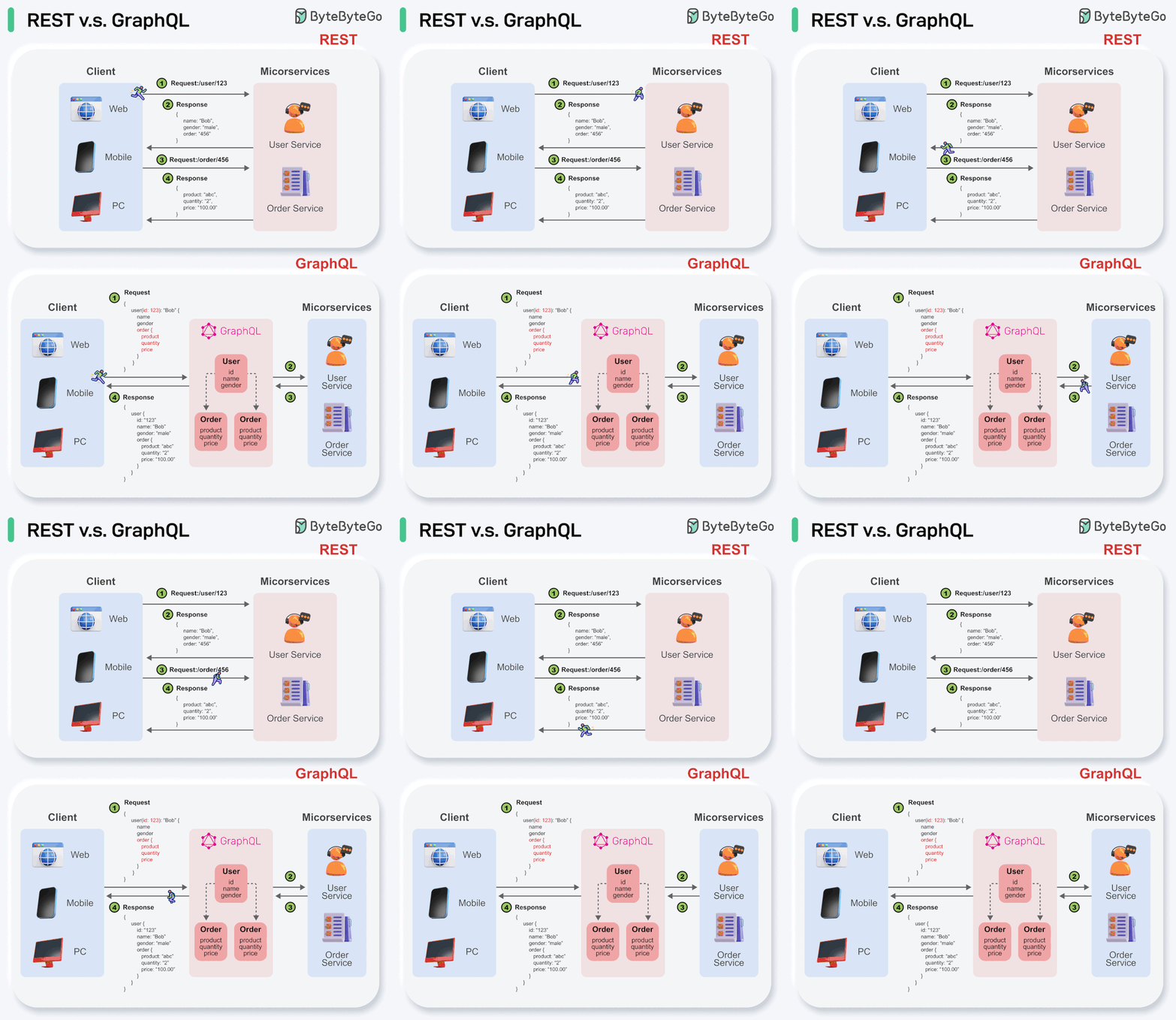
Below is actually from Alex Xu and it shows some insight.

When it comes to API design, REST and GraphQL each have their own strengths and weaknesses. 

REST 
- Uses standard HTTP methods like GET, POST, PUT, DELETE for CRUD operations. 
- Works well when you need simple, uniform interfaces between separate services/applications. 
- Caching strategies are straightforward to implement. 
- The downside is it may require multiple roundtrips to assemble related data from separate endpoints. 

GraphQL 
- Provides a single endpoint for clients to query for precisely the data they need. 
- Clients specify the exact fields required in nested queries, and the server returns optimized payloads containing just those fields. 
- Supports Mutations for modifying data and Subscriptions for real-time notifications. 
- Great for aggregating data from multiple sources and works well with rapidly evolving frontend requirements. 
- However, it shifts complexity to the client side and can allow abusive queries if not properly safeguarded 
- Caching strategies can be more complicated than REST. 

The best choice between REST and GraphQL depends on the specific requirements of the application and development team. GraphQL is a good fit for complex or frequently changing frontend needs, while REST suits applications where simple and consistent contracts are preferred.
REST API Vs. GraphQL

Tags ByteByteGo GraphQL REST Facebook X
Comments 0
Similar posts
  1. The Ultimate Data Engineering Roadmap
    1,084
  2. GraphQL Tutorial on CentOS 7: From Installation to Deployment
    564
  3. Cloud-Native Capital Markets: Architecture, Compliance, and Innovation
    218
  4. How to create private URL on S3/CloudFront with time-limit ?
    920
  5. Uploading files to Amazon S3 with REST API in PHP
    846
  6. Where to get AWS Access Key ?
    11,270
  1. Add New Address to gmail without SMTP (forwarding-only-address)
    1,701
  2. Registering an App on the Google Play Store
    1,481
  3. AGENT.md: AI's Blueprint for Robust Software and Vibe Coding
    563
  4. Tailscale: Zero-Config Remote Access to Your Home PC, Firewall-Free
    539
  5. Markdown's Visual Revolution: Meet Mermaid.js
    417
  6. Viewing Git Graph in ASCII
    600
  7. Vibe Coding: Harmonizing Intent with AI Productivity
    505
  8. How do I change the theme for code block in Confluence Cloud?
    1,397
  9. FIPS - Federal Information Processing Standards
    1,406
  10. Simplify Your Workflow: Switching Git Profiles Automatically by Folder
    759
  11. How to Control External Monitor Brightness, Sound Volume on a Mac with MonitorControl (Even Over HDMI)
    2,410
  12. Building Multilingual Applications with i18n
    1,208
  13. Kiro versus Cursor AI - Spec-Driven? or Chat-Driven?
    408
  14. How to use multiple RSA (SSH) keys for GitHub
    337
  15. Key Metrics Track to Ensure the Health and Performance of a Distributed System
    181
  16. Project Libre similar to MS Project
    533
  17. Learning about Firestore: Architecture, Pros, Cons, and Real-World Deployments
    173
  18. Building Privacy-First Infrastructure: Network Isolation + Zero Trust for GDPR Compliance
    298
  19. Why supabase is not safe for the Fintech project?
    862
  20. Nine Types of Testing while we develop APIs
    519
  21. Apache Kafka - a distributed, fault-tolerant, high-throughput streaming platform
    618
  22. Comprehensive Software Development Flow : How Companies Ship Code To Production
    2,334
  23. DeepSeek v3 offers of ChatGPT's performance at 1/10 the price!
    639
  24. Difference between CPU and GPU - Why GPU is faster than CPU?
    809
  25. gRPC - Open-source Universal RPC Framework developed by Google
    770
  26. Exploring the Depths of Data Transfer: sendfile vs. kTLS
    1,328
  27. How Netflix Ensures Smooth Streaming with Open Connect CDN
    2,135
  28. Public DNS (Domain Name Service) based on IPv4, IPv6 widely used
    1,247
  29. All Engineering Software Development How can you prioritize software design trade-offs when developing a new product?
    1,346
  30. MR(Mixed Reality) Game Programming based on Unity 3D
    1,372
Recently updated
  1. Google OAuth Token Expiration: Causes and Solutions
    31
  2. Why 100% SEO Guarantees Better User Engagement and How to Achieve It in Your Service
    57
  3. Why SPF and DKIM Are Essential for Linux Email Servers?
    51
  4. How do I create animated background for Google Meet?
    23,240
  5. MaxMind GeoLite2 vs. DB-IP Lite vs. ip-api.com: Choosing the Right Free IP Geolocation Solution
    273
  6. Meet Valkey: Why Redis Changed Its License, Why Valkey is Better, and How to Use It as a Drop-in Replacement
    104
  7. How Rogue Web Scrapers Are Stealing My Content and Destroying My Server
    170
  8. Array of arguments passed to script in PHP
    99
  9. Invalid Auction Storms in Ad Tech
    107
  10. Building MRC-Compliant Instrumentation in Ad Tech: Implementation Steps and Key Challenges
    208
  11. The Two Clocks of Ad Server Architecture
    78
  12. Frequency Cap Architecture Overview
    527
  13. Collecting Proof-of-Play from 100,000 Screens
    153
  14. Vector Search in Relational Databases (RDBs): Trends & Usage Environments
    303
  15. What is RedisVL?
    116
  16. Designing a Skill Registry Architecture: Minimize Token Usage and Maximize AI Performance
    247
  17. TPU & GPU Cluster Management Tools
    258
  18. The Concept of Scaffolding in AI Agents
    245
  19. Beyond Static Pipelines: Architecting LLM Multi-Agent Systems for Autonomous Workflow Orchestration
    598
  20. AI-DLC vs. AI-SDLC: Model-Centric vs. System-Centric AI Development
    269
  21. Fine-Tuning Open-Weight LLMs: Training, Licensing, and Deploying Custom Models with Ollama
    355
  22. Inside the Next-Generation Streaming Architecture: Ultra-Low Latency, SGAI, and AI Codecs
    207
  23. Machine Learning: Training vs. Ranking
    230
  24. The Continuous Learning Machine: Designing a Loop That Actually Turns
    228
  25. The Next-Gen Low-Latency Standards: LL-HLS & MoQ
    204
  26. Designing a Data Curation System Around a Vector Database
    230
  27. Extracting Context from Live Video: The Architecture Got Simpler When We Stopped Building Features
    263
  28. The New Ad Stack Behind Live Sports Streaming: Inside SGAI, EABN, and the Standards Race to Fix Live Monetization
    674
  29. Designing MLOps Architectures to Handle Seasonal Data Drift in EV Fleet Models
    201
  30. From 15 to 40+ FPS: Accelerating PyTorch Object Detection on Automotive ECUs
    233