| AGENT.md is a proposed standard file, similar in concept to README.md, but specifically designed to define the role, capabilities, goals, constraints, and operational details of an AI agent within a software project. Its purpose is to provide clear, structured instructions and context to AI agents, enabling them to understand their assignment, interact effectively with the codebase, and collaborate with human developers.
Key elements typically included in an AGENT.md file are: - Agent Name and Role: A descriptive name and the primary function it performs (e.g.,
CodeReviewAgent, FeatureDevelopmentAgent, TestGenerationAgent). - Goals/Objectives: The high-level outcomes the agent is expected to achieve.
- Capabilities/Tools: A list of the tools, APIs, and access permissions the agent has (e.g., access to specific directories, ability to run tests, use of a linter, API access to GitHub).
- Constraints/Limitations: Boundaries within which the agent must operate (e.g., "do not modify production code without explicit approval," "adhere strictly to PEP 8").
- Persona/Personality: Optional guidelines for how the agent should communicate or approach tasks (e.g., "be concise and technical," "provide detailed explanations").
- Execution Context: Information about the environment the agent operates in.
- Communication Protocols: How the agent should report progress, ask questions, or signal completion.
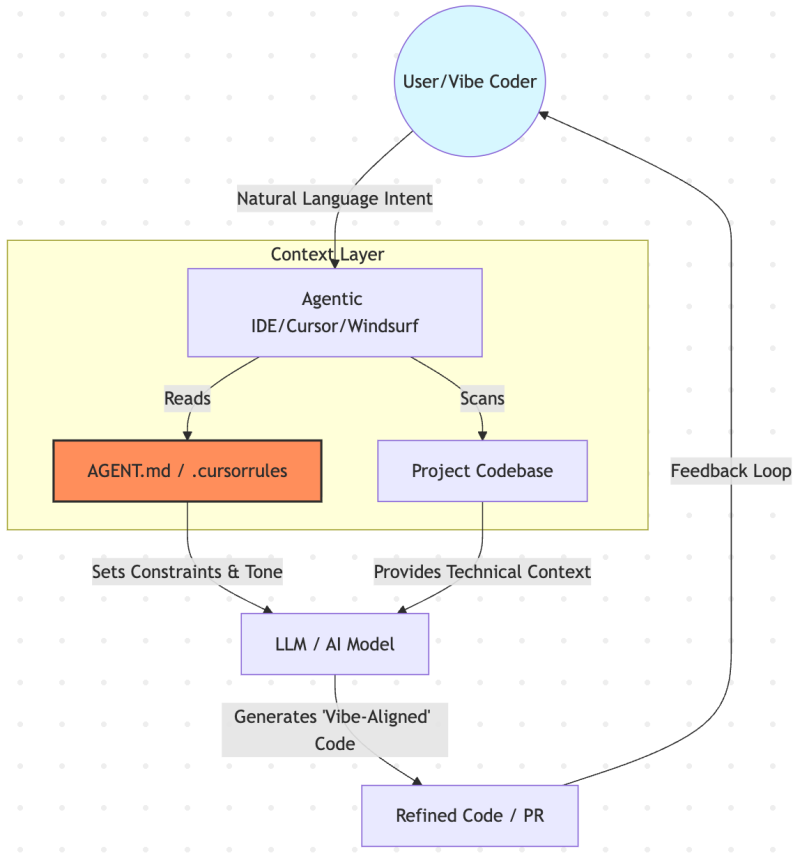
How it is Helpful for Robust and Perfect Software Development?AGENT.md significantly enhances the robustness and quality of software development by bringing structure and predictability to AI-assisted workflows.
- Clarity and Consistency: It ensures that all AI agents and human developers have a shared, explicit understanding of an agent's purpose, scope, and operational boundaries, minimizing misunderstandings and errors.
- Predictable AI Behavior: By clearly defining an agent's role and constraints, its actions become more predictable and aligned with project requirements, leading to more reliable outputs.
- Enhanced Automation: Facilitates seamless automation of complex tasks by providing AI agents with the precise context and instructions needed to generate code, run tests, update documentation, or refactor existing systems.
- Improved Quality Assurance: Agents can be specifically configured via
AGENT.md to enforce coding standards, perform thorough reviews, identify vulnerabilities, or generate comprehensive test suites, thereby contributing directly to higher code quality. - Reproducibility and Debugging: When an agent's output is unexpected or incorrect,
AGENT.md serves as a blueprint to understand its intended behavior, aiding in debugging and identifying deviations. - Effective Collaboration: Human developers can collaborate more effectively with AI agents, knowing exactly what an agent is designed to do and how to interact with it. This reduces friction and wasted effort.
- Systematization of AI Roles: For projects utilizing multiple AI agents,
AGENT.md helps define their individual responsibilities and how they interact, creating a more organized and robust multi-agent system.
How AI Use It?AI models, particularly Large Language Models (LLMs) and autonomous AI agents, leverage AGENT.md as a critical source of truth and operational guidance. - Contextual Understanding: LLMs parse the
AGENT.md file to gain a comprehensive understanding of their assigned role, the specific project context, and the expectations placed upon them. This prevents them from generating generic or out-of-scope responses. - Goal-Oriented Planning: Agents use the defined goals and objectives to formulate execution plans, breaking down complex tasks into manageable steps and prioritizing actions.
- Tool Selection and Usage: The "Capabilities/Tools" section guides the AI in selecting and utilizing the appropriate tools (e.g., IDE extensions, API calls, command-line utilities) to interact with the codebase or external services.
- Constraint Adherence: AI models refer to the "Constraints/Limitations" to ensure their actions and generated output adhere to project standards, security policies, and architectural guidelines, acting as self-imposed guardrails.
- Self-Correction and Refinement: If an agent's initial output is rejected or requires modification, it can re-evaluate its actions against its
AGENT.md definition to understand where it might have deviated and adjust its strategy accordingly. - Communication and Reporting: The
AGENT.md can instruct the AI on how to report progress, ask clarifying questions, or notify human developers of significant events, making its interaction more natural and helpful. - Orchestration in Multi-Agent Systems: In environments where multiple AI agents collaborate, each agent's
AGENT.md defines its specific contribution, allowing an orchestrator AI to assign tasks and manage dependencies effectively.
Is That Helpful for Vibe Coding?Yes, AGENT.md is immensely helpful for "Vibe coding," which refers to maintaining a developer's flow state and overall positive experience by ensuring smooth, intuitive, and effective interactions with tools and the development environment. - Seamless AI Integration: By clearly defining an AI agent's role and capabilities,
AGENT.md allows AI assistance to integrate seamlessly into the developer's workflow, making AI feel like a natural extension of the team rather than a disruptive external tool. - Reduced Cognitive Load: Developers spend less time re-prompting, correcting, or explaining context to AI. With
AGENT.md, the AI "understands" the project's specific nuances upfront, allowing developers to focus on problem-solving rather than managing the AI. This helps maintain the flow state. - Consistent and Relevant Assistance: The
AGENT.md ensures that AI suggestions, code generations, or reviews are consistently aligned with the project's established style, standards, and overall "vibe." This minimizes the need for manual adjustments, which can break a developer's concentration. - Proactive and Context-Aware Support: An AI agent configured via
AGENT.md can provide proactive, contextually relevant assistance (e.g., suggesting a refactor that aligns with architectural principles, generating boilerplate consistent with project patterns) without explicit prompting. - Personalized Developer Experience:
AGENT.md can define agents tailored to specific team conventions or even individual developer preferences, creating a more personalized and comfortable coding environment. - Trust and Reliability: When developers know an AI agent is operating within well-defined parameters and has a clear understanding of its task, trust in the AI's output increases. This reliability is crucial for a positive "vibe."
- Focus on Creativity: By offloading repetitive or context-sensitive tasks to a well-defined AI agent, developers are freed up to concentrate on more creative, high-level problem-solving and design, enhancing the overall enjoyment and productivity of coding.
Example of AGENT.md# AGENT: Knowledge Base Curator
## 1. Overview
The **Knowledge Base Curator Agent** is an autonomous software agent designed to maintain the quality, relevance, and accuracy of a dynamic knowledge base. Its primary goal is to ensure that the information presented to users is up-to-date, comprehensive, and free from redundancies or inaccuracies, thereby enhancing the overall user experience and reducing support load.
## 2. Core Capabilities
* **Content Discovery:** Monitors the existing knowledge base for new articles, updates, or modifications.
* **Content Analysis:** Processes new and existing articles to understand their topic, key concepts, sentiment, and potential overlap with other content using NLP techniques.
* **Redundancy Detection:** Identifies articles or sections that convey the same information, suggesting merges or deprecation.
* **Outdated Content Flagging:** Flags articles that contain potentially outdated information based on creation date, last update, or external data sources (e.g., product version changes, policy updates).
* **Completeness Assessment:** Identifies gaps in the knowledge base by analyzing common user queries, support tickets, and external trends, suggesting new article topics.
* **Quality Review:** Assesses content for clarity, conciseness, and adherence to style guides, proposing linguistic improvements.
* **Suggestion Generation:** Generates actionable recommendations for human editors, such as:
* "Merge Article A into Article B."
* "Review and update Article C regarding [specific topic]."
* "Draft new article on [suggested topic]."
* "Improve clarity in paragraph X of Article D."
## 3. Perception (Inputs)
The agent perceives its environment through the following data sources:
* **Knowledge Base Content:** Full text of all articles, associated metadata (author, date, tags, categories, version history).
* **User Feedback:** Article ratings, comments, search queries within the KB, common support ticket keywords.
* **External Data Sources:** Product roadmap APIs, changelogs, relevant news feeds, industry standards.
* **System Analytics:** Page views, time on page, bounce rates for KB articles.
* **Editor Input:** Direct feedback or configuration settings from human knowledge base editors.
## 4. Action (Outputs)
The agent acts upon its environment by generating outputs for human editors or directly updating the knowledge base (under strict supervision):
* **Actionable Reports/Dashboards:** Presents a prioritized list of suggested actions to human editors via a dedicated UI or daily digest.
* **Draft Articles/Updates:** Generates initial drafts or proposed modifications for new or existing content, ready for editor review.
* **Notifications:** Sends alerts to relevant editors for critical issues (e.g., highly outdated critical article).
* **Categorization/Tagging Updates:** Suggests or applies appropriate tags and categories to articles.
* **Automated Archiving (Optional, with high confidence):** Automatically moves low-traffic, outdated, or redundant articles to an archive state after a review period.
## 5. Environment & Dependencies
* **Runtime Environment:** Cloud-based (e.g., AWS Lambda, Kubernetes pods)
* **Programming Language:** Python
* **Core Libraries:** Transformers (Hugging Face), NLTK, spaCy, scikit-learn
* **Data Storage:** PostgreSQL database for agent state and findings; direct API access to the Knowledge Base system.
* **Integrations:**
* Knowledge Base API (for reading content and submitting drafts/updates)
* Analytics Platform API (for user behavior data)
* Notification Service (e.g., Slack, email)
* Version Control System (e.g., Git) for content management (if KB is Git-based).
## 6. Architecture (High-Level)
1. **Perception Module:** Connects to data sources, extracts and preprocesses information.
2. **Analysis & Reasoning Engine:** Applies NLP models, ML algorithms, and rule-based logic to process perceived data and identify issues/opportunities.
3. **Prioritization & Decision Module:** Ranks findings based on severity, impact, and configured priorities.
4. **Action Generation Module:** Formulates concrete suggestions and drafts based on decisions.
5. **Reporting & Integration Module:** Formats outputs for human consumption and interacts with external systems.
6. **Memory/State Management:** Stores configuration, learned patterns, and a history of past actions and suggestions.
## 7. Limitations & Constraints
* **Human Oversight:** Requires human review for all critical content changes to ensure accuracy, tone, and strategic alignment.
* **Nuance & Subjectivity:** May struggle with highly nuanced topics, subjective interpretations, or humor.
* **Data Quality:** Performance is heavily dependent on the quality and volume of training data and the existing KB content.
* **Computational Cost:** NLP and ML processing can be resource-intensive for very large knowledge bases.
## 8. Future Enhancements
* **Proactive Q&A Generation:** Automatically generate Q&A pairs from articles.
* **Personalized Content Recommendations:** Suggest articles to users based on their role, past behavior, or explicit preferences.
* **Multi-language Support:** Extend capabilities to knowledge bases in multiple languages.
* **Self-Correction & Learning:** Improve reasoning based on human editor acceptance/rejection of suggestions.
* **Real-time Monitoring:** Provide immediate alerts for critical content decay or high-impact search gaps.
## 9. Contact / Maintainers
* **Owner:** Knowledge Management Team
* **Lead Developer:** [Developer Name/Team Alias]
* **Support:** #knowledge-base-support (Slack channel)
* **Repository:** [Link to Agent's code repository]
|