Content-Based Filtering for Recommendation Service (aka User-based Model)

CK CK 3788 
Created at  
189 0 0

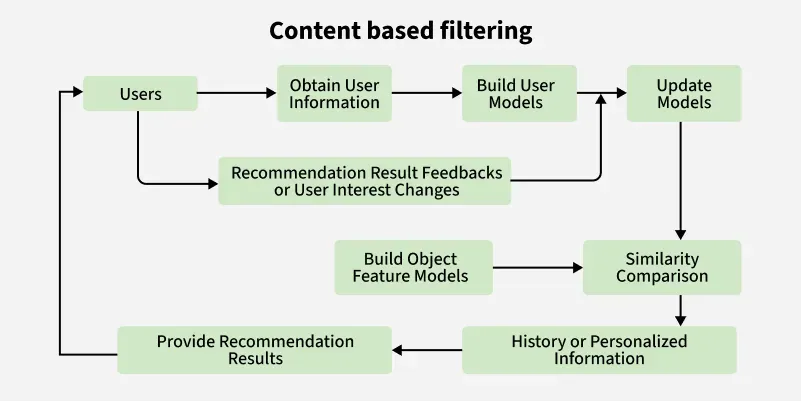
Content-Based Filtering (CBF) recommends items whose attributes resemble items a user has already engaged with. Instead of learning from the behavior of other users, it builds a profile of the target user purely from the features of the items in that user’s history.

The core hypothesis: if you liked items with certain attributes, you will like other items that share those attributes. A user who watched several documentaries by a particular director is shown that director’s other films.

This makes CBF a per-user model: each user has an independent profile, and recommendations never depend on the existence of a user community.

Content-Based Filtering for Recommendation Service (aka User-based Model)


How It Works (The Math)

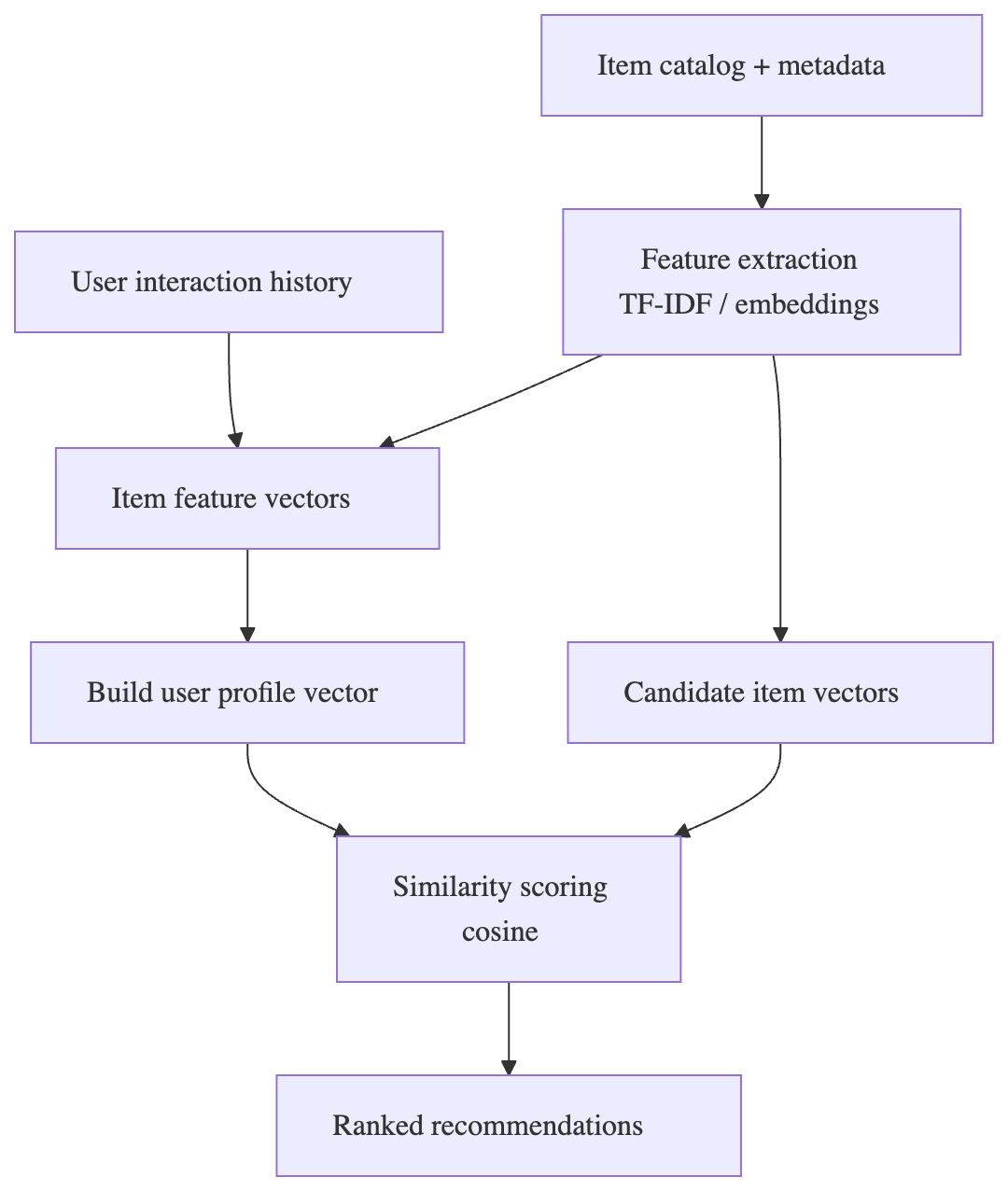
CBF has three stages: item representation, profile construction, and scoring.

1. Item representation

Each item i is converted to a feature vector vᵢ. Common encodings:

  • TF-IDF (Term Frequency–Inverse Document Frequency) over text (titles, descriptions, tags). For term t in document d:

    tfidf(t, d) = tf(t, d) · log(N / df(t))

    where N is the corpus size and df(t) the number of items containing t.

  • One-hot / multi-hot for categorical metadata (genre, brand, language).
  • Dense embeddings from a pretrained encoder (e.g., a text transformer for descriptions, a CNN — Convolutional Neural Network — or ViT — Vision Transformer — for images, audio embeddings for music).

2. User profile construction

The user profile pᵤ is an aggregate of the vectors of items the user interacted with, often weighted by rating or engagement:

pᵤ = ( Σ_{i ∈ Hᵤ} wᵤᵢ · vᵢ ) / ( Σ_{i ∈ Hᵤ} wᵤᵢ )

where Hᵤ is the user’s interaction history and wᵤᵢ the weight (rating, watch fraction, recency decay).

3. Scoring

Candidate items are ranked by similarity to the profile, typically cosine similarity:

score(u, i) = cos(pᵤ, vᵢ) = (pᵤ · vᵢ) / (‖pᵤ‖ · ‖vᵢ‖)

Alternatively, a supervised classifier/regressor (logistic regression, gradient-boosted trees) is trained per user or globally with the user profile as features, predicting the probability of a positive interaction.


Requirements

To deploy CBF you need:

  • Rich, structured item features. The quality ceiling of CBF is set by feature quality. Sparse or missing metadata caps performance.
  • A feature extraction pipeline. Text cleaning, tokenization, embedding inference, and normalization must run on every new item before it can be recommended.
  • Per-user history storage. Even a short interaction history is enough to seed a profile.
  • A similarity / retrieval index. For large catalogs, an Approximate Nearest Neighbor (ANN) index — e.g., FAISS (Facebook AI Similarity Search), ScaNN (Scalable Nearest Neighbors), or HNSW (Hierarchical Navigable Small World) — over item vectors enables sub-linear retrieval.
  • No dependency on other users, which is why CBF is attractive for cold-start communities and privacy-sensitive contexts.


Simplified Architecture

Content-Based Filtering for Recommendation Service (aka User-based Model)


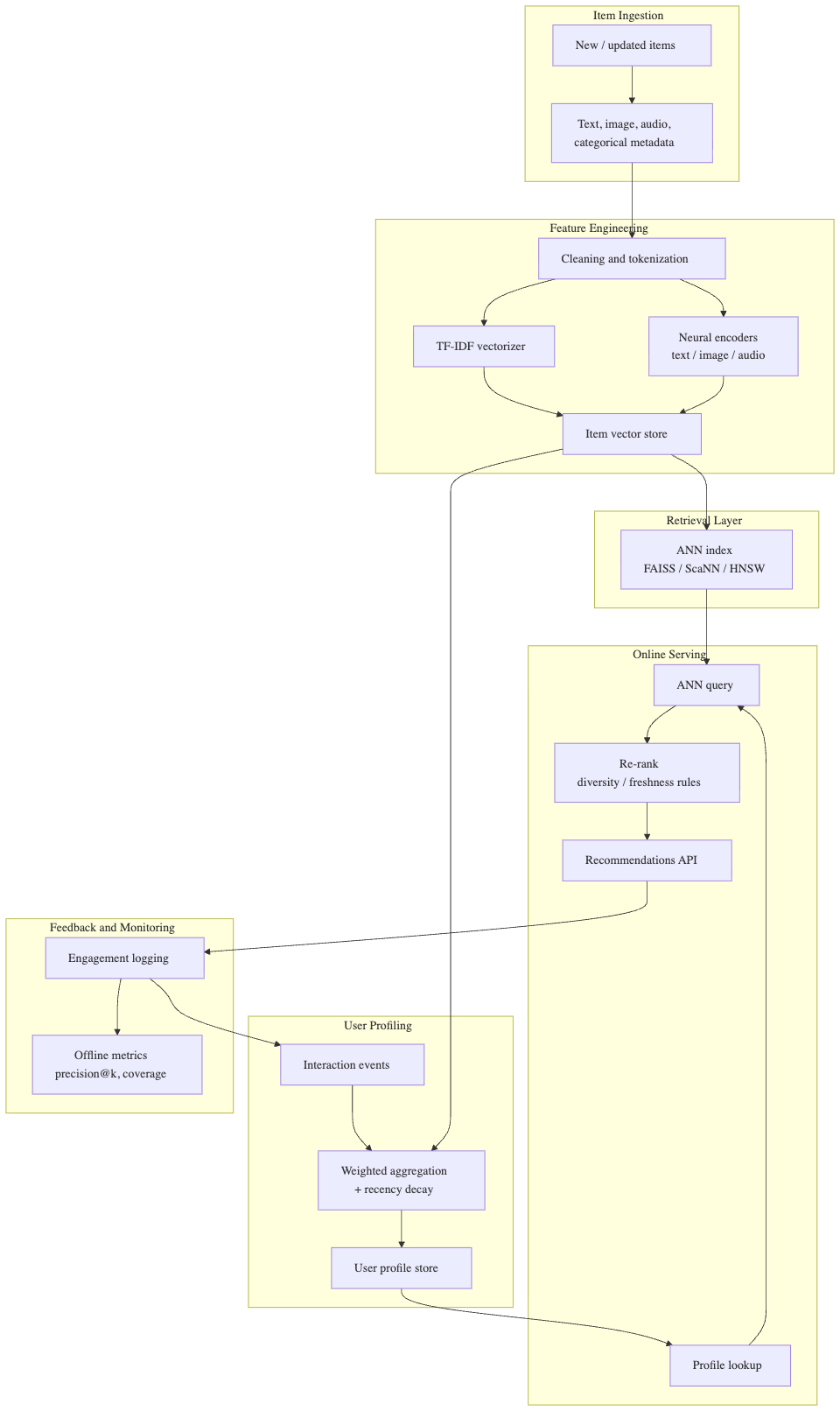
Reference Architecture

Content-Based Filtering for Recommendation Service (aka User-based Model)


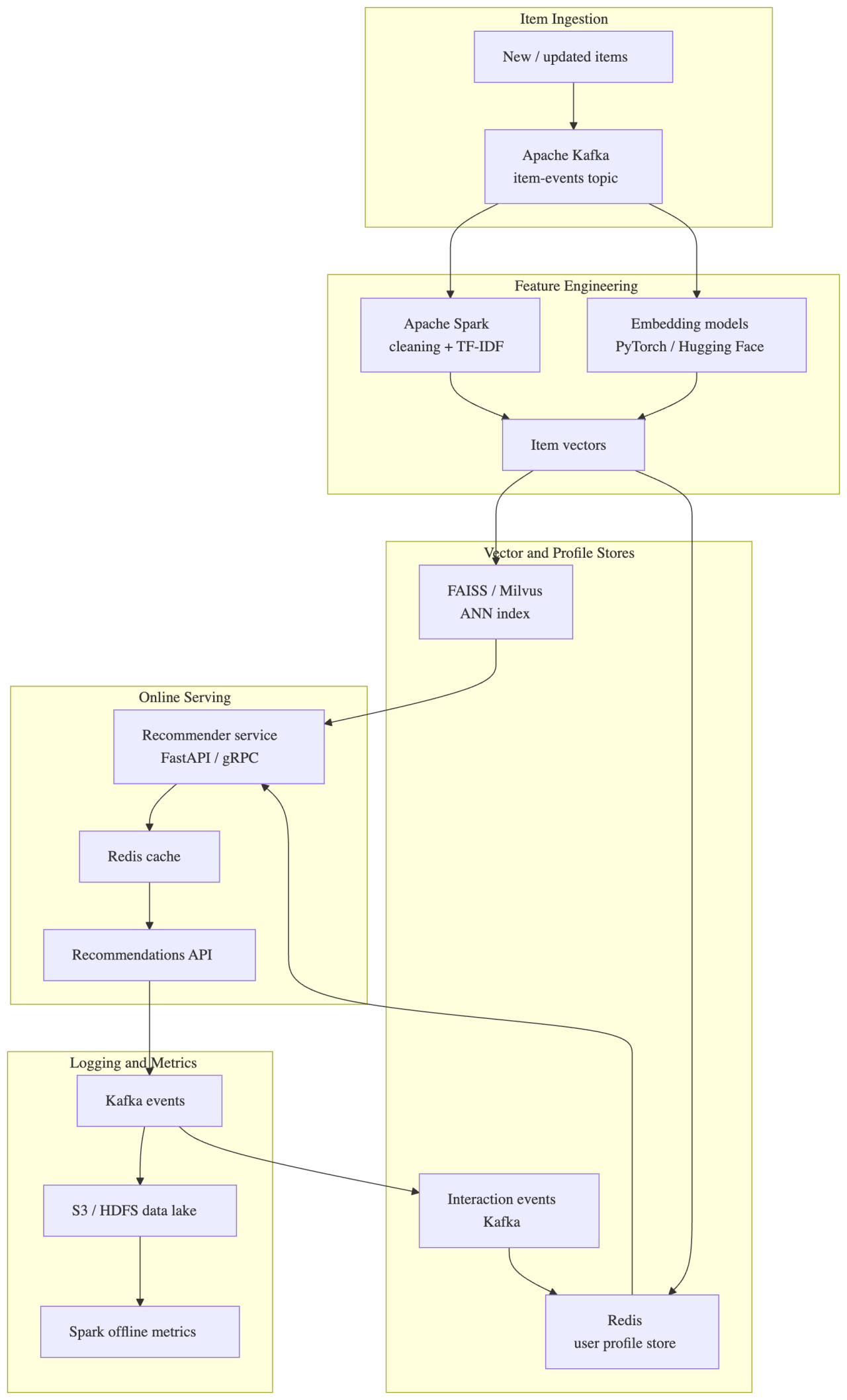
Reference Architecture (with Technology Stack)

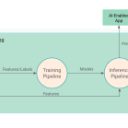
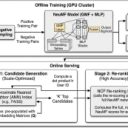
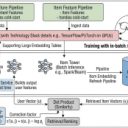
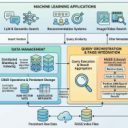
The same flow mapped onto common production technologies — Kafka for event streaming, Spark for batch feature jobs, Redis for the online profile store, and FAISS/Milvus for vector retrieval.

Content-Based Filtering for Recommendation Service (aka User-based Model)

PRO


Signals & Features

The most common feature families are item text (titles, descriptions, transcripts), structured metadata (genre, category, brand, price band, language), media embeddings (image/audio/video), and provenance signals (creator, publication date). On the user side, the only required signal is the item-interaction history, optionally enriched with explicit ratings and per-interaction weights such as dwell time or watch fraction.


Training & Serving Considerations

CBF often has no global training step when using pure similarity — profiles are computed on the fly. When a supervised model is layered on top (e.g., logistic regression predicting click probability from profile-item interaction features), training is standard offline batch learning with periodic refresh.

Serving cost is dominated by ANN retrieval and feature freshness. New items become recommendable as soon as their vectors are indexed, which is why CBF handles item cold-start gracefully — a key contrast with collaborative filtering.


Evaluation

Offline, CBF (Content-Based Filtering) is evaluated with ranking metrics: precision@k, recall@k, MAP (Mean Average Precision), and NDCG (Normalized Discounted Cumulative Gain) on held-out interactions. Because over-specialization is the dominant failure mode, teams also track catalog coverage, intra-list diversity, and novelty to detect filter-bubble behavior. Online, the decisive signals are A/B-tested click-through rate, engagement depth, and long-term retention.


Strengths & Weaknesses

Strengths: works for new users with even a little history; no dependence on a user community (no user cold-start); naturally handles new items; transparent and explainable (“recommended because it shares X with something you liked”).

Weaknesses: prone to over-specialization / filter bubbles — it rarely surfaces genuinely novel interests; quality is bounded by feature richness and requires significant feature-engineering investment; it cannot capture “users like you also enjoyed…” signals that drive serendipity.


When to Use It

Reach for content-based filtering when item metadata is rich and well-structured, when the catalog turns over quickly (news, job postings, listings) so item cold-start matters, when you cannot rely on cross-user data for privacy reasons, or as the content arm of a hybrid system that compensates for collaborative filtering’s cold-start gap.

Tags Cold Start Content-Based Filtering Feature Engineering Filter Bubbles Item Features Machine Learning Privacy Sensitive Recommendation Architecture Recommendation Systems Similarity Search User Profile Facebook X
Comments 0
Similar posts
  1. Memory-Based Collaborative Filtering for Recommendation Service
    193
  2. Common Recommendation Service Architecture
    532
  3. Model-Based CF: Matrix Factorization for Recommendation Service
    178
  4. Hybrid Methods for Recommendation Service
    217
  5. Neural Collaborative Filtering (NCF) for Recommendation Service
    241
  6. Sequence Models (RNN / Transformer) for Recommendation Service widely used at OTT and e-Commerce
    248
  7. Two-Tower Model for Recommendation Service having a Very Large Catalog
    263
  8. Wide & Deep / DeepFM for Recommendation Service (aka Ranking Service)
    252
  9. Harnessing the Power of Random Forest Algorithm in Python
    658
  10. Mastering Model Persistence: Saving and Loading Trained Machine Learning Models in Python
    1,156
  11. YouTube's Recommendation System
    263
  12. Reinforcement Learning–Based Methods for CTR Improvement based on Recommendation System
    265
  13. Understanding and Implementing K-Nearest Neighbors (KNN) Algorithm in Python
    633
  14. Forecasting the Weather with PyTorch: A Beginner's Guide to Temperature Prediction
    1,434
  15. Getting Started with PyTorch: A Beginner's Guide to Building Your First Neural Network
    800
  16. Mastering AI: A Beginner's Guide to Python Programming and Beyond
    1,034
  17. Forecasting with Linear Regression and KNN Regression in Python
    925
  18. Vector Databases: From Embeddings to Application
    315
  19. Image Embeddings for Vector Databases
    248
  20. Deep Dive into Vector Databases: Understanding Collections (Not Tables) and Embeddings
    232
  21. Machine Learning Models for Ad Detection from a Video Stream
    188
  22. FAISS Already Does ANN... So Why Do Top Teams Still Pay for SageMaker?
    309
  23. TikTok's Recommendation System - Monolith
    291
  24. Milvus & FAISS: Decoding Their ML Synergy
    278
  25. Getting Started with FAISS: A CentOS 7 Installation Guide
    280
  26. PyTorch example to Forcast Stock Price based on 10 days Dataset
    651
  27. Predicting Buyer Preferences with PyTorch: A Deep Learning Approach
    1,233
  28. Mastering Ad Budget Throttling: Static, PID, and ML Strategies
    321
  29. Ad Impression Forecasting (aka Ad Inventory Forecasting): Architecting for Scale, Speed, and Accuracy
    330
  30. Navigating the Ad Tech Cold Start: Simple Solutions for a Complex Problem
    333
  1. DeepSeek v3 offers of ChatGPT's performance at 1/10 the price!
    634
  2. Difference between CPU and GPU - Why GPU is faster than CPU?
    803
  3. gRPC - Open-source Universal RPC Framework developed by Google
    767
  4. Exploring the Depths of Data Transfer: sendfile vs. kTLS
    1,320
  5. How Netflix Ensures Smooth Streaming with Open Connect CDN
    2,129
  6. Public DNS (Domain Name Service) based on IPv4, IPv6 widely used
    1,242
  7. All Engineering Software Development How can you prioritize software design trade-offs when developing a new product?
    1,340
  8. MR(Mixed Reality) Game Programming based on Unity 3D
    1,356
  9. Temporal Programming Model - Robust, Long-Running, Fault-Tolerant Applications as WorkFlows
    352
  10. Cadence Programming Model - A Distributed, Fault-Tolerant, Stateful Workflow Orchestration Framework
    287
  11. Multi-AZ Kafka Architecture
    147
  12. Large-Scale Concurrency Control: Solving the DB Bottleneck from a Flood of “Likes”
    271
  13. Hybrid Methods for Recommendation Service
    217
  14. Model-Based CF: Matrix Factorization for Recommendation Service
    178
  15. Memory-Based Collaborative Filtering for Recommendation Service
    193
  16. Stateful Databases: A Deep Dive with Cassandra & TiDB
    187
  17. Why Kubernetes? Core Features and Microservice Orchestration Strategies
    574
  18. Quiz : Twice counter
    700
  19. Kubernetes, aka K8s, is an open-source container orchestration platform
    539
  20. Architecting for Resilience: AWS High Availability Components Including API Gateway
    137
  21. Is AWS API Gateway Disaster-Proof? DR, Benefits, and Multi-AZ Architecture Explained
    142
  22. FNC(Photo/Video File Name Changer) v1.1 Release - Date Time Bug Fix & Retry Function Added
    705
  23. Smart TV Cycling Apps – TV for Fitness
    808
  24. The public could reduce server cost, and enhance performance for global service distribution
    10,741
  25. Cloud gaming coming to Samsung Smart TVs
    557
  26. Kids App – Kids Learn While Parents Control on Samsung Smart TV
    762
  27. Fitness Hub presents your personal trainer, Fitness VOD on Samsung Smart TV
    520
  28. Word counting source program based on MapReduce framework
    692
  29. The leaders who created Smart TV
    812
  30. FNC(Photo/Video File Name Changer) v1.02 release - The file created date time information is available for those cameras providing incorrect EXIF data
    977
Recently updated
  1. Why 100% SEO Guarantees Better User Engagement and How to Achieve It in Your Service
    40
  2. Why SPF and DKIM Are Essential for Linux Email Servers?
    34
  3. How do I create animated background for Google Meet?
    20,611
  4. MaxMind GeoLite2 vs. DB-IP Lite vs. ip-api.com: Choosing the Right Free IP Geolocation Solution
    244
  5. Meet Valkey: Why Redis Changed Its License, Why Valkey is Better, and How to Use It as a Drop-in Replacement
    94
  6. How Rogue Web Scrapers Are Stealing My Content and Destroying My Server
    157
  7. Array of arguments passed to script in PHP
    90
  8. Invalid Auction Storms in Ad Tech
    98
  9. Building MRC-Compliant Instrumentation in Ad Tech: Implementation Steps and Key Challenges
    202
  10. The Two Clocks of Ad Server Architecture
    70
  11. Frequency Cap Architecture Overview
    514
  12. Collecting Proof-of-Play from 100,000 Screens
    146
  13. Vector Search in Relational Databases (RDBs): Trends & Usage Environments
    287
  14. What is RedisVL?
    109
  15. Designing a Skill Registry Architecture: Minimize Token Usage and Maximize AI Performance
    230
  16. TPU & GPU Cluster Management Tools
    243
  17. The Concept of Scaffolding in AI Agents
    233
  18. Beyond Static Pipelines: Architecting LLM Multi-Agent Systems for Autonomous Workflow Orchestration
    583
  19. AI-DLC vs. AI-SDLC: Model-Centric vs. System-Centric AI Development
    258
  20. Fine-Tuning Open-Weight LLMs: Training, Licensing, and Deploying Custom Models with Ollama
    339
  21. Inside the Next-Generation Streaming Architecture: Ultra-Low Latency, SGAI, and AI Codecs
    202
  22. Machine Learning: Training vs. Ranking
    221
  23. The Continuous Learning Machine: Designing a Loop That Actually Turns
    222
  24. The Next-Gen Low-Latency Standards: LL-HLS & MoQ
    195
  25. Designing a Data Curation System Around a Vector Database
    220
  26. Extracting Context from Live Video: The Architecture Got Simpler When We Stopped Building Features
    256
  27. The New Ad Stack Behind Live Sports Streaming: Inside SGAI, EABN, and the Standards Race to Fix Live Monetization
    656
  28. Designing MLOps Architectures to Handle Seasonal Data Drift in EV Fleet Models
    195
  29. From 15 to 40+ FPS: Accelerating PyTorch Object Detection on Automotive ECUs
    217
  30. Understanding Data Lineage
    260