Model-Based CF: Matrix Factorization for Recommendation Service

CK CK 3776 
Created at  
177 0 0

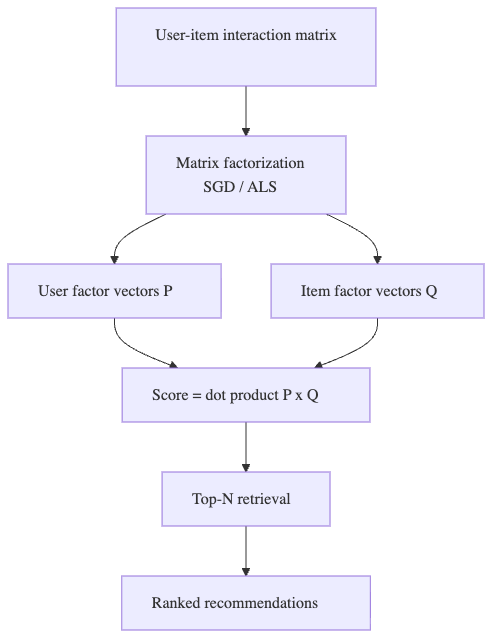
Model-Based Collaborative Filtering replaces the on-demand similarity lookups of memory-based CF with a compact learned model. The dominant family is Matrix Factorization (MF): the large, sparse user–item interaction matrix R (dimensions m × n) is decomposed into two low-rank matrices of latent factors — a user matrix P (m × k) and an item matrix Q (n × k), with k ≪ m, n.

Each user and item becomes a k-dimensional vector. These latent dimensions are not hand-defined; the model discovers them. They often correspond loosely to interpretable axes (e.g., “how much sci-fi”, “how mainstream”), but in general they are abstract taste directions.


How It Works (The Math)

A predicted interaction is the dot product of the user and item factor vectors:

r̂_{u,i} = pᵤ · qᵢ = Σ_{f=1}^{k} p_{u,f} · q_{i,f}

A fuller model adds bias terms for global mean, user, and item:

r̂_{u,i} = μ + b_u + b_i + pᵤ · qᵢ

Learning objective

Minimize regularized squared error over observed ratings only:

min_{P,Q,b} Σ_{(u,i) ∈ observed} ( r_{u,i} − μ − b_u − b_i − pᵤ·qᵢ )² + λ ( ‖pᵤ‖² + ‖qᵢ‖² + b_u² + b_i² )

Optimization methods

  • SGD (Stochastic Gradient Descent): iterate over observed pairs, update factors along the gradient. Flexible, the basis of the “FunkSVD” approach popularized in the Netflix Prize.
  • ALS (Alternating Least Squares): fix Q, solve the convex least-squares problem for P; then fix P, solve for Q; repeat. Each half-step has a closed form and parallelizes well — the workhorse for implicit-feedback data at scale (Spark MLlib’s recommender).

Implicit feedback (the weighted variant)

For clicks/watches rather than explicit ratings, the Hu–Koren–Volinsky formulation introduces a preference p_{u,i} ∈ {0,1} and a confidence c_{u,i} = 1 + α·r_{u,i} (higher confidence for more interactions), optimizing over all user–item pairs:

min Σ_{u,i} c_{u,i} ( p_{u,i} − pᵤ·qᵢ )² + λ ( ‖pᵤ‖² + ‖qᵢ‖² )


Requirements

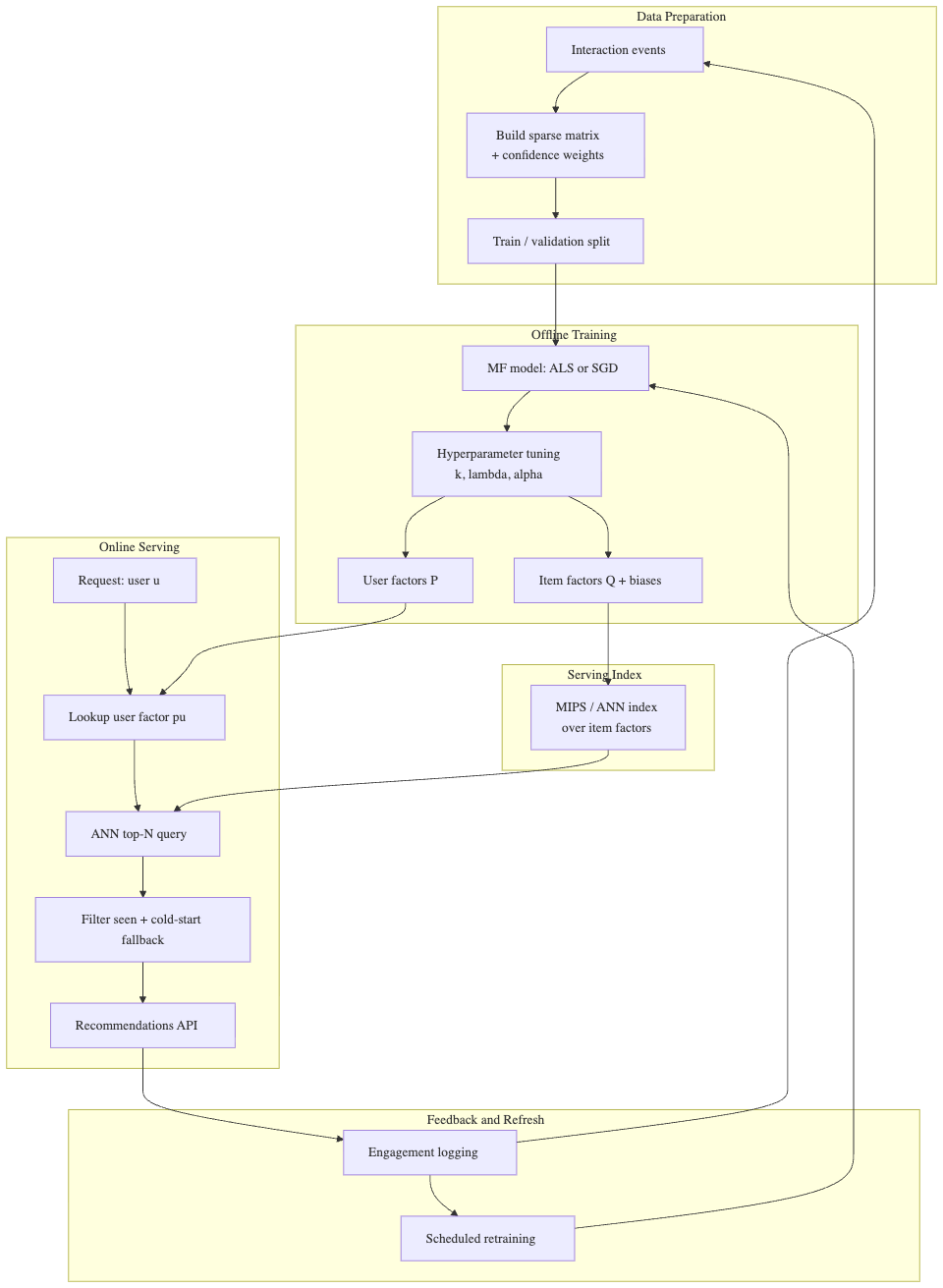
  • A user–item interaction matrix, explicit (ratings) or implicit (clicks/watches with confidence weighting).
  • An offline training pipeline capable of SGD or ALS over potentially billions of interactions.
  • Hyperparameter tuning: latent dimension k, regularization λ, learning rate / ALS iterations, and α for implicit confidence.
  • A factor store and retrieval layer. Serving top-N requires a maximum-inner-product search (MIPS) over item factors — typically an ANN index.
  • A cold-start strategy. Brand-new users/items have no learned factors and need fallbacks (popularity, content features, or a hybrid model).


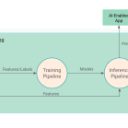
Simplified Architecture

Model-Based CF: Matrix Factorization for Recommendation Service


Reference Architecture

Model-Based CF: Matrix Factorization for Recommendation Service


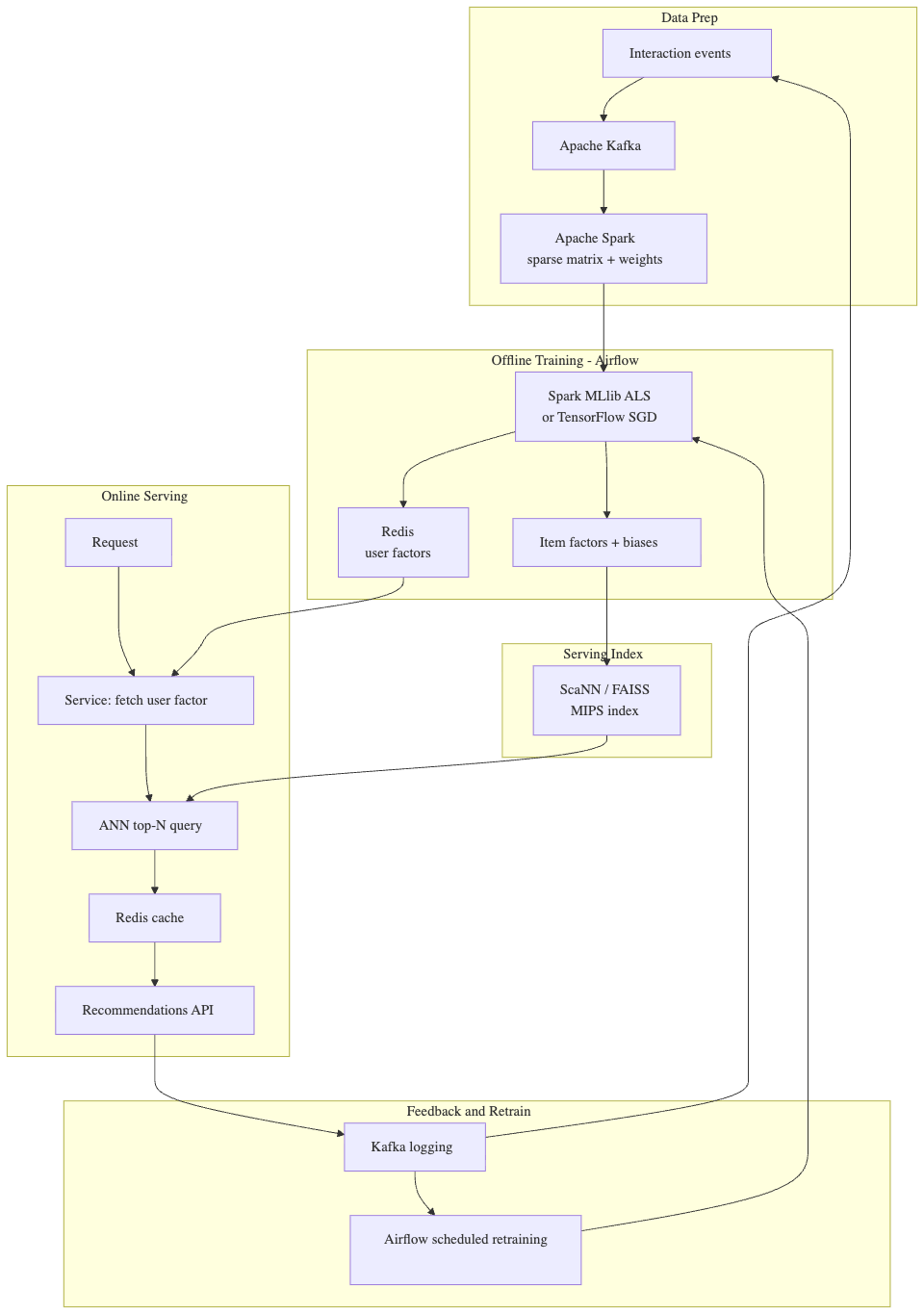
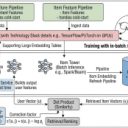
Reference Architecture (with Technology Stack)

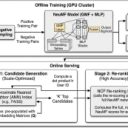
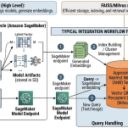
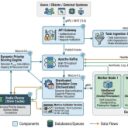
The same flow on concrete tooling — Spark MLlib (ALS) or TensorFlow for training, Redis for user factors, ScaNN/FAISS for the item MIPS index, and Airflow for scheduled retraining.

Model-Based CF: Matrix Factorization for Recommendation Service


Signals & Features

Classic MF uses only the interaction matrix — IDs and rating/engagement values, no side features. This purity is what makes the model so general, but it is also the root of the cold-start problem. Extensions (SVD++ — an extension of Singular Value Decomposition that incorporates implicit feedback — and factorization machines) fold in implicit feedback and side features, blurring the line toward hybrid and deep approaches.


Training & Serving Considerations

Training is offline and periodic (hourly to daily). ALS distributes naturally across a cluster and handles implicit data robustly; SGD is more flexible for custom loss terms. Because factor vectors drift as tastes change, scheduled retraining is essential. At serving time, exact top-N over millions of items is infeasible per request, so item factors are loaded into a MIPS/ANN index and the user vector queries it. New users/items must be routed to fallbacks until the next training run incorporates their interactions — or handled by a folding-in approximation.


Evaluation

Explicit-feedback MF is benchmarked with RMSE (Root Mean Square Error) / MAE (Mean Absolute Error) (the Netflix Prize metric was RMSE); implicit-feedback and top-N settings use recall@k, MAP (Mean Average Precision), NDCG (Normalized Discounted Cumulative Gain), and AUC (Area Under the ROC Curve). Track coverage and cold-start hit rate to quantify the method’s known blind spots, and validate with temporal splits (train on past, test on future) to avoid leakage that inflates offline numbers.


Strengths & Weaknesses

Strengths: handles sparsity far better than memory-based CF by generalizing through latent factors; captures non-obvious taste dimensions; compact and scalable with ALS/SGD; fast dot-product serving via ANN.

Weaknesses: cold-start for new users and new items (no factors learned yet); latent factors are hard to interpret; the basic model is linear in latent space (a single dot product) and misses complex, non-linear feature interactions — the gap that deep models later filled.


When to Use It

Matrix factorization is the canonical workhorse for medium-to-large recommendation problems with abundant interaction data and limited side features — e-commerce, media catalogs, music. It remains a strong, cheap-to-serve baseline and frequently survives inside modern stacks as a candidate-generation source feeding a deep ranking layer, or as one signal in a hybrid ensemble.

Tags ALS Algorithm Cold Start Collaborative Filtering Implicit Feedback Latent Factors Machine Learning Matrix Factorization Recommendation Architecture Recommendation Engine Recommender Systems SGD Optimization Facebook X
Comments 0
Similar posts
  1. Memory-Based Collaborative Filtering for Recommendation Service
    185
  2. Hybrid Methods for Recommendation Service
    211
  3. Content-Based Filtering for Recommendation Service (aka User-based Model)
    187
  4. Neural Collaborative Filtering (NCF) for Recommendation Service
    234
  5. Sequence Models (RNN / Transformer) for Recommendation Service widely used at OTT and e-Commerce
    239
  6. Common Recommendation Service Architecture
    523
  7. Two-Tower Model for Recommendation Service having a Very Large Catalog
    253
  8. Wide & Deep / DeepFM for Recommendation Service (aka Ranking Service)
    245
  9. Harnessing the Power of Random Forest Algorithm in Python
    656
  10. Mastering Model Persistence: Saving and Loading Trained Machine Learning Models in Python
    1,152
  11. YouTube's Recommendation System
    257
  12. Reinforcement Learning–Based Methods for CTR Improvement based on Recommendation System
    258
  13. Understanding and Implementing K-Nearest Neighbors (KNN) Algorithm in Python
    629
  14. Forecasting the Weather with PyTorch: A Beginner's Guide to Temperature Prediction
    1,427
  15. Getting Started with PyTorch: A Beginner's Guide to Building Your First Neural Network
    797
  16. Mastering AI: A Beginner's Guide to Python Programming and Beyond
    1,031
  17. Forecasting with Linear Regression and KNN Regression in Python
    919
  18. Vector Databases: From Embeddings to Application
    309
  19. Machine Learning Models for Ad Detection from a Video Stream
    184
  20. FAISS Already Does ANN... So Why Do Top Teams Still Pay for SageMaker?
    307
  21. TikTok's Recommendation System - Monolith
    284
  22. Milvus & FAISS: Decoding Their ML Synergy
    275
  23. PyTorch example to Forcast Stock Price based on 10 days Dataset
    651
  24. Predicting Buyer Preferences with PyTorch: A Deep Learning Approach
    1,228
  25. Mastering Ad Budget Throttling: Static, PID, and ML Strategies
    315
  26. Ad Impression Forecasting (aka Ad Inventory Forecasting): Architecting for Scale, Speed, and Accuracy
    327
  27. Navigating the Ad Tech Cold Start: Simple Solutions for a Complex Problem
    330
  28. AI-Powered Ad Fraud Detection: Architectural Strategies
    331
  29. Brand Safety: AI-Driven Content Moderation on AWS
    703
  30. Building a MCP server in PHP
    624
  1. Apache Kafka - a distributed, fault-tolerant, high-throughput streaming platform
    611
  2. Comprehensive Software Development Flow : How Companies Ship Code To Production
    2,307
  3. DeepSeek v3 offers of ChatGPT's performance at 1/10 the price!
    632
  4. Difference between CPU and GPU - Why GPU is faster than CPU?
    801
  5. gRPC - Open-source Universal RPC Framework developed by Google
    766
  6. Exploring the Depths of Data Transfer: sendfile vs. kTLS
    1,314
  7. How Netflix Ensures Smooth Streaming with Open Connect CDN
    2,124
  8. Public DNS (Domain Name Service) based on IPv4, IPv6 widely used
    1,239
  9. All Engineering Software Development How can you prioritize software design trade-offs when developing a new product?
    1,338
  10. MR(Mixed Reality) Game Programming based on Unity 3D
    1,352
  11. Temporal Programming Model - Robust, Long-Running, Fault-Tolerant Applications as WorkFlows
    349
  12. Cadence Programming Model - A Distributed, Fault-Tolerant, Stateful Workflow Orchestration Framework
    284
  13. Multi-AZ Kafka Architecture
    140
  14. Large-Scale Concurrency Control: Solving the DB Bottleneck from a Flood of “Likes”
    268
  15. Hybrid Methods for Recommendation Service
    211
  16. Memory-Based Collaborative Filtering for Recommendation Service
    185
  17. Content-Based Filtering for Recommendation Service (aka User-based Model)
    187
  18. Stateful Databases: A Deep Dive with Cassandra & TiDB
    185
  19. Why Kubernetes? Core Features and Microservice Orchestration Strategies
    568
  20. Quiz : Twice counter
    700
  21. Kubernetes, aka K8s, is an open-source container orchestration platform
    538
  22. Architecting for Resilience: AWS High Availability Components Including API Gateway
    132
  23. Is AWS API Gateway Disaster-Proof? DR, Benefits, and Multi-AZ Architecture Explained
    138
  24. FNC(Photo/Video File Name Changer) v1.1 Release - Date Time Bug Fix & Retry Function Added
    699
  25. Smart TV Cycling Apps – TV for Fitness
    807
  26. The public could reduce server cost, and enhance performance for global service distribution
    10,738
  27. Cloud gaming coming to Samsung Smart TVs
    554
  28. Kids App – Kids Learn While Parents Control on Samsung Smart TV
    758
  29. Fitness Hub presents your personal trainer, Fitness VOD on Samsung Smart TV
    518
  30. Word counting source program based on MapReduce framework
    690
Recently updated
  1. How do I create animated background for Google Meet?
    18,998
  2. MaxMind GeoLite2 vs. DB-IP Lite vs. ip-api.com: Choosing the Right Free IP Geolocation Solution
    192
  3. Meet Valkey: Why Redis Changed Its License, Why Valkey is Better, and How to Use It as a Drop-in Replacement
    75
  4. How Rogue Web Scrapers Are Stealing My Content and Destroying My Server
    151
  5. Array of arguments passed to script in PHP
    83
  6. Invalid Auction Storms in Ad Tech
    91
  7. Building MRC-Compliant Instrumentation in Ad Tech: Implementation Steps and Key Challenges
    194
  8. The Two Clocks of Ad Server Architecture
    61
  9. Frequency Cap Architecture Overview
    505
  10. Collecting Proof-of-Play from 100,000 Screens
    139
  11. Vector Search in Relational Databases (RDBs): Trends & Usage Environments
    276
  12. What is RedisVL?
    102
  13. Designing a Skill Registry Architecture: Minimize Token Usage and Maximize AI Performance
    218
  14. TPU & GPU Cluster Management Tools
    229
  15. The Concept of Scaffolding in AI Agents
    217
  16. Beyond Static Pipelines: Architecting LLM Multi-Agent Systems for Autonomous Workflow Orchestration
    568
  17. AI-DLC vs. AI-SDLC: Model-Centric vs. System-Centric AI Development
    246
  18. Fine-Tuning Open-Weight LLMs: Training, Licensing, and Deploying Custom Models with Ollama
    321
  19. Inside the Next-Generation Streaming Architecture: Ultra-Low Latency, SGAI, and AI Codecs
    196
  20. Machine Learning: Training vs. Ranking
    200
  21. The Continuous Learning Machine: Designing a Loop That Actually Turns
    212
  22. The Next-Gen Low-Latency Standards: LL-HLS & MoQ
    188
  23. Designing a Data Curation System Around a Vector Database
    212
  24. Extracting Context from Live Video: The Architecture Got Simpler When We Stopped Building Features
    228
  25. The New Ad Stack Behind Live Sports Streaming: Inside SGAI, EABN, and the Standards Race to Fix Live Monetization
    646
  26. Designing MLOps Architectures to Handle Seasonal Data Drift in EV Fleet Models
    179
  27. From 15 to 40+ FPS: Accelerating PyTorch Object Detection on Automotive ECUs
    203
  28. Understanding Data Lineage
    251
  29. System Requirements and Architecture: Intelligent Priority-Based Scheduler
    159
  30. GPU & LLM Cluster Infrastructure & Task Scheduling Architecture
    229