Building Privacy-First Infrastructure: Network Isolation + Zero Trust for GDPR Compliance
CK 3788 Created at
29400
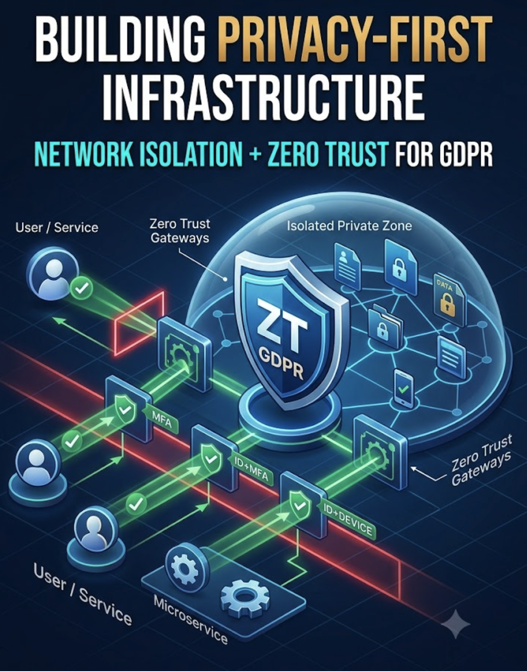
When you handle EU personal data, “trust but verify” is no longer enough. The modern baseline is “never trust, always verify” — combined with hard network isolation so that even a breached perimeter doesn’t expose regulated data. This post lays out the foundational infrastructure for a GDPR-aligned Network Isolation + Zero Trust environment, drawn in three diagram modes.
1. Why Network Isolation and Zero Trust?
GDPR doesn’t prescribe a specific architecture, but its principles — data minimization, purpose limitation, integrity & confidentiality (Art. 5), and security of processing (Art. 32) — push you toward a design where:
Personal data lives in isolated network segments that have no direct path to the public internet.
Every access request is authenticated, authorized, and encrypted, regardless of where it originates (“never trust the network”).
Access is least-privilege and auditable, so you can prove who accessed what personal data, when, and why.
Network Isolation contains the blast radius. Zero Trust ensures that being “inside” the network grants no implicit privilege. Together they give you defense-in-depth and the audit trail regulators expect.
2. Core Building Blocks
Block
Purpose
Identity Provider (IdP)
Central authentication, MFA, SSO — the root of trust
Policy Decision/Enforcement Point (PDP/PEP)
Evaluates and enforces every access request
Public / Private Subnet split
Only proxies/gateways are public; workloads and data stay private
Isolated Data Zone
Regulated personal data, reachable only through controlled paths
Encryption (in transit & at rest)
TLS/mTLS everywhere; KMS-managed keys for data at rest
Centralized Logging & Audit
Immutable trail for accountability and DSAR/breach response
Secrets & Key Management
No static credentials in code; short-lived, rotated secrets
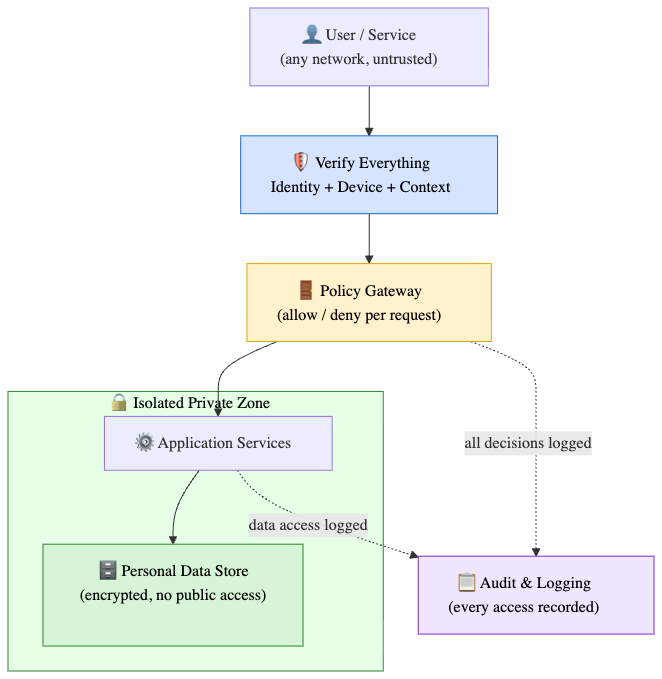
3. Architecture — Mode 1: Simplified View
The big picture for stakeholders, DPOs, and onboarding. Shows the trust boundary at a glance.
One-line summary: Nobody is trusted by default. Every request is verified, passed through a policy gateway, and logged — and personal data sits in a sealed zone with no direct internet path.
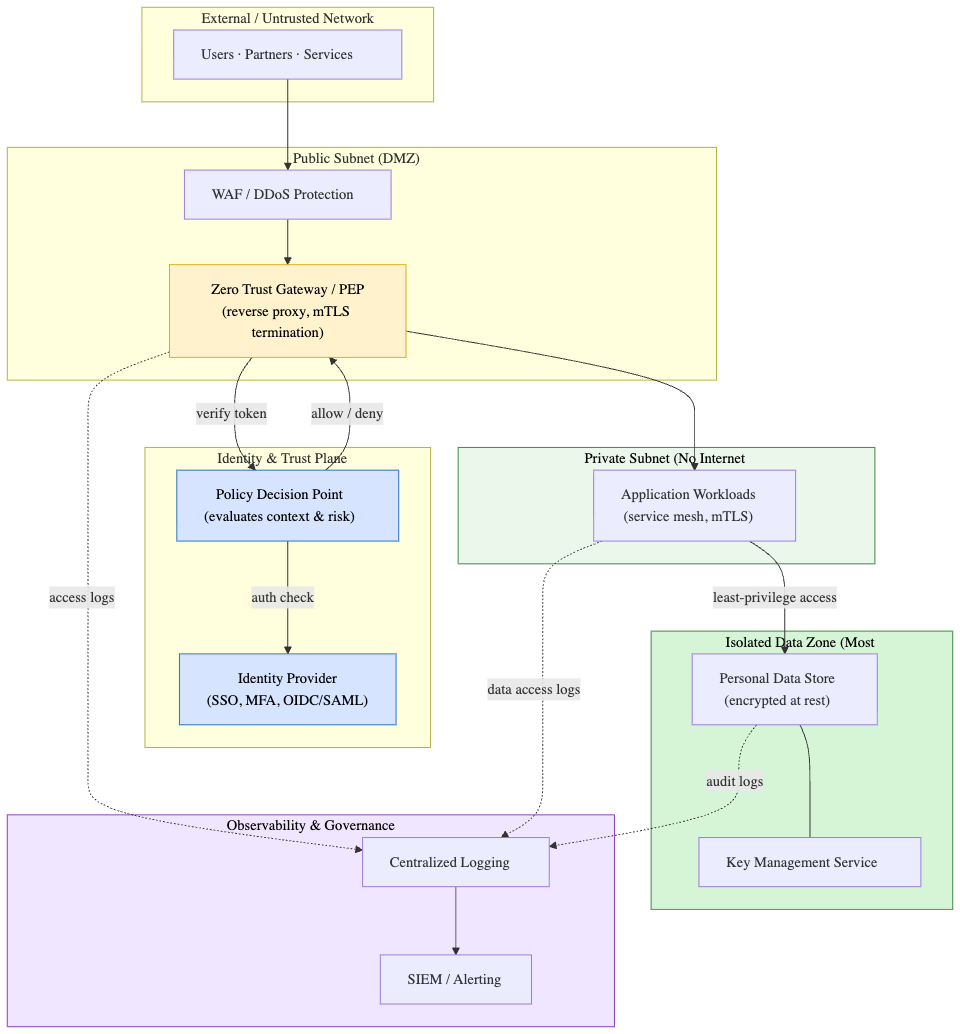
4. Architecture — Mode 2: Reference View
Component roles and traffic flow across network tiers. For design reviews and security architecture documentation.
PR
Tier Responsibilities
Tier
Role
Identity & Trust Plane
Central authN/authZ; risk-aware policy decisions
Public Subnet (DMZ)
Only internet-facing tier; WAF + Zero Trust gateway, no business data
Private Subnet
Workloads with no inbound internet route; mutual TLS between services
Isolated Data Zone
Most restricted segment; personal data + KMS, reachable only via app tier
Observability
Immutable logs feeding SIEM for detection and compliance evidence
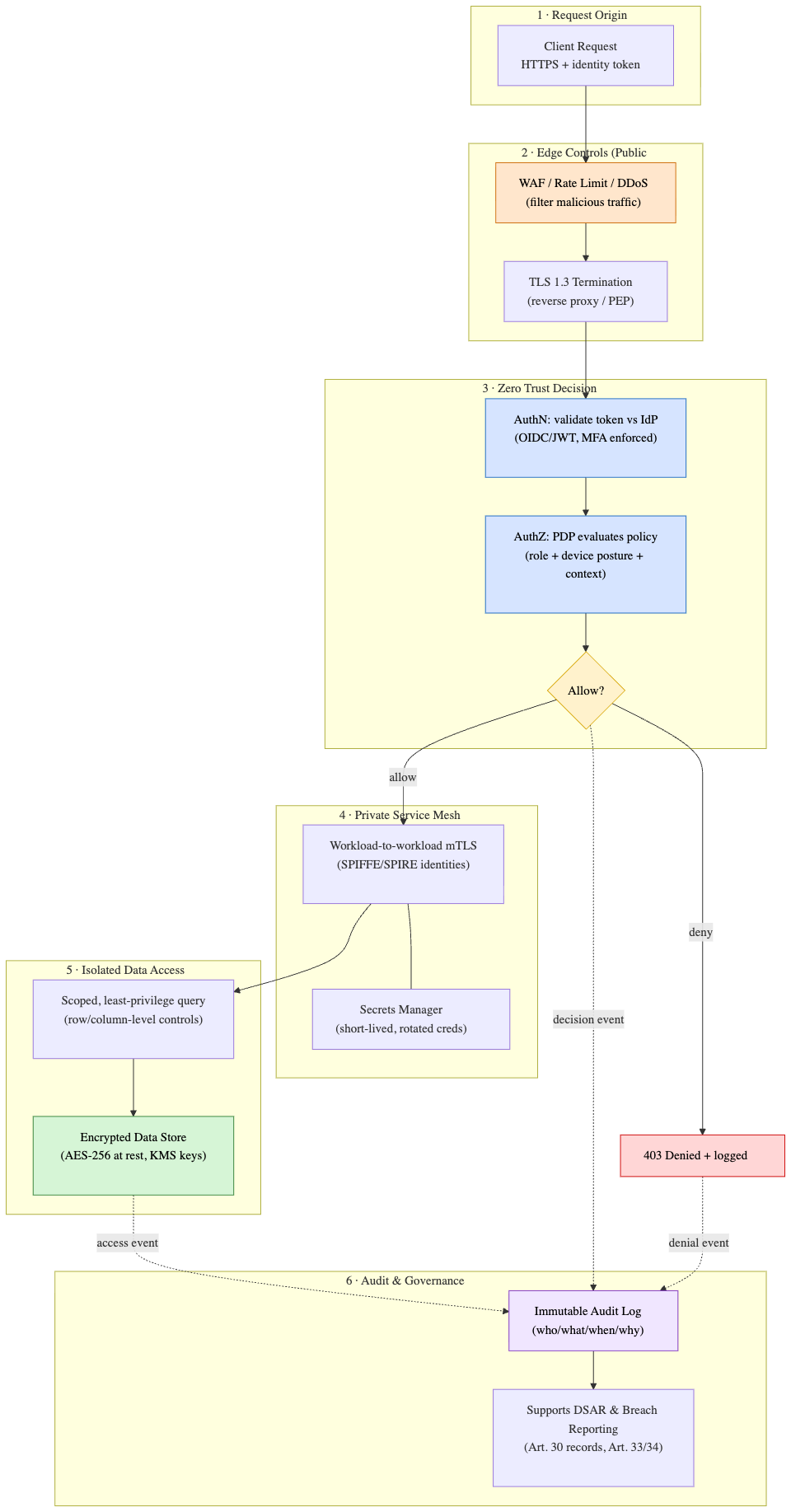
5. Architecture — Mode 3: Technical View
Implementation-level detail: request lifecycle, network controls, encryption boundaries, and the GDPR control mapped to each step. For engineers and security teams building it.
PRO
Implementation Notes
Identity as the perimeter There is no “trusted network.” Every request — even service-to-service traffic inside the private subnet — carries a verifiable identity (JWT for users, SPIFFE/SPIRE or mTLS certs for workloads). The IdP enforces MFA; the PDP makes a per-request decision based on role, device posture, and context.
Hard network isolation The personal-data store has no public IP and no internet egress. It accepts connections only from the application tier within the private subnet, which in turn is only reachable through the Zero Trust gateway in the DMZ. A compromised public component cannot reach regulated data directly.
Encryption everywhere TLS 1.3 in transit at the edge, mTLS between internal services, and AES-256 at rest with keys held in a managed KMS (separated from the data, with rotation and access policies). This directly supports GDPR Art. 32’s “encryption of personal data.”
Least privilege & data minimization Queries are scoped — row- and column-level access controls ensure each service reads only the personal data it needs for its stated purpose, reflecting GDPR’s data-minimization and purpose-limitation principles.
Accountability by design Every decision and data-access event flows to an immutable audit log. This is what lets you answer a Data Subject Access Request (DSAR), maintain Art. 30 records of processing, and meet the 72-hour breach-notification duty (Art. 33/34) with evidence rather than guesswork.
Note: Architecture supports compliance but does not by itself constitute compliance. Legal bases for processing, consent management, DPAs with processors, and data-residency choices remain organizational responsibilities.
7. Data Protection: Defending the Data Itself
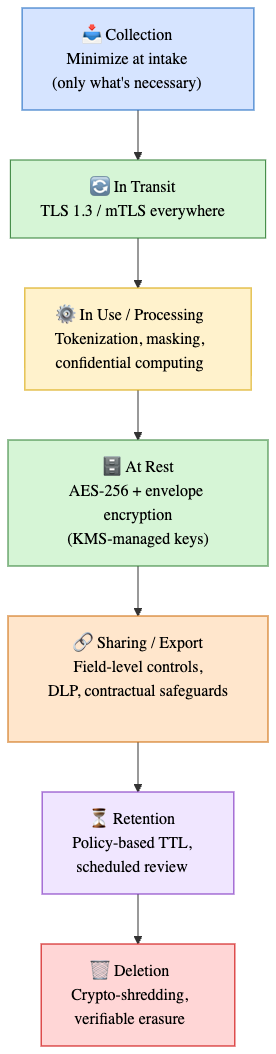
Network isolation and Zero Trust guard the paths to data. But a complete privacy posture must also protect the data itself — at every stage of its lifecycle and even in the event that an attacker gets past the controls above. This is the principle of defense in depth: assume any single layer can fail, and ensure personal data stays protected anyway.
7.1 Protect Data Across Its Full Lifecycle
PRO
7.2 Core Data Protection Techniques
Technique
What It Does
When to Use
Encryption at rest
AES-256 with KMS-managed keys; envelope encryption
Always, for any stored personal data
Encryption in transit
TLS 1.3 externally, mTLS between services
Every network hop, no exceptions
Tokenization
Replaces sensitive values with non-sensitive tokens; original kept in a secured vault
Payment data, IDs reused across systems
Data masking
Hides/obscures fields for non-privileged viewers (e.g., ****1234)
Support tools, lower environments, analytics UIs
Pseudonymization
Separates identifiers from data; re-linkable only with a key (GDPR Art. 4(5), Art. 25)
Analytics, ML training, internal processing
Anonymization
Irreversibly strips identifiability; data leaves GDPR scope
Published datasets, long-term aggregates
Field-/row-level access
Each service sees only the columns/rows it needs
Enforcing data minimization in practice
Confidential computing
Encrypts data even while in use (in-memory, in enclaves)
Highest-sensitivity processing
7.3 Key Management — The Linchpin
Encryption is only as strong as its key management. A few non-negotiables:
Separate keys from data. Keys live in a dedicated KMS/HSM, never alongside the ciphertext they protect.
Envelope encryption. Data keys are themselves encrypted by a root key, enabling fast rotation without re-encrypting everything.
Rotation and revocation. Keys rotate on a schedule; compromised keys can be revoked, instantly rendering the protected data unreadable.
Crypto-shredding. To “delete” data irreversibly (supporting GDPR’s right to erasure, Art. 17), destroy the key — the ciphertext becomes permanently unrecoverable without bulk deletion.
7.4 Data Loss Prevention & Discovery
You cannot protect what you cannot see. Two operational practices close the loop:
Data discovery & classification. Automatically scan stores to locate and tag personal/special-category data, so protection policies apply consistently (and you can answer “where does this person’s data live?” for a DSAR).
Data Loss Prevention (DLP). Monitor and block unauthorized exfiltration — e.g., personal data leaving via email, exports, or API responses — at egress points.
7.5 Mapping to GDPR
GDPR Requirement
Data Protection Control
Data Protection by Design & Default (Art. 25)
Minimization at collection, pseudonymization, default-encrypted stores
Classification catalog + audit logs of data handling
Key insight: Zero Trust answers “who can reach the data.” Data protection answers “what happens if they reach it anyway.” GDPR-grade privacy needs both — the second layer is what turns a breach of access into a non-event for the data subject.
8. Is It Hard to Connect? The User Access Experience
A common worry is that Zero Trust makes daily access painful. In practice, a well-built Zero Trust environment is usually simpler for the end user — the complexity is pushed down into infrastructure and operations. The answer depends on whose perspective you take.
For the End User (Employee) — Often Simpler
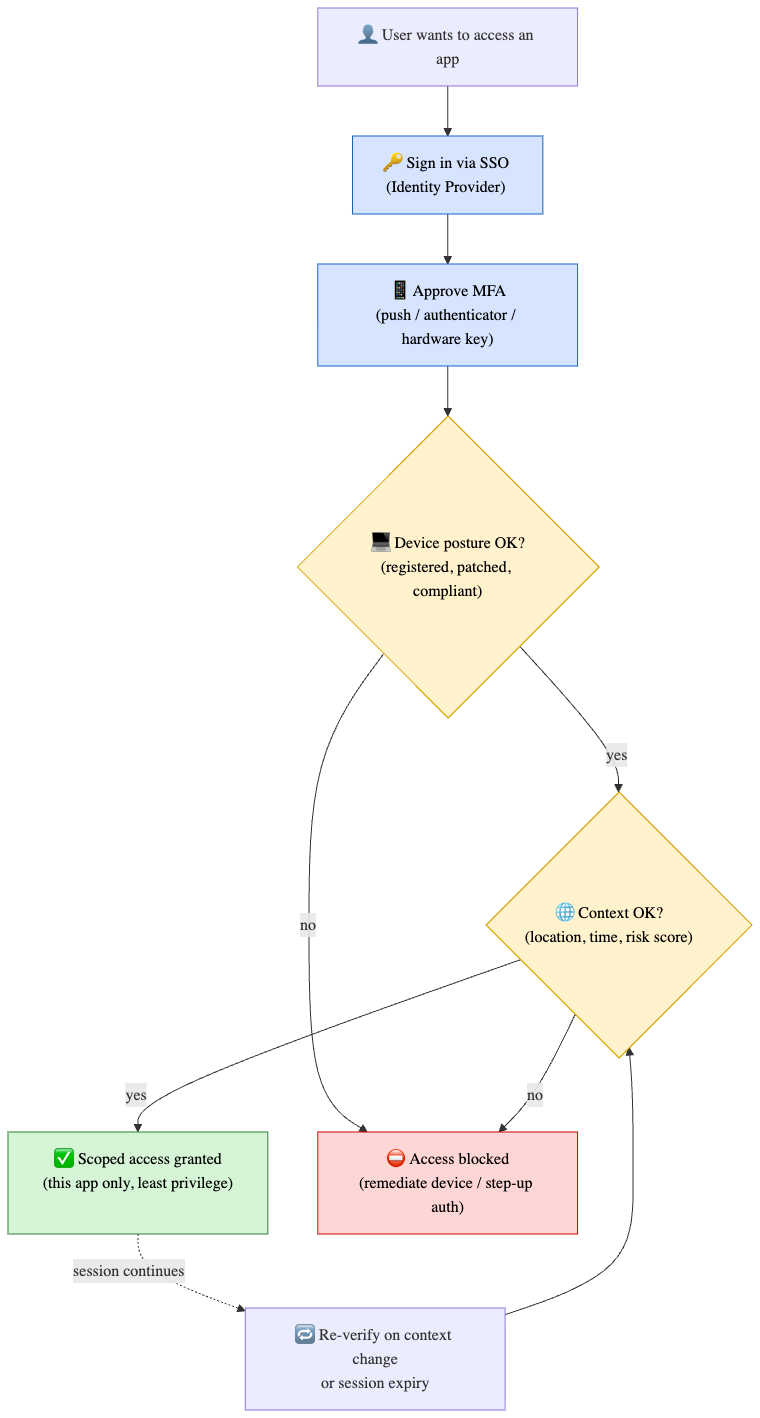
The traditional flow meant launching a heavy VPN client, joining the corporate network, then logging in separately to each system. Zero Trust actually reduces this friction:
One SSO + MFA unlocks many applications — no need to memorize a different password per system.
VPN shrinks or disappears. With ZTNA (Zero Trust Network Access), instead of a broad VPN tunnel, only authenticated, per-application connections open. The user just reaches the app through a browser or a lightweight agent.
A typical connection is simply: log in → approve MFA (one phone push) → access. It feels much like signing into any modern SaaS product.
The Connection Flow
PRO
The Friction Users Do Accept
It isn’t entirely free. A few intentional points of friction remain:
MFA is always required. Users must keep a push approval, authenticator app, or hardware key (e.g., YubiKey) on hand.
Device registration and management are prerequisites. Zero Trust validates device posture, so an unregistered or unpatched machine may be denied access.
Re-authentication and session expiry happen more often. If context changes (location, time, risk), the system may prompt to verify again.
These are deliberate, security-driven trade-offs rather than accidental inconvenience.
Where Did the Complexity Go? — The Operations View
The simplicity users feel is paid for by the infrastructure team. Standing up and maintaining the IdP, PDP/PEP, service mesh (mTLS), KMS, and SIEM — plus policy upkeep — is genuinely complex. Automated issuance and rotation of short-lived credentials, device-enrollment pipelines, and policy-engine tuning all carry real operational weight without mature automation.
Complexity by Perspective
Perspective
Complexity
End user
Low — SSO+MFA streamlines access, though MFA and device management are mandatory
External partner / vendor
Medium — may require guest IdP federation or separate onboarding
Infrastructure / security team
High — this is where most of the complexity concentrates
In one line: the goal of well-designed Zero Trust is to be “easier for the user, more sophisticated for the operator.”
9. Trade-offs — Security vs. Operational Cost
Zero Trust + Network Isolation raises the bar on operational complexity: more moving parts (IdP, PDP/PEP, service mesh, KMS, SIEM), more latency per request from verification steps, and a steeper learning curve for teams. Short-lived credentials and per-request policy checks demand mature automation; done manually, they break.
The payoff is a drastically smaller blast radius and demonstrable compliance. A leaked credential or a breached edge component no longer means exposed personal data, and you can prove your security posture to regulators with logs rather than assertions.
In short: you trade upfront engineering investment and some runtime overhead for containment, auditability, and regulatory defensibility — a trade that strongly favors any organization processing EU personal data at scale.
This post outlines a foundational reference pattern. Real deployments must be tailored to your cloud provider, data-residency requirements, threat model, and the specific categories of personal data you process. Consult your DPO and legal team for compliance decisions.