ETL vs ELT what makes the differeence? Why MLOps leverage ELT?
CK 3788 Created at
19600
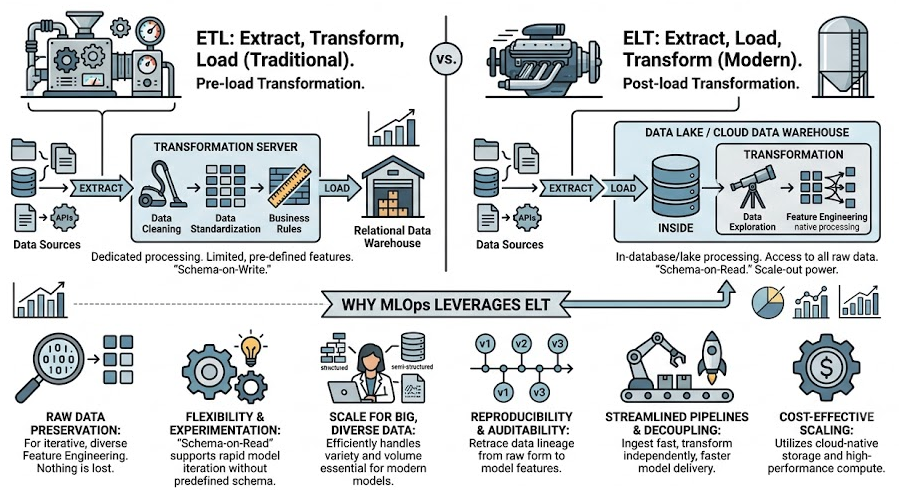
ETL (Extract, Transform, Load) transforms data before loading it into a destination, while ELT (Extract, Load, Transform) first loads raw data into the target system and performs transformations within it, leveraging the destination's computational power. MLOps adopts ELT because it provides access to the full, raw dataset, crucial for diverse feature engineering and model iteration without needing predefined transformations, offering enhanced flexibility for experimentation and scalability as modern data lakes and warehouses efficiently handle the large, varied datasets essential for training and deploying machine learning models.
ETL (Extract, Transform, Load)
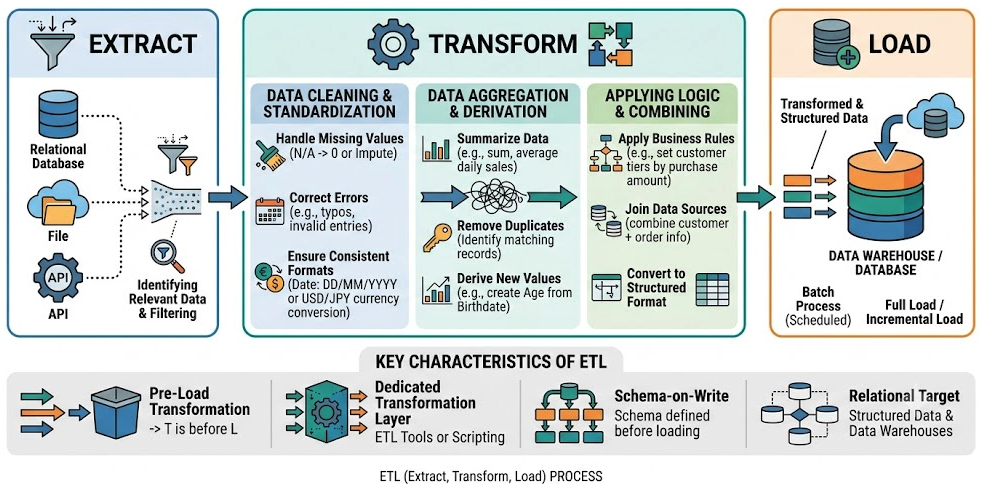
ETL is a traditional data integration process used to consolidate data from various sources into a data warehouse or other target system.
Extract: Data is pulled from source systems (databases, flat files, APIs, etc.). This step involves identifying relevant data and sometimes initial filtering.
Transform: The extracted data is then cleaned, enriched, validated, aggregated, and converted into a structured format suitable for the target system. This might involve:
Data cleansing (handling missing values, correcting errors)
Data standardization (ensuring consistent formats)
Data deduplication (removing duplicate records)
Data aggregation (summarizing data)
Deriving new values
Applying business rules
Joining data from multiple sources
Load: The transformed and structured data is loaded into the target data warehouse or database. Typically, this is a batch process that can involve full loads or incremental loads.
Key Characteristics of ETL:
Transformation happens before the data is loaded into the destination.
Requires dedicated ETL tools or custom scripting for the transformation layer.
Often involves a "schema-on-write" approach, where the schema is predefined before loading.
Historically used for relational data warehouses and structured data.
ELT (Extract, Load, Transform)
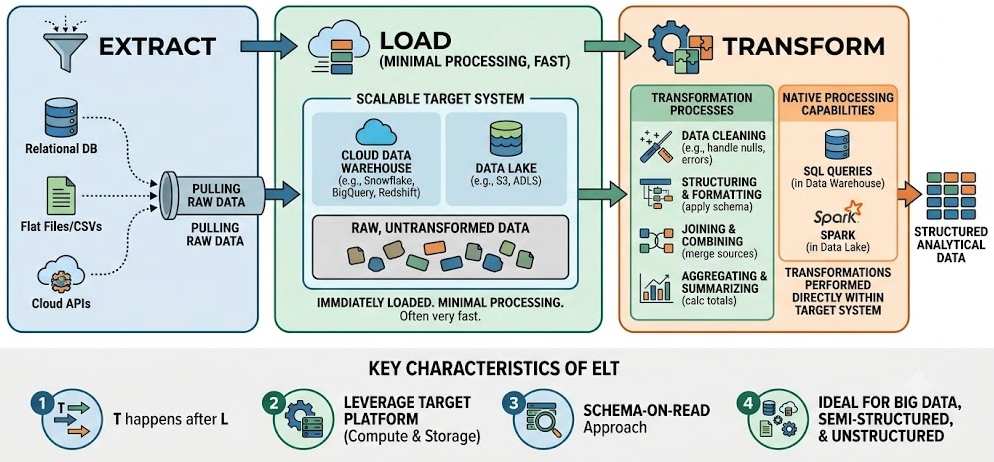
ELT is a modern data integration paradigm that emerged with the advent of cloud-based data warehouses and data lakes capable of storing and processing vast amounts of raw data efficiently.
Extract: Data is pulled from various source systems, similar to ETL.
Load: The raw, untransformed data is immediately loaded into a scalable target system, such as a cloud data warehouse (e.g., Snowflake, BigQuery, Redshift) or a data lake (e.g., S3, ADLS). This step is often very fast as it involves minimal processing.
Transform: Once the raw data resides in the target system, transformations are performed directly within that system using its native processing capabilities (e.g., SQL queries in a data warehouse, Spark in a data lake). This step involves cleaning, structuring, joining, and aggregating the data as needed, often for specific analytical or application purposes.
Key Characteristics of ELT:
Transformation happens after the raw data is loaded into the destination.
Leverages the processing power and storage capabilities of the target data platform.
Often involves a "schema-on-read" approach, where the schema is applied or inferred during the transformation phase, allowing for greater flexibility.
Ideal for big data, semi-structured, and unstructured data.
Key Differences: ETL vs. ELT
Feature
ETL
ELT
Transformation Point
Before loading to the target system.
After loading raw data into the target system.
Data Storage
Only transformed data is stored in the target.
Raw data is stored in the target, then transformed versions.
Processing Power
Dedicated ETL servers/tools for transformation.
Leverages the processing power of the target data warehouse/lake.
Data Volume
Better suited for smaller, structured datasets.
Ideal for large, diverse, and semi-structured/unstructured datasets.
Lower initial load time, faster access to raw data.
Cost
Can be higher due to specialized ETL tools and servers.
Often more cost-effective by utilizing cloud-native storage and compute.
Complexity
Can be complex to manage and scale ETL pipelines.
Simplifies initial loading; complexity shifts to in-database transformations.
Data Quality
Enforced strictly before loading.
Can be refined iteratively after loading.
Why MLOps Leverages ELT?
MLOps (Machine Learning Operations) benefits significantly from the ELT paradigm due to several key aspects inherent to machine learning workflows:
Raw Data Preservation for Feature Engineering:
ML models often require access to the most granular, raw data to derive meaningful features. Transformations in ETL might discard or aggregate raw details that could be critical for future feature engineering iterations.
ELT ensures that the raw data is always available in the data lake or warehouse, allowing data scientists to experiment with different feature extraction techniques without re-ingesting data.
Flexibility and Iterative Development:
Machine learning development is highly iterative. Data scientists constantly experiment with new features, model architectures, and data preparation techniques.
ELT's "schema-on-read" approach perfectly aligns with this. Data scientists can transform data as needed for specific models or experiments, without impacting the upstream raw data ingestion pipeline.
This agility speeds up the feature engineering and model development cycles.
Scalability for Big Data and Diverse Data Types:
ML models thrive on large datasets, often composed of diverse data types (structured, semi-structured, unstructured).
ELT, coupled with cloud data lakes and warehouses, is designed to ingest and store massive volumes of raw data efficiently and cost-effectively.
The powerful compute capabilities of these platforms can then be leveraged for complex transformations required for ML, such as natural language processing (NLP) features or image metadata extraction.
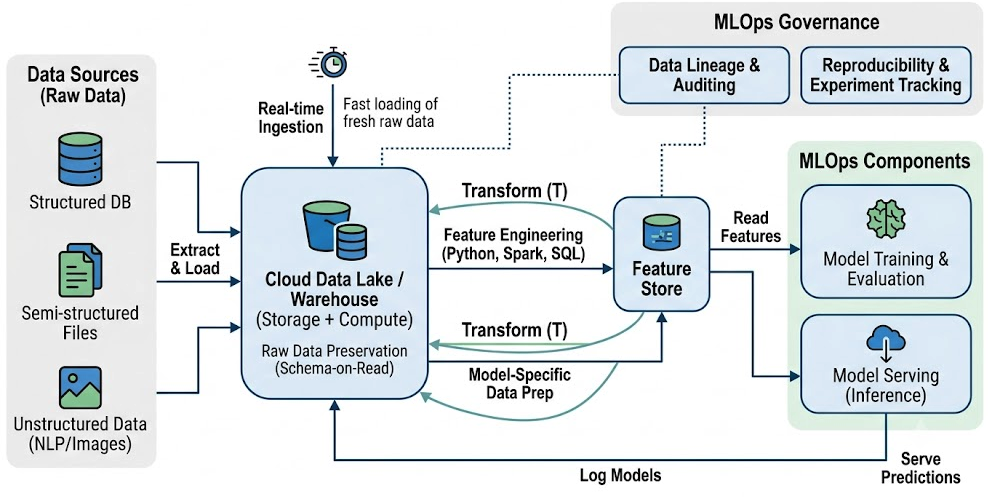
Feature Store Development and Management:
Feature stores are crucial components in MLOps for managing, sharing, and serving features consistently for training and inference.
ELT facilitates populating feature stores by providing a readily available source of raw data from which features can be computed and transformed within the data platform.
This ensures consistency between the data used for training and the data served for real-time predictions.
Auditability and Reproducibility:
In MLOps, it's essential to trace the lineage of data from its raw form to the features used by a model. ELT preserves the raw data, making it easier to audit transformations and reproduce datasets for model training or debugging.
This is vital for model governance, compliance, and understanding model behavior.
Decoupling of Ingestion and Transformation:
ELT separates the ingestion process from the transformation process. This means data can be ingested quickly into the data platform as soon as it's available.
Data scientists and engineers can then work on transformations independently, using their preferred tools and languages (e.g., SQL, Python with Spark), without bottlenecking the data ingestion pipeline.
Real-time and Near Real-time Scenarios:
For MLOps applications requiring real-time or near real-time predictions, ELT allows for rapid loading of fresh raw data. Transformations can then be applied quickly within the high-performance data platform to prepare features for serving.