What is the Temporal Programming Model?The Temporal Programming Model refers to a paradigm for building robust, long-running, and fault-tolerant applications as workflows. It allows developers to write complex business logic as ordinary code, abstracting away the inherent complexities of distributed systems such as retries, timeouts, state persistence, task management, and communication across microservices. At its core, Temporal ensures that a declared workflow will eventually complete, regardless of infrastructure failures (e.g., worker crashes, network partitions, server reboots) or temporary external service unavailability. This is achieved by maintaining the full state and execution history of a workflow, allowing it to resume precisely where it left off. 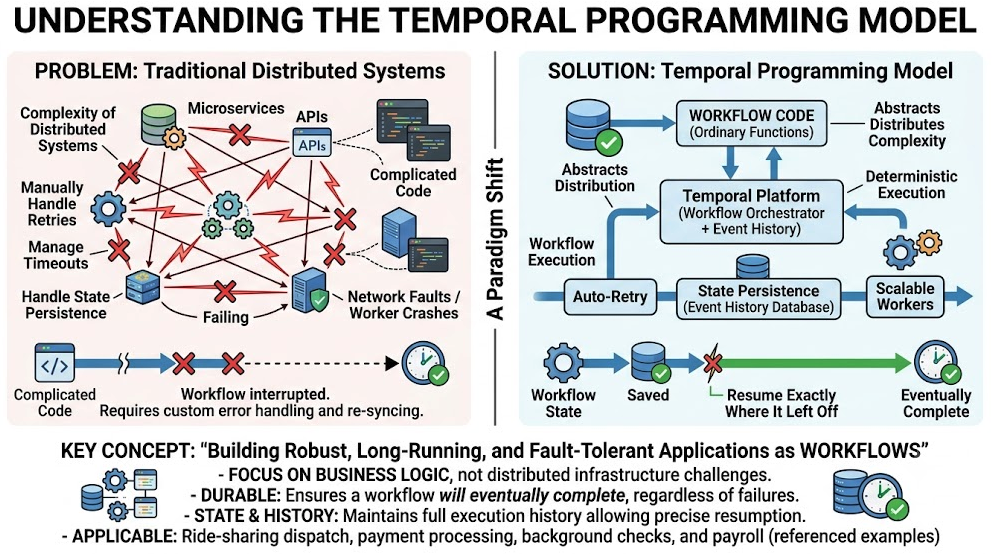
Motivation for CreationThe Temporal Programming Model was primarily created to solve the "distributed systems problem" – the immense difficulty and boilerplate involved in building reliable applications that span multiple services, machines, or processes. Traditional approaches often force developers to: - Manually implement complex retry logic with exponential backoffs.
- Manage timeouts and cancellation across service boundaries.
- Persist and rehydrate application state across crashes.
- Handle duplicate messages and ensure idempotency.
- Orchestrate long-running business processes that might take hours, days, or even months to complete.
- Deal with network failures, service outages, and worker restarts gracefully.
Temporal was designed to provide a programming model where developers can focus on the business logic of their application, allowing the Temporal platform to handle the operational complexities, guarantees, and failure recovery automatically. This significantly reduces development time, operational burden, and the likelihood of bugs in critical distributed workflows. Originators and HistoryThe foundational technology behind the Temporal Programming Model originated at Uber Technologies. 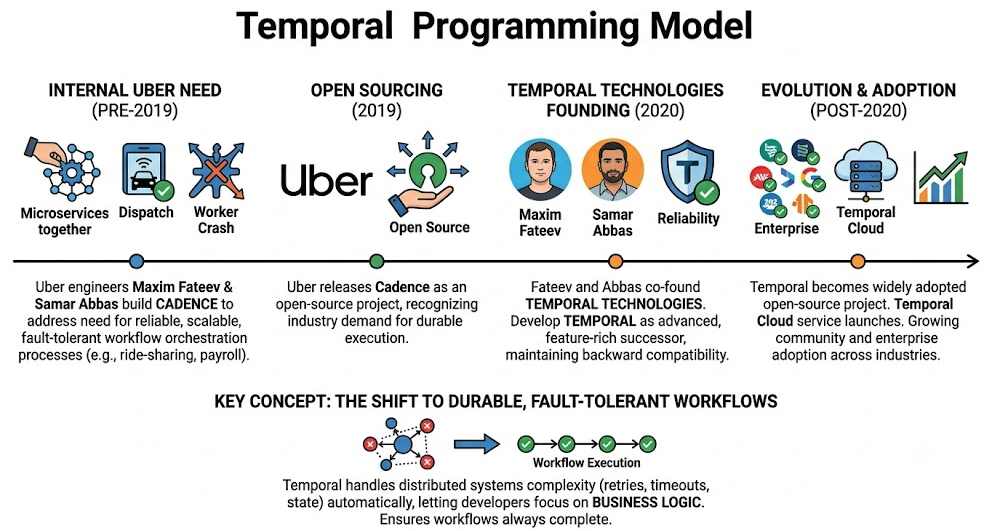
- Cadence: The initial system, named Cadence, was developed internally at Uber by engineers Maxim Fateev and Samar Abbas. They built Cadence to address Uber's growing need for a reliable, scalable, and fault-tolerant workflow orchestration engine to manage critical business processes such as ride-sharing dispatch, payment processing, background checks, and payroll.
- Open Sourcing: Recognizing the broader industry need for such a platform, Cadence was open-sourced by Uber in 2019.
- Temporal Technologies: Shortly after, Maxim Fateev and Samar Abbas left Uber to co-found Temporal Technologies in 2020. They continued the development of the platform as Temporal, which became a more advanced and feature-rich successor to Cadence, maintaining backward compatibility while introducing significant improvements.
- Evolution: Temporal has since evolved into a widely adopted open-source project and a commercial cloud service (Temporal Cloud), with a growing community and increasing enterprise adoption across various industries for critical long-running applications.
Architectural Features of Temportal Programming ModelThe Temporal Programming Model is built upon several key architectural components and principles: 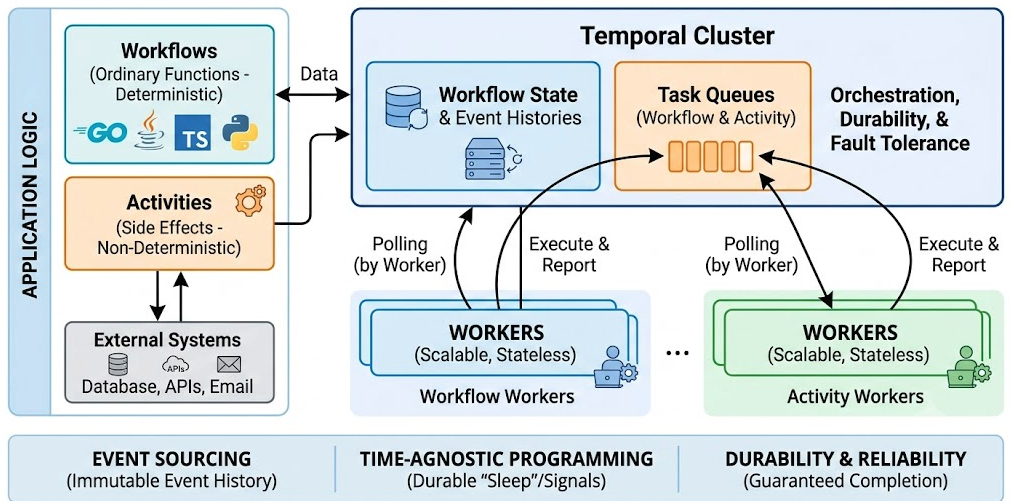
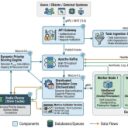
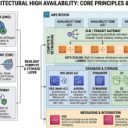
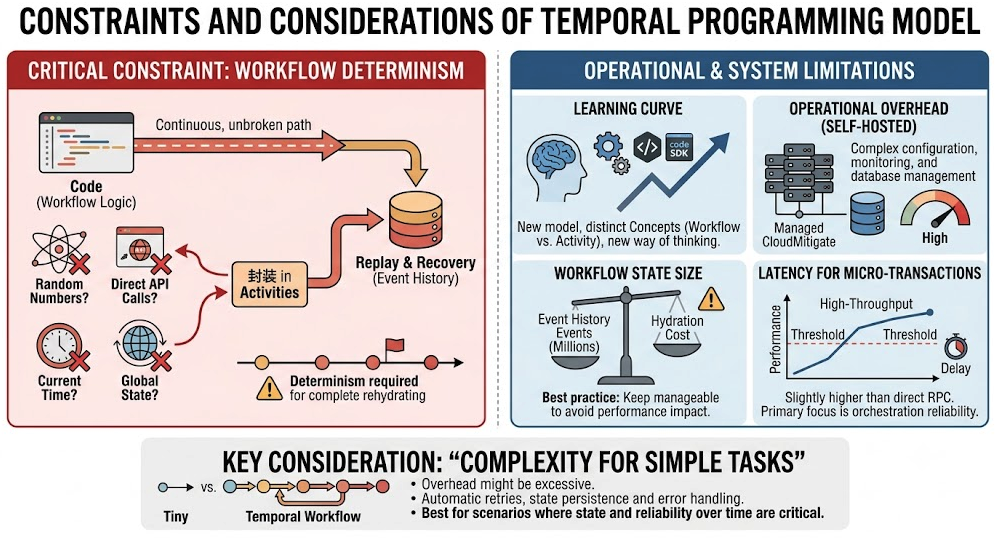
This high-level architectural diagram integrates the key features of the Temporal Programming Model onto a clean, white background. It visually segments the system into the deterministic logic layer and the platform infrastructure, illustrating how the Temporal Cluster acts as the persistent orchestrator that ensures workflows complete reliably. The flow of information between Workflows, Activities, and the Cluster via Task Queues and Workers is clearly articulated. The diagram includes detailed explanations for each architectural feature to provide a comprehensive overview. Constraints and Limitations of Temporal Programming ModelWhile powerful, the Temporal Programming Model comes with certain constraints and considerations: - Workflow Determinism: Workflow code must be deterministic. This is the most significant constraint. It means workflows cannot directly perform non-deterministic operations like generating random numbers, accessing the current time, making direct API calls, or using global mutable state. All non-deterministic operations must be encapsulated within Activities. This ensures that a workflow's execution can be faithfully replayed from its event history.
- Learning Curve: Adopting Temporal requires developers to learn a new programming model, SDKs, and a different way of thinking about distributed application logic. Understanding the distinction between Workflows and Activities and the determinism requirement is crucial.
- Operational Overhead (Self-Hosted): Running and maintaining a self-hosted Temporal Cluster involves operational overhead. It's a distributed system itself, requiring careful configuration, monitoring, scaling, and database management (e.g., Cassandra, PostgreSQL, MySQL). Cloud offerings (like Temporal Cloud) mitigate this by providing a managed service.
- Workflow State Size: Workflows with extremely large event histories (e.g., millions of events) can impact performance due to the cost of replaying the history during hydration and persisting large amounts of data. Best practices encourage keeping workflow state manageable.
- Latency for High-Throughput Micro-Transactions: While Temporal excels at long-running, fault-tolerant processes, its architecture might introduce slightly higher latency compared to direct, low-latency RPC calls for extremely high-throughput, simple micro-transactions where fault tolerance at the orchestration layer is not the primary concern.
- Complexity for Simple Tasks: For extremely simple, single-step operations that require no retries, state persistence, or complex orchestration, using Temporal might introduce unnecessary overhead. It's best suited for tasks where reliability and state management over time are critical.
Temporal-like Model on AWS Managed Services: Feasibility and ArchitectureConcept and FeasibilityIt is absolutely possible to build a system that provides a "Temporal-like" programming model using AWS Managed Services. The core idea is to leverage AWS's serverless and managed offerings to achieve fault-tolerant, long-running, and stateful workflows without managing the underlying infrastructure that a self-hosted Temporal cluster would require. The key is to combine several AWS services that collectively fulfill the functions of a robust workflow orchestration engine, activity workers, persistence, and observability. Core Components and AWS MappingA Temporal-like system typically consists of the following components, and here's how they can be mapped to AWS Managed Services: - Workflow Orchestrator: Manages the state, execution, retries, and timers of long-running workflows.
- AWS Service: AWS Step Functions (Standard Workflows). This service is designed precisely for orchestrating complex, fault-tolerant, stateful workflows, including built-in retries, error handling, and
Wait states for timers.
- Activity Workers: Execute the actual business logic invoked by the workflow.
- AWS Service: AWS Lambda (for serverless, event-driven functions), AWS Fargate/ECS (for containerized applications, longer-running tasks, or custom runtimes), or EC2 (for specific requirements).
- Task Queues: Decouple workflow orchestration from activity execution, ensuring reliability and scalability.
- AWS Service: Step Functions internally manages task distribution and state. Amazon SQS can be used for external asynchronous activity invocation, fan-out patterns, or as a buffer for activities not directly invoked by Step Functions. Amazon EventBridge can trigger workflows or activities based on events.
- Persistence Layer: Stores workflow state, execution history, and application data.
- AWS Service: AWS Step Functions inherently manages its own execution state and history. Amazon DynamoDB for external application state, event sourcing, or durable storage of large payloads passed between workflow steps (referencing S3 objects).
- Timers and Schedulers: Enables delays, timeouts, and scheduled workflow invocations.
- AWS Service: AWS Step Functions
Wait states for in-workflow delays and timeouts. Amazon EventBridge Scheduler for external, time-based triggers or cron-like scheduling of workflows.
- Visibility and Monitoring: Provides insights into workflow execution, errors, and performance.
- AWS Service: Amazon CloudWatch Logs (for Step Functions execution logs, Lambda logs), CloudWatch Metrics (for performance), AWS X-Ray (for distributed tracing across services), CloudTrail (for API activity logging).
Possible Architecture OverviewA high-level architecture would revolve around AWS Step Functions as the central orchestration engine, invoking AWS Lambda functions or containers on AWS Fargate/ECS as its "activities." 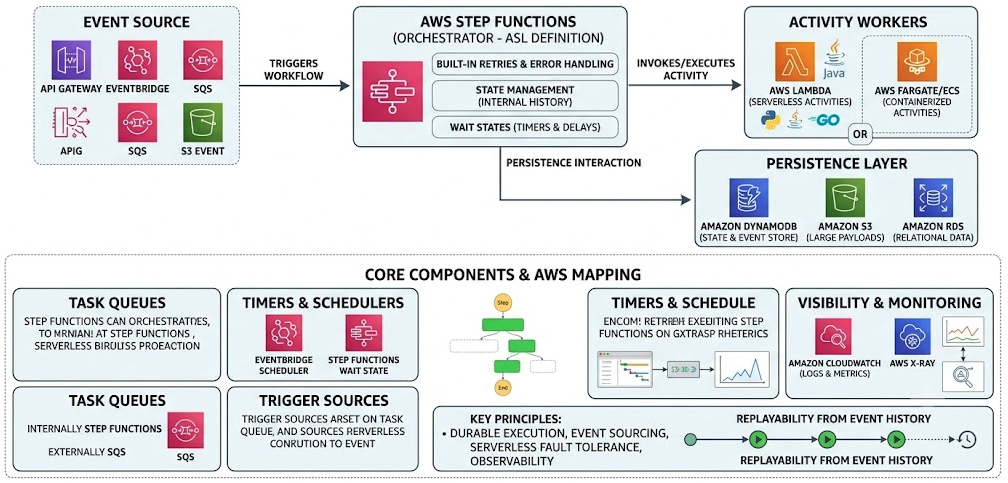
Detailed Architecture Components1. Workflow Definition (AWS Step Functions): - Define your workflow as a state machine using Amazon States Language (ASL).
- Each "step" in your workflow can represent a distinct activity.
- Utilize
Task states to invoke Lambda functions, ECS/Fargate tasks, or even other Step Functions. - Implement
Wait states for delays, Choice states for conditional logic, Map states for parallel processing of items, and Parallel states for concurrent execution paths. - Leverage built-in retry mechanisms, catch states for error handling, and timeouts to ensure fault tolerance.
- Standard Workflows are ideal for long-running processes (up to a year), providing an audit trail and exactly-once task delivery.
2. Activity Implementations (AWS Lambda / Fargate / ECS): - Lambda: Write lightweight, single-purpose functions in your preferred language. These functions are invoked directly by Step Functions. They are ideal for discrete, short-duration tasks.
- Fargate/ECS: For activities that require more execution time, custom runtimes, larger memory/CPU, or a containerized environment. Step Functions can integrate directly with ECS Task.
3. Persistence and Data Flow: - Step Functions State: Step Functions automatically manages the state of your workflow execution. Input/output for each step is passed as JSON.
- DynamoDB: Use for durable storage of application-specific data, event logs, or to track complex state outside of what Step Functions passes directly. DynamoDB Streams can act as an event source for other processes.
- S3: For storing large payloads (e.g., files, documents) that are too big to pass directly through Step Functions' state. The workflow would pass S3 object references instead.
4. Triggers and Events: - API Gateway: Expose an HTTP endpoint to start Step Functions workflows, allowing external applications or user interfaces to initiate processes.
- EventBridge: Can be used to trigger workflows based on events from AWS services (e.g., S3 object created, DynamoDB stream events) or custom application events. EventBridge Scheduler can schedule recurring workflow executions.
- SQS: A message in an SQS queue can trigger a Lambda function, which then starts a Step Functions workflow. This provides an asynchronous entry point with built-in retry.
5. Observability: - CloudWatch Logs: All Step Functions executions and Lambda function invocations generate logs here, crucial for debugging.
- CloudWatch Metrics: Monitor the performance and health of your Step Functions and Lambda functions (e.g., execution count, duration, errors).
- AWS X-Ray: Gain end-to-end visibility of requests as they flow through your distributed services, helping identify performance bottlenecks.
Benefits- Serverless: No servers to provision, patch, or manage for most components (Step Functions, Lambda, DynamoDB).
- High Availability and Scalability: Services automatically scale to meet demand and are inherently highly available.
- Reduced Operational Overhead: AWS handles the infrastructure, patching, and scaling, allowing your team to focus on business logic.
- Cost-Effective: Pay-per-use model for most services, eliminating costs for idle resources.
- Fault Tolerance: Step Functions provides built-in retries, error handling, and durable state, making workflows resilient to failures.
- Integration: Seamless integration with a wide array of other AWS services.
Considerations- Workflow Definition Language: AWS Step Functions uses Amazon States Language (ASL), which is a JSON-based declarative language. While powerful, it might have a learning curve compared to defining workflows directly in code (as Temporal SDKs allow). However, tools like AWS CDK can programmatically generate ASL.
- Cost for Very Long-Running/Complex Workflows: While generally cost-effective, very chatty or extremely long-running (many state transitions) Step Functions workflows can accumulate costs.
- State Machine Limits: Step Functions has limits on state machine definition size, history event limits, and payload sizes. These generally accommodate most use cases but are important to be aware of.
- Local Development/Testing: Testing Step Functions locally can be more involved than testing a pure code-based workflow, though AWS SAM and local mocks can help.
- Vendor Lock-in: This approach ties you closely to the AWS ecosystem.
|