Redis vs Memcached: Why Enterprise Tech Giants Choose Redis
CK 3788 Created at
25200
While both Redis and Memcached are powerful, open-source, in-memory data stores, their architectural philosophies differ significantly. Understanding why major tech companies (such as Netflix, Uber, Twitter, and Airbnb) overwhelmingly favor Redis requires a deep dive into their core capabilities, performance under scale, and operational flexibility.
1. Architectural and Core Differences
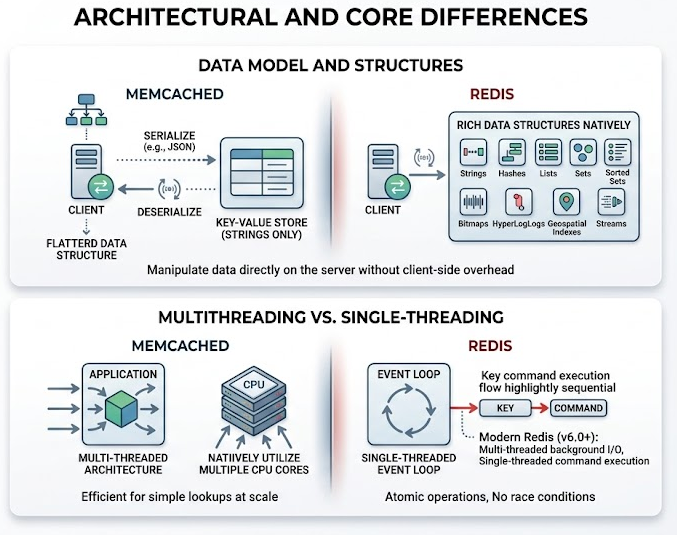
Data Model and Structures
Memcached: Operates strictly as a key-value store where both keys and values are simple strings. If you want to store a complex object, list, or associative array, you must serialize it (e.g., to JSON or Protocol Buffers) on the client side before saving it, and deserialize it upon retrieval.
Redis: Supports rich data structures natively. These include Strings, Hashes, Lists, Sets, Sorted Sets (with range queries), Bitmaps, HyperLogLogs, Geospatial indexes, and Streams. This allows developers to manipulate data directly on the server without the overhead of network round-trips for serialization/deserialization.
Multithreading vs. Single-threading
Memcached: Built with a multi-threaded architecture. It can natively utilize multiple CPU cores out of the box, making it exceptionally efficient at handling massive throughput of simple key-value lookups without complex setup.
Redis: Historically operated on a single-threaded event loop (using multiplexing via epoll or kqueue). While modern Redis (v6.0+) utilizes multi-threading for background I/O operations (like socket reading/writing), the execution of commands remains single-threaded. This design guarantees atomic operations and prevents race conditions without the overhead of thread locking.
Native Redis Cluster (sharding & high availability)
Transactions
Basic CAS (Check-And-Set)
MULTI/EXEC, Lua Scripting (ACID properties)
Pub/Sub Messaging
No
Yes (native Publish/Subscribe patterns and Streams)
3. Why Big Companies Prefer Redis
Large-scale enterprises choose Redis because it transcends the role of a simple cache, acting as a multi-tool that simplifies system architecture.
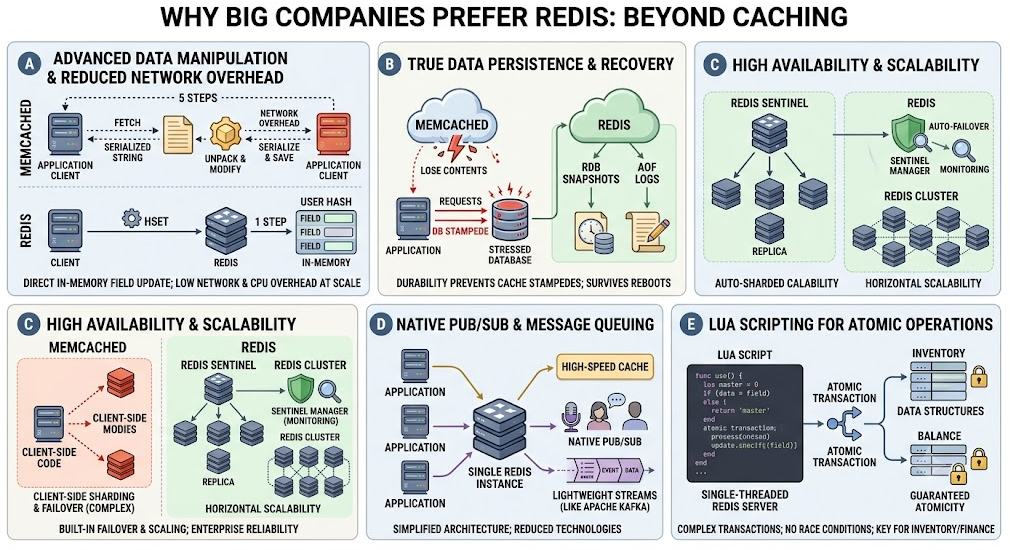
A. Advanced Data Manipulation and Reduced Network Overhead
In Memcached, updating a single field in a cached user profile requires: 1. Fetching the entire serialized string over the network. 2. Deserializing it in the application server. 3. Modifying the field. 4. Serializing it again. 5. Sending it back over the network to Memcached.
With Redis, developers use Hashes (HSET/HGET). The application can update a single field directly in-memory on the Redis server in a single network call. This drastically reduces network bandwidth and CPU usage on application servers at scale.
B. True Data Persistence and Recovery
Memcached is purely volatile. If a server crashes or reboots, the entire cache is lost, resulting in a "cache stampede" where backend databases are suddenly hammered with requests. Redis offers two persistent options:
RDB (Redis Database): Point-in-time compact snapshots of your dataset at specified intervals.
AOF (Append Only File): Logs every write operation received by the server.
This durability allows Redis to act as a primary database (e.g., for user sessions, shopping carts, or real-time leaderboards) that can survive system reboots without data loss.
C. High Availability and Scalability (Redis Sentinel & Cluster)
For enterprise reliability, Redis provides built-in high-availability solutions:
Redis Sentinel: Monitors master and replica nodes, performing automatic failover if a master node goes down.
Redis Cluster: Automatically shards data across up to 1,000 nodes, providing horizontal scalability and continuous availability even during partial node failures.
Memcached requires complex, custom client-side logic or third-party proxy tools (like Twemproxy) to achieve similar sharding and failover behaviors.
D. Native Pub/Sub and Message Queuing
Large architectures rely heavily on asynchronous event-driven communication. Redis has built-in Pub/Sub mechanisms and Redis Streams (similar to a lightweight Apache Kafka). Companies can use a single Redis instance to handle both high-speed caching and microservices messaging pipelines, reducing the number of technologies they need to maintain.
E. Lua Scripting for Atomic Operations
Redis allows developers to write complex transactions using Lua scripts that execute directly on the server. Because Redis is single-threaded, these scripts are guaranteed to run atomically. This is crucial for systems dealing with inventory management, financial transactions, or rate-limiting.
4. When Memcached is Still Preferred
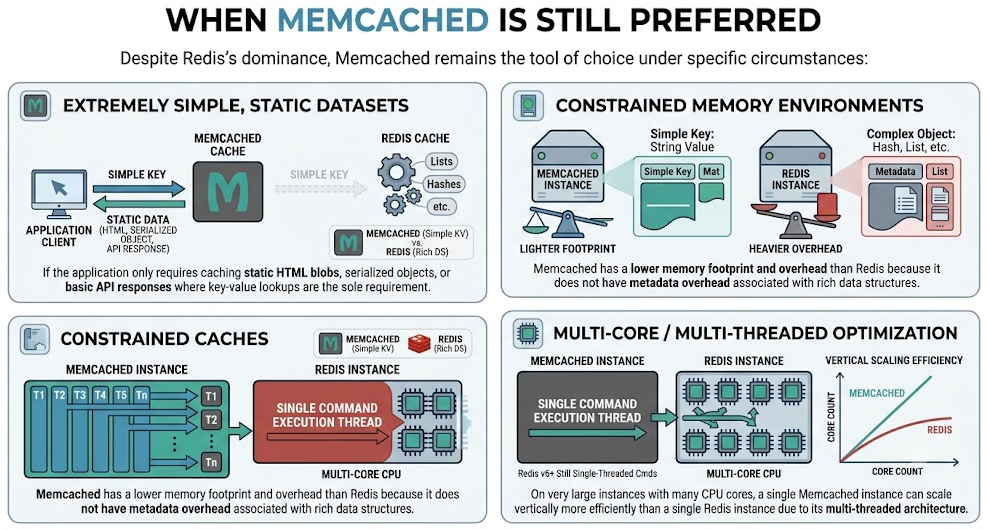
Despite Redis's dominance, Memcached remains the tool of choice under specific circumstances:
Extremely Simple, Static Datasets: If the application only requires caching static HTML blobs, serialized objects, or basic API responses where key-value lookups are the sole requirement.
Constrained Memory Environments: Memcached has a lower memory footprint and overhead than Redis because it does not have metadata overhead associated with rich data structures.
Multi-core/Multi-threaded Optimization: On very large instances with many CPU cores, a single Memcached instance can scale vertically more efficiently than a single Redis instance due to its multi-threaded architecture.