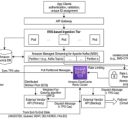
| Developing an Intelligent Priority-Based Scheduler requires defining functional requirements such as automated task ingestion, dynamic AI-driven priority calculation based on deadlines and resource availability, preemptive execution management, and real-time status reporting, alongside non-functional requirements including low latency, high throughput, fault tolerance, strict security protocols, and seamless scalability. To fulfill these specifications, the system architecture adopts an event-driven microservices design featuring an API Gateway, an ingestion engine backed by a high-throughput message queue like Apache Kafka, an intelligent scoring module powered by machine learning, a distributed scheduler orchestrator, a pool of execution workers, a Redis-based state cache, and a persistent database for telemetry and auditing. 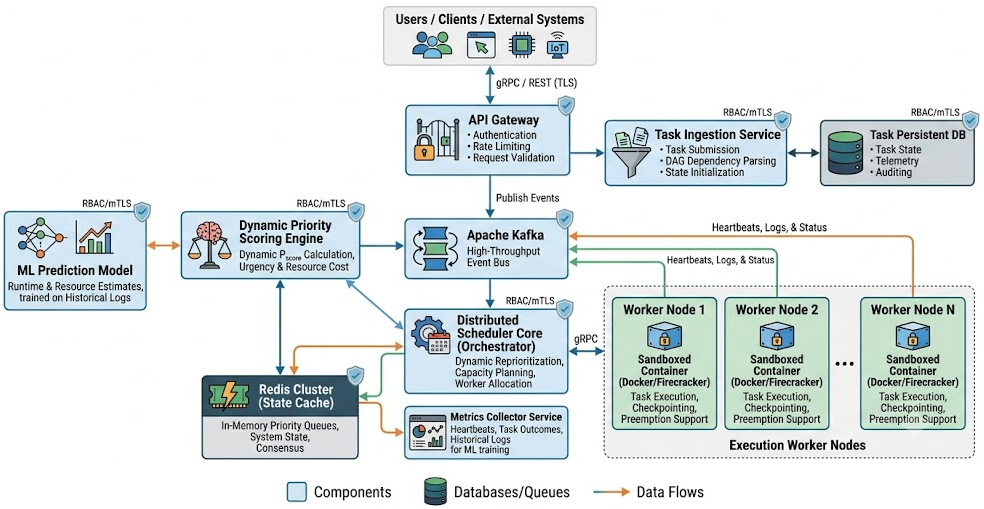
1. Functional Requirements (FRs)The functional requirements define the specific behaviors, capabilities, and features that the Intelligent Priority-Based Scheduler system must provide. 1.1 Task Ingestion and Lifecycle Management- FR-1.1: Task Submission: The system must accept tasks submitted via API endpoints (REST/gRPC) or message streams (Kafka/RabbitMQ) with metadata including task ID, payload, static priority baseline, resource requirements (CPU, RAM, GPU), deadline, and dependencies.
- FR-1.2: Dependency Resolution: The system must support Directed Acyclic Graph (DAG) task dependencies, ensuring child tasks are held until all parent tasks execute successfully.
- FR-1.3: Lifecycle Tracking: The system must maintain real-time task states (
SUBMITTED, QUEUED, RUNNING, PAUSED, COMPLETED, FAILED, CANCELLED).
1.2 Dynamic Priority Calculation Engine- FR-2.1: Multi-Factor Priority Scoring: The scheduler must calculate a dynamic score P_{score} using factors such as:
- Static user-assigned priority weight.
- Time-to-SLA deadline (Urgency Factor).
- Task age in queue (Aging Factor to prevent starvation).
- Resource cost and execution duration estimates.
- FR-2.2: Machine Learning Execution Prediction: The system must use an ML regression model to predict task duration and memory usage based on historical execution metrics, overriding user estimates when necessary.
- FR-2.3: Adaptive Reprioritization: The scheduler must periodically re-score queued tasks to elevate aging tasks and prioritize tasks close to violating their Service Level Agreement (SLA).
1.3 Scheduling and Dispatching- FR-3.1: Priority Queue Routing: The engine must push scored tasks into appropriate priority queues (e.g., High-Priority, Normal-Priority, Batch/Low-Priority).
- FR-3.2: Resource-Aware Allocation: Tasks must only be dispatched to execution nodes that have adequate available CPU, GPU, memory, and network throughput capacity.
- FR-3.3: Preemption Management: The scheduler must support preemptive scheduling for ultra-critical tasks, gracefully pausing or terminating lower-priority jobs with optional state checkpointing.
1.4 Admin Controls and Observability- FR-4.1: Manual Overrides: System administrators must have the ability to manually change task priorities, pause execution queues, or cancel running jobs through a GUI dashboard or CLI.
- FR-4.2: Rule Configuration: Administrators must be able to adjust scoring weights (e.g., prioritizing deadline proximity over resource efficiency) dynamically without restarting the service.
2. Non-Functional Requirements (NFRs)Non-functional requirements describe system attributes, quality characteristics, and operational constraints. 2.1 Performance and Latency- NFR-1.1: Low Scheduling Overhead: The scheduler must determine task placement within \le 10 ms for high-priority single tasks, and process batches of 10,000 tasks in under 1 second.
- NFR-1.2: Scalability: The system must horizontally scale to support up to 1,000,000 active/queued tasks concurrently across distributed cluster environments.
2.2 Reliability and Availability- NFR-2.1: High Availability (HA): The scheduler core must run in an active-passive or active-active consensus configuration (e.g., using Raft/ZooKeeper) ensuring 99.99\% uptime.
- NFR-2.2: Fault Tolerance & At-Least-Once Execution: If an execution node crashes mid-task, the scheduler must detect heart-beat failure within 5 seconds, re-queue the task, and trigger execution on a healthy node.
- NFR-2.3: Crash Recovery: System state (task queues, dependency trees, scoring metrics) must be continuously persisted to disk/distributed state store to survive full cluster restarts.
2.3 Security and Compliance- NFR-3.1: Authentication & Authorization: All API access must be secured using OAuth2 / mTLS with Role-Based Access Control (RBAC) governing who can submit, view, or modify tasks.
- NFR-3.2: Payload Isolation: Task payloads and code execution environments must run in isolated containers/microVMs (e.g., Docker, Firecracker) to ensure multi-tenant security.
2.4 Maintainability and Extensibility- NFR-4.1: Modular Scoring Plugins: The scoring engine must utilize a plugin architecture, allowing developers to add custom ML models or business logic algorithms easily.
- NFR-4.2: Audit Trail: All priority adjustments, worker assignments, and execution failures must be logged into a structured, searchable log repository (e.g., OpenTelemetry / ELK).
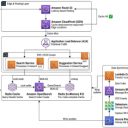
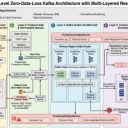
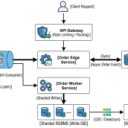
3. System Architecture DesignThe architecture is divided into decoupled microservices communicating via asynchronous event streams and high-speed gRPC channels. 3.1 High-Level Architecture Component Diagram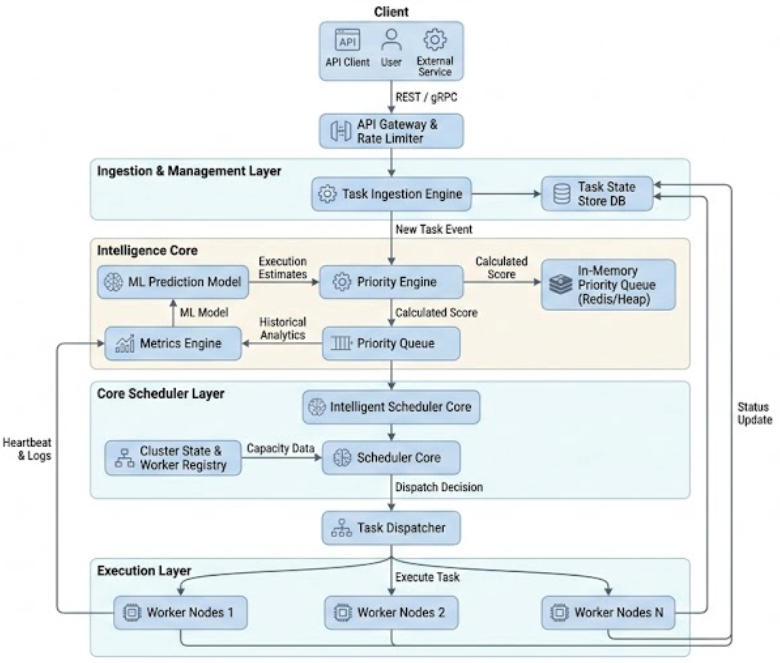
3.2 System Component Descriptions1. Ingestion Layer - API Gateway: Handles authentication, rate limiting, and request validation.
- Task Ingestion Engine: Parses submitted task definitions, validates DAG dependencies, records initial task state into the persistent DB, and notifies the Priority Engine.
2. Intelligence Core - Dynamic Priority Engine: Runs mathematical algorithms combining urgency, resource cost, aging, and base priority. Recalculates priorities asynchronously at configured intervals to adjust for aging tasks.
- ML Prediction Model: Inferencing engine (built on XGBoost or LightGBM) trained on historical execution logs. Predicts runtime, memory usage, and risk of failure for newly submitted jobs.
- In-Memory Priority Queue: Fast, synchronized storage (e.g., Redis Enterprise or Min-Heap structures in memory) storing task references ordered by priority score P_{score}.
3. Core Scheduler & Dispatcher - Intelligent Scheduler Core: Evaluates top-ranked tasks against current cluster capacity. Checks resource availability against the Worker Registry.
- Worker Registry: Continuously tracks node health, available CPU/RAM/GPU, and current load via node agents.
- Task Dispatcher: Communicates directly with worker nodes over gRPC to trigger containerized task executions.
4. Execution & Feedback Engine - Worker Nodes: Execute assigned tasks within sandboxed runtime environments. Report execution events, resource consumption, and heartbeats back to the system.
- Metrics Collector: Processes heartbeats, execution metrics, and task outcomes to feed continuous operational monitoring and retrain ML dynamic execution models.
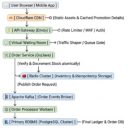
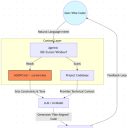
3.3 Task Execution Sequence Flow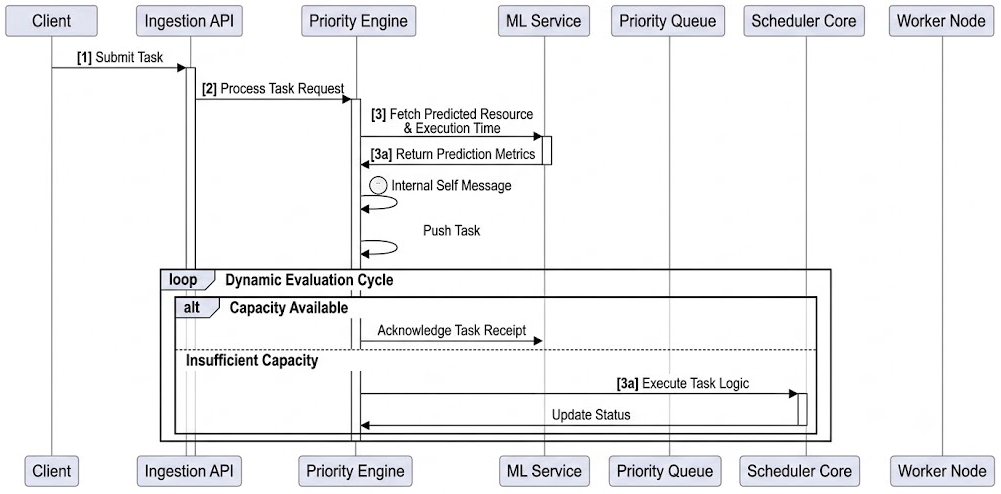
|