| The Java Spring Framework began as a lightweight alternative to complex J2EE, revolutionizing enterprise development with its core principles of Inversion of Control and Dependency Injection, subsequently evolving into a comprehensive ecosystem that notably simplified microservices development through Spring Boot. Current trends emphasize reactive programming with Spring WebFlux for highly scalable, non-blocking applications, extensive support for cloud-native deployments via Spring Cloud, and a pivotal architectural shift in Spring Framework 6 and Spring Boot 3 towards native compilation using GraalVM. This architectural evolution dramatically improves application startup times, significantly reduces memory footprint, and produces smaller executable sizes, making Spring applications much more efficient for containerized and serverless environments, alongside enhancing developer productivity through AOT processing and simplifying the creation of resilient, high-performance distributed systems. 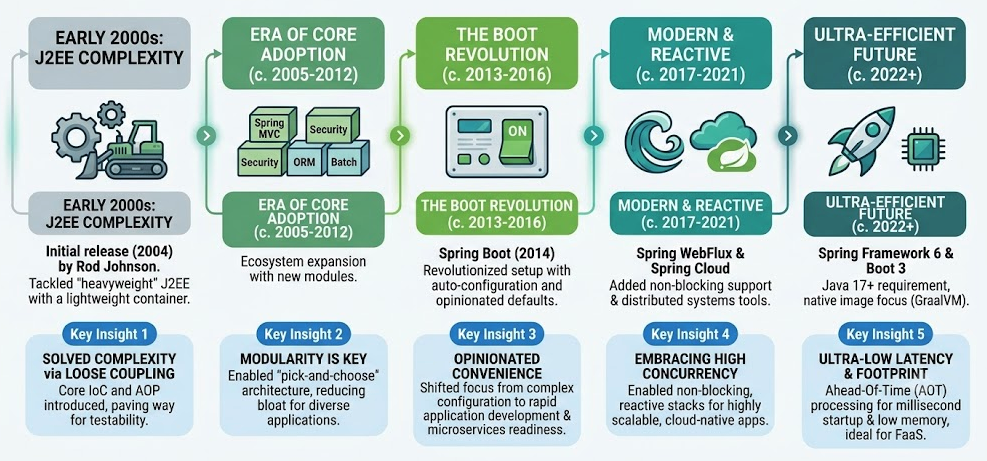
Inception- Origin (2002): Conceived by Rod Johnson, who published "Expert One-on-One J2EE Design and Development." This book outlined issues with J2EE and proposed better ways to build enterprise applications, which later formed the foundation of Spring.
- Initial Release (2004): The first official release of Spring Framework provided a lightweight alternative to heavyweight J2EE application servers and EJBs.
Core Concepts & Early Evolution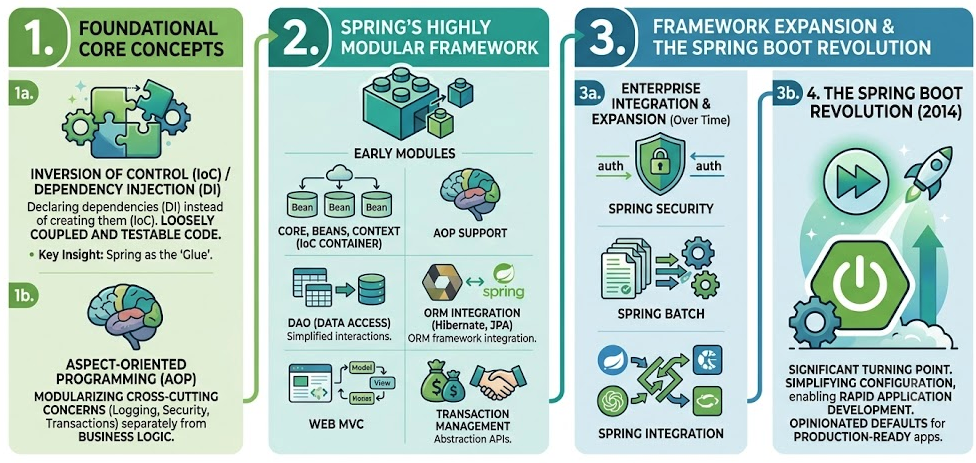
- Inversion of Control (IoC) / Dependency Injection (DI): This became the cornerstone, allowing components to declare their dependencies rather than creating them, leading to loosely coupled and testable code.
- Aspect-Oriented Programming (AOP): Provided a way to modularize cross-cutting concerns (like logging, security, transactions) separately from business logic, enhancing modularity.
- Modularity: Spring was designed as a highly modular framework, allowing developers to pick and choose the parts they needed. Early modules included:
- Core, Beans, Context: The fundamental IoC container.
- AOP: Aspect-oriented programming support.
- DAO: Data Access Object support for simplifying database interactions.
- ORM: Integration with Object-Relational Mapping frameworks like Hibernate and JPA.
- Web MVC: A robust model-view-controller framework for web applications.
- Transaction Management: Abstracting transaction APIs across various technologies.
- Enterprise Integration: Over time, Spring expanded its reach with projects like Spring Security (for authentication/authorization), Spring Batch (for batch processing), and Spring Integration (for enterprise integration patterns).
- Spring Boot (2014): A significant turning point, Spring Boot revolutionized Spring development by simplifying configuration, enabling rapid application development, and providing opinionated defaults for standalone, production-ready Spring applications.
Latest Trends in Spring FrameworkThe Spring ecosystem continues to evolve rapidly, adapting to modern software development paradigms and cloud-native architectures. Microservices & Cloud-Native Development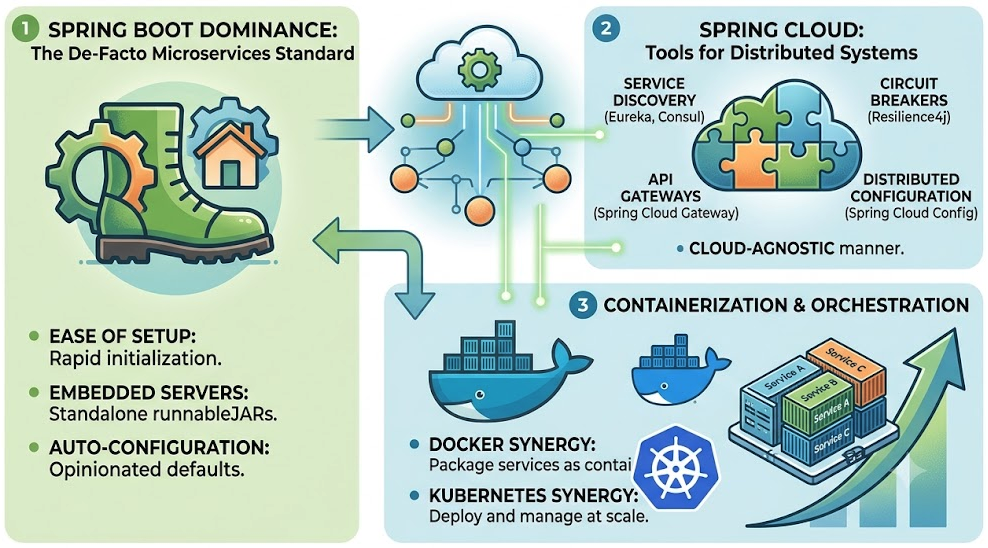
- Spring Boot Dominance: Spring Boot remains the de-facto standard for building microservices due to its ease of setup, embedded servers, and auto-configuration capabilities.
- Spring Cloud: A collection of projects that provide tools for building common patterns in distributed systems (e.g., service discovery, circuit breakers, API gateways, distributed configuration) in a cloud-agnostic manner.
- Containerization & Orchestration: Strong synergy with Docker and Kubernetes for deploying and managing microservices at scale.
Reactive Programming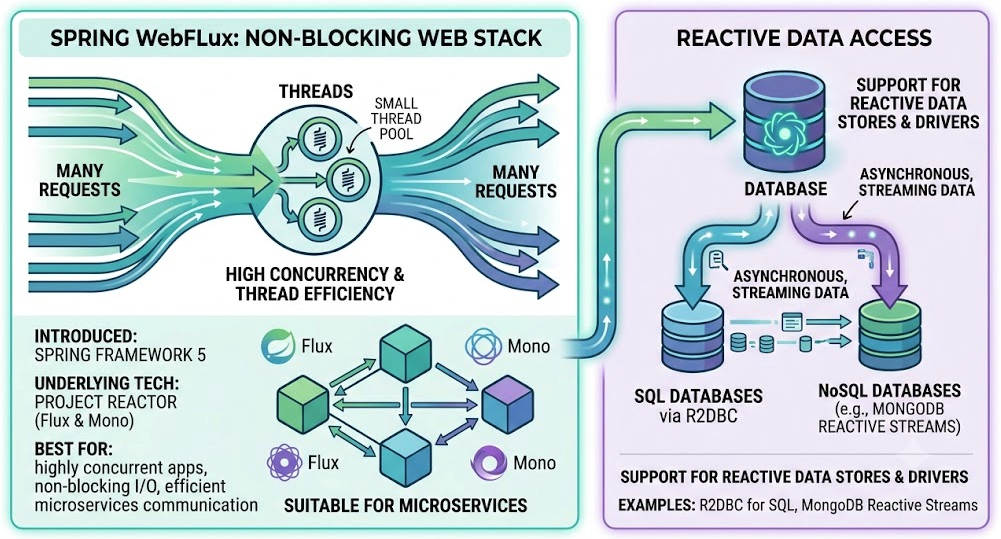
- Spring WebFlux: Introduced in Spring Framework 5, WebFlux provides a reactive, non-blocking web stack built on Project Reactor. It's suitable for highly concurrent applications that need to handle a large number of requests with a small number of threads, especially for microservices communication.
- Reactive Data Access: Support for reactive data stores and drivers (e.g., MongoDB Reactive Streams, R2DBC for SQL databases).
GraalVM Native Images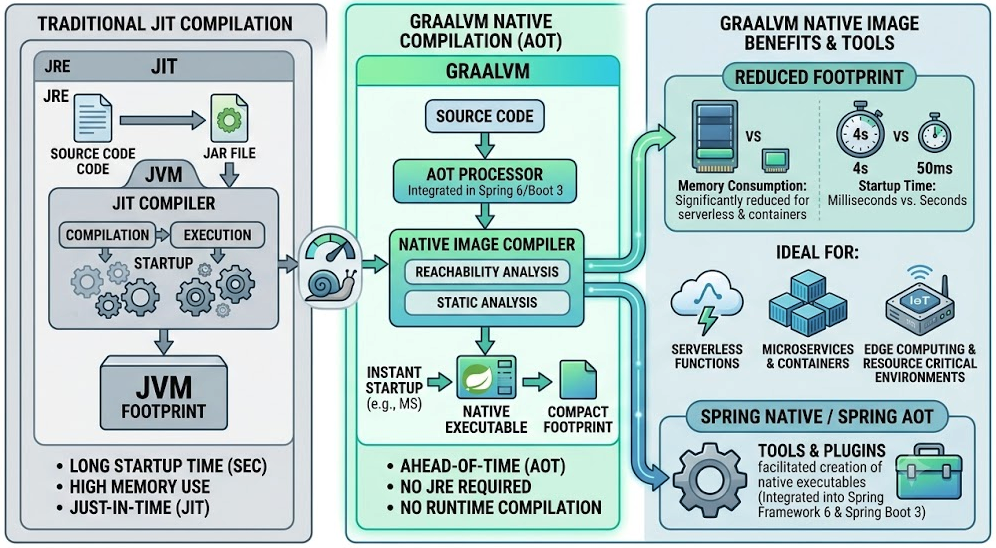
- Reduced Footprint: Growing focus on compiling Spring applications into GraalVM native images. This significantly reduces startup time and memory consumption, making Spring applications ideal for serverless functions, containers, and environments where resource efficiency is critical.
- Spring Native / Spring AOT: Tools and plugins (now integrated into Spring Framework 6 and Spring Boot 3) to facilitate the creation of native executables.
Kotlin Support- First-Class Language: Kotlin is increasingly supported as a first-class language alongside Java, offering conciseness, null safety, and functional programming features that appeal to developers.
- Coroutine Support: Integration with Kotlin Coroutines for asynchronous and reactive programming.
Observability- Unified Observability APIs: A shift towards comprehensive, integrated observability solutions covering metrics, tracing, and logging, often using standards like OpenTelemetry.
Architectural Changes & Improvements in Latest Versions (Spring Framework 6 / Spring Boot 3)The latest major versions of Spring Framework (6.x) and Spring Boot (3.x) bring significant architectural upgrades and improvements, primarily focusing on modernization, cloud-native readiness, and enhanced developer experience. 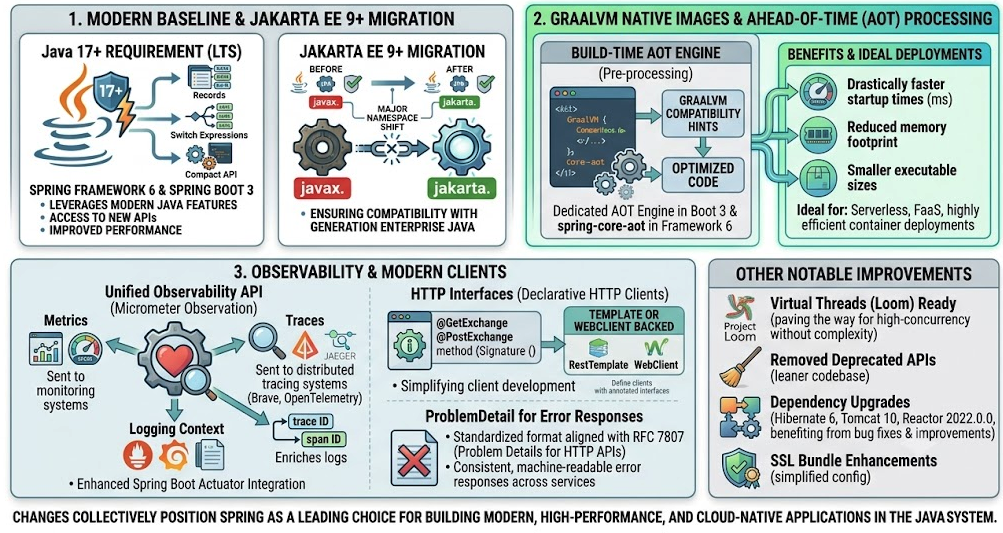
Modern Baseline & Jakarta EE 9+- Java 17+ Requirement: Spring Framework 6 and Spring Boot 3 require Java 17 (LTS) or later, allowing the framework to leverage modern Java features and APIs.
- Jakarta EE 9+ Migration: The biggest breaking change is the migration from the
javax. namespace to the jakarta. namespace for all Java EE (now Jakarta EE) APIs. This affects dependencies like Servlet, JPA, Bean Validation, etc., ensuring compatibility with the latest generation of enterprise Java.
GraalVM Native Images & Ahead-Of-Time (AOT) Processing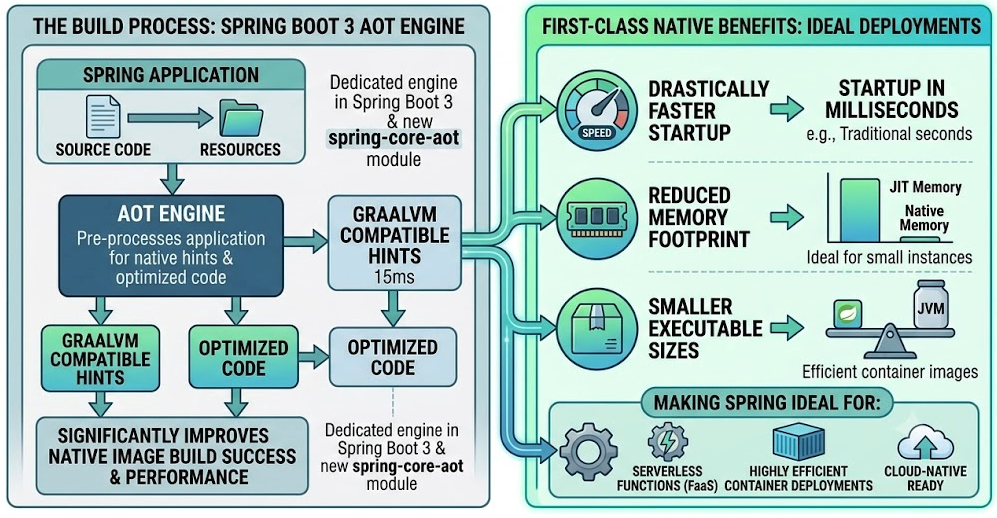
- First-Class Native Support: This is a paramount focus. Spring Framework 6 includes a new
spring-core-src-aot module and Spring Boot 3 provides a dedicated AOT engine. - AOT Engine: During the build process, the AOT engine pre-processes Spring applications to generate GraalVM-compatible hints and optimized code. This significantly improves the success rate and performance of generating native executables.
- Benefits: Drastically faster startup times (milliseconds), reduced memory footprint, and smaller executable sizes, making Spring ideal for serverless, FaaS, and highly efficient container deployments.
Observability- Unified Observability API (Micrometer Observation): Spring Boot 3 introduces a new, unified API for observability based on Micrometer's
Observation API. This single API allows developers to instrument their code once to generate:- Metrics: Sent to monitoring systems like Prometheus, Grafana.
- Traces: Sent to distributed tracing systems like Zipkin, Jaeger via Brave or OpenTelemetry.
- Logging Context: Enriches logs with trace and span IDs.
- Spring Boot Actuator Integration: Actuator endpoints are enhanced to provide better insights into application health and performance with this new observability model.
HTTP Interfaces (Declarative HTTP Clients)- Simplified Client Development: Spring Framework 6 introduces HTTP Interfaces, a new way to define declarative HTTP clients. Inspired by libraries like Retrofit and Feign, it allows defining an interface with annotations to specify HTTP requests (e.g.,
@GetExchange, @PostExchange). - Underlying Clients: These interfaces can be backed by Spring's
RestTemplate or WebClient, simplifying the process of interacting with REST APIs.
ProblemDetail for Error Responses- RFC 7807 Compliance: Spring Framework 6 introduces
ProblemDetail as a standardized way to represent API error responses, aligning with RFC 7807 (Problem Details for HTTP APIs). - Consistent Error Handling: This promotes more consistent and machine-readable error responses across different services, improving interoperability.
Other Notable Improvements- Virtual Threads (Project Loom): While not fully integrated as a production feature, Spring Framework 6 is designed with Project Loom's Virtual Threads in mind, paving the way for easier high-concurrency, blocking-style programming in the future without complex reactive programming.
- Removed Deprecated APIs: Cleanup and removal of many deprecated classes and methods, leading to a leaner and more modern codebase.
- Dependency Upgrades: Updates to various third-party libraries (e.g., Hibernate 6, Tomcat 10, Reactor 2022.0.0) to their latest stable versions, benefiting from their improvements and bug fixes.
- SSL Bundle Enhancements: Simplified configuration and management of SSL certificates.
These changes collectively position Spring Framework as a leading choice for building modern, high-performance, and cloud-native applications in the Java ecosystem. |