| PyTorch is an open-source machine learning library predominantly used for building and training deep learning models. It provides a flexible, Python-based framework that enables researchers and developers to easily construct neural networks, perform tensor computations, and leverage automatic differentiation for efficient model training and experimentation. PyTorch supports a vast array of deep learning models spanning diverse domains, encompassing popular architectures for computer vision such as ResNet, VGG, YOLO, U-Net, and Vision Transformers used for image classification, object detection, and segmentation. For natural language processing, models range from recurrent networks like LSTMs and GRUs to advanced Transformer-based architectures including BERT and GPT for tasks like text classification, machine translation, and generation. Furthermore, PyTorch facilitates the development of models for speech recognition, audio processing, tabular data analysis, various generative models such as GANs and VAEs, and complex algorithms within reinforcement learning. 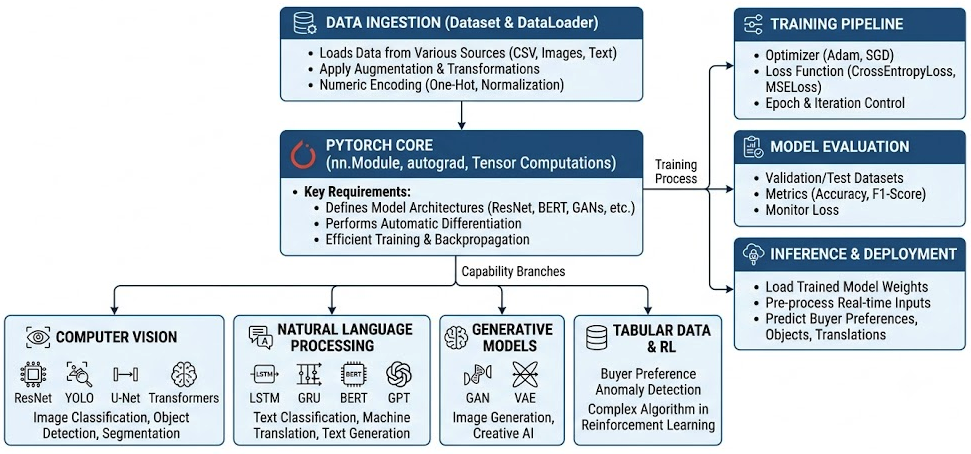
To classify buyer groups based on gender, age, and city for two different products and predict which product a sample buyer might purchase, we can use a classification model in PyTorch. Below is a simplified example that demonstrates how to achieve this. We'll create synthetic data for two products and train a neural network classifier to predict the product based on gender, age, and city. import torch
import torch.nn as nn
import torch.optim as optim
import numpy as np
# Generate synthetic data
np.random.seed(0)
# Sample data: gender (0: male, 1: female), age, city (0: City A, 1: City B)
# For Product 1
product1_data = np.random.randint(0, 2, (1000, 3)) # 1000 samples
# For Product 2
product2_data = np.random.randint(0, 2, (1000, 3)) # 1000 samples
# Define labels: 0 for Product 1, 1 for Product 2
product1_labels = np.zeros((1000,))
product2_labels = np.ones((1000,))
# Combine data and labels
data = np.concatenate([product1_data, product2_data], axis=0)
labels = np.concatenate([product1_labels, product2_labels])
# Convert data and labels to PyTorch tensors
data = torch.tensor(data, dtype=torch.float32)
labels = torch.tensor(labels, dtype=torch.long)
# Define the neural network model
class BuyerClassifier(nn.Module):
def __init__(self):
super(BuyerClassifier, self).__init__()
self.fc1 = nn.Linear(3, 64) # Input features: gender, age, city
self.fc2 = nn.Linear(64, 64)
self.fc3 = nn.Linear(64, 2) # Output: 2 classes (Product 1 or Product 2)
def forward(self, x):
x = torch.relu(self.fc1(x))
x = torch.relu(self.fc2(x))
x = self.fc3(x)
return x
# Initialize the model, loss function, and optimizer
model = BuyerClassifier()
criterion = nn.CrossEntropyLoss()
optimizer = optim.Adam(model.parameters(), lr=0.001)
# Train the model
num_epochs = 100
for epoch in range(num_epochs):
optimizer.zero_grad()
outputs = model(data)
loss = criterion(outputs, labels)
loss.backward()
optimizer.step()
if (epoch + 1) % 10 == 0:
print(f'Epoch [{epoch+1}/{num_epochs}], Loss: {loss.item():.4f}')
# Sample data for prediction (gender, age, city)
sample_data = torch.tensor([[1, 35, 0]], dtype=torch.float32) # Example: Female, 35 years old, City A
# Predict the purchasing product for the sample data
with torch.no_grad():
model.eval()
prediction = model(sample_data)
predicted_class = torch.argmax(prediction).item()
if predicted_class == 0:
print("The sample buyer is predicted to purchase Product 1.")
else:
print("The sample buyer is predicted to purchase Product 2.")
This code demonstrates a basic example of using PyTorch to classify buyer groups based on gender, age, and city for two different products. It generates synthetic data, defines a neural network classifier, trains the model, and then predicts the purchasing product for a sample buyer based on their demographic information. You may curious if you can use string instead of numeric data for gender and city. Below code shows the example import torch
import torch.nn as nn
import torch.optim as optim
import numpy as np
# Generate synthetic data
np.random.seed(0)
# Sample data: gender (male, female), age, city (City_A, City_B)
# For Product 1
product1_data = np.random.choice(['male', 'female'], (1000, 1)) # 1000 samples
product1_data = np.hstack((product1_data, np.random.randint(18, 65, (1000, 1))))
product1_data = np.hstack((product1_data, np.random.choice(['City_A', 'City_B'], (1000, 1))))
# For Product 2
product2_data = np.random.choice(['male', 'female'], (1000, 1)) # 1000 samples
product2_data = np.hstack((product2_data, np.random.randint(18, 65, (1000, 1))))
product2_data = np.hstack((product2_data, np.random.choice(['City_A', 'City_B'], (1000, 1))))
# Define labels: 0 for Product 1, 1 for Product 2
product1_labels = np.zeros((1000,))
product2_labels = np.ones((1000,))
# Combine data and labels
data = np.concatenate([product1_data, product2_data], axis=0)
labels = np.concatenate([product1_labels, product2_labels])
# Convert string data to numeric using one-hot encoding
data_encoded = np.zeros((data.shape[0], 4))
for i, row in enumerate(data):
if row[0] == 'male':
data_encoded[i, 0] = 1
else:
data_encoded[i, 1] = 1
data_encoded[i, 2] = row[1] / 100 # Normalize age to range [0, 1]
if row[2] == 'City_A':
data_encoded[i, 3] = 1
else:
data_encoded[i, 4] = 1
# Convert data and labels to PyTorch tensors
data = torch.tensor(data_encoded, dtype=torch.float32)
labels = torch.tensor(labels, dtype=torch.long)
# Define the neural network model
class BuyerClassifier(nn.Module):
def __init__(self):
super(BuyerClassifier, self).__init__()
self.fc1 = nn.Linear(4, 64) # Input features: gender, age, city
self.fc2 = nn.Linear(64, 64)
self.fc3 = nn.Linear(64, 2) # Output: 2 classes (Product 1 or Product 2)
def forward(self, x):
x = torch.relu(self.fc1(x))
x = torch.relu(self.fc2(x))
x = self.fc3(x)
return x
# Initialize the model, loss function, and optimizer
model = BuyerClassifier()
criterion = nn.CrossEntropyLoss()
optimizer = optim.Adam(model.parameters(), lr=0.001)
# Train the model
num_epochs = 100
for epoch in range(num_epochs):
optimizer.zero_grad()
outputs = model(data)
loss = criterion(outputs, labels)
loss.backward()
optimizer.step()
if (epoch + 1) % 10 == 0:
print(f'Epoch [{epoch+1}/{num_epochs}], Loss: {loss.item():.4f}')
# Sample data for prediction (gender, age, city)
sample_data = torch.tensor([[0, 35 / 100, 1]], dtype=torch.float32) # Example: Male, 35 years old, City B
# Predict the purchasing product for the sample data
with torch.no_grad():
model.eval()
prediction = model(sample_data)
predicted_class = torch.argmax(prediction).item()
if predicted_class == 0:
print("The sample buyer is predicted to purchase Product 1.")
else:
print("The sample buyer is predicted to purchase Product 2.")
In the modified code, the main difference lies in how we handle the string data for gender and city attributes:
Data Generation: Instead of generating numeric data directly, we generate string data for gender ('male' or 'female') and city ('City_A' or 'City_B'). Data Encoding: We encode the string data into numeric representations using one-hot encoding. Each categorical variable (gender and city) is represented by a binary vector, where each element indicates the presence or absence of a category. Model Input Size: Since we're using one-hot encoding, the input size of the neural network model changes accordingly. We now have 4 input features instead of 3: gender_male, gender_female, age (normalized), and city. Sample Data Encoding: When providing sample data for prediction, we encode it in the same way as the training data, converting string values to their corresponding numeric representations. Other than these differences related to handling string data and encoding, the overall structure of the code, including data generation, model definition, training, and prediction, remains similar to the original code.
|