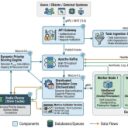
| A queue is a linear data structure that follows the First-In, First-Out (FIFO) principle. Elements are added to the rear (enqueue operation) and removed from the front (dequeue operation). This ensures that the element that has been waiting the longest is processed first, similar to a real-world queue of people waiting for service. Common queue implementations include arrays and linked lists, with each offering trade-offs in terms of memory management and efficiency for different operations.
In redis-py, RPUSH adds an element to the right (tail) of a Redis list, while LPOP removes and returns the element at the left (head) of a Redis list. Both commands operate on lists which are implemented as linked lists in Redis. RPUSH is often used for queuing, appending new data to a list, while LPOP retrieves and removes the oldest element, making it suitable for first-in, first-out (FIFO) queue implementations. These functions are accessed via the Redis connection object, typically using methods like rpush(key, value) and lpop(key).
RPUSH and LPOP can be used together to implement a queue in Redis. Here's how they work:
RPUSH: Adds items to the end of the list (enqueue).LPOP: Removes and retrieves items from the start of the list (dequeue).
This makes them ideal for a First In, First Out (FIFO) queue.
Example Code in Pythonimport redis
# Connect to Redis
client = redis.StrictRedis(
host='localhost',
port=6379,
db=0,
decode_responses=True # Ensures string decoding
)
# Enqueue (add items to the queue)
client.rpush('queue', 'task1') # Add task1
client.rpush('queue', 'task2', 'task3') # Add task2 and task3
print("Queue after enqueue:", client.lrange('queue', 0, -1)) # View entire queue
# Dequeue (remove items from the queue)
task = client.lpop('queue') # Remove the first item
print("Dequeued task:", task)
# View the queue after dequeue
print("Queue after dequeue:", client.lrange('queue', 0, -1))
# Continue dequeuing
task = client.lpop('queue')
print("Dequeued task:", task)
print("Queue after dequeue:", client.lrange('queue', 0, -1))
Output ExampleQueue after enqueue: ['task1', 'task2', 'task3']
Dequeued task: task1
Queue after dequeue: ['task2', 'task3']
Dequeued task: task2
Queue after dequeue: ['task3']
Step-by-Step Explanation- Enqueue with
RPUSH:- Adds items (
task1, task2, task3) to the end of the list named queue.
- Dequeue with
LPOP:- Removes the first item (
task1) from the start of the list. - Each subsequent
LPOP continues to remove the next item in FIFO order.
- View Queue with
LRANGE:- Use
LRANGE to check the current state of the queue.
Notes |