What is TensorRT?TensorRT is an NVIDIA SDK (Software Development Kit) designed for high-performance deep learning inference. It includes an optimizer and runtime that takes trained neural networks and optimizes them for faster execution on NVIDIA GPUs. TensorRT focuses on improving throughput and reducing latency of models in production environments, converting models into highly optimized "engines" tailored for specific NVIDIA hardware. It supports various deep learning frameworks like TensorFlow, PyTorch, and ONNX by importing models trained in these frameworks. 
How does it differ from TensorFlow?TensorRT and TensorFlow serve distinct but often complementary purposes: - TensorFlow: This is a comprehensive open-source deep learning framework used for building, training, and deploying machine learning models. It provides a vast ecosystem for data preprocessing, model architecture design, training loops, experimentation, and various deployment options. It's an end-to-end platform for the entire deep learning lifecycle, from research to development.
- TensorRT: This is an inference optimizer and runtime specifically designed to accelerate the execution of already trained deep learning models on NVIDIA GPUs. It does not provide tools for training models or defining their architectures from scratch. Instead, it takes a trained model (often exported from frameworks like TensorFlow or PyTorch) and applies a suite of optimizations to maximize its performance during deployment.
In essence, TensorFlow is like the entire factory for designing, building, and testing a high-performance vehicle, while TensorRT is a specialized tuning shop that takes that finished vehicle and optimizes its engine for maximum speed and efficiency on a specific race track. They are frequently used together: a model is trained using TensorFlow, then optimized by TensorRT for deployment. 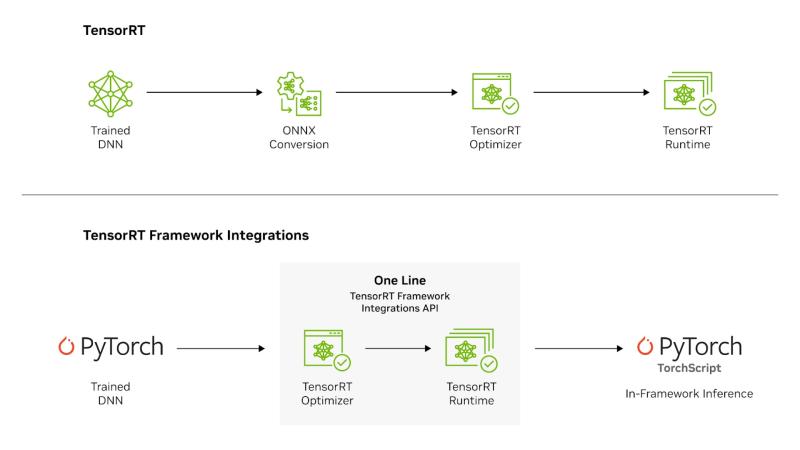
How does it improve LLM?Large Language Models (LLMs) are computationally intensive, and their efficient inference is crucial for practical applications. TensorRT significantly improves LLM performance through several key optimizations: - Quantization: Reduces the precision of weights and activations (e.g., from FP32 to FP16 or INT8), leading to a smaller memory footprint, lower memory bandwidth requirements, and faster computation with specialized hardware cores (like Tensor Cores).
- Layer Fusion: Combines multiple consecutive neural network layers or operations into a single kernel. This reduces the overhead of launching multiple GPU kernels and minimizes data movement between GPU memory and processing units.
- Kernel Auto-tuning: TensorRT automatically selects the most efficient kernel implementation for specific layers and hardware configurations, leveraging NVIDIA's highly optimized libraries.
- Memory Optimization: Efficiently manages GPU memory allocation and reuse, which is critical for the large size of LLMs.
- Graph Optimization: Analyzes the model's computation graph to identify and remove redundant layers, reorder operations for better data locality, and perform other structural optimizations.
- Dynamic Shape Optimization: LLMs often deal with variable input lengths (e.g., different prompt sizes). TensorRT can optimize for dynamic input shapes, providing efficient execution without recompiling the model for every possible input size.
These optimizations collectively lead to significantly lower inference latency, higher throughput, and reduced memory consumption, making LLMs more responsive and cost-effective to deploy. Can a startup use it?Absolutely, yes. Startups can and should use TensorRT, especially if their products or services rely on deploying AI models, particularly LLMs, in production. - Cost-Effectiveness: For startups with limited budgets, TensorRT allows them to get maximum performance out of their existing NVIDIA GPU hardware, potentially reducing the number of GPUs needed for a given workload. This translates directly into lower cloud computing costs or reduced capital expenditure.
- Competitive Advantage: Delivering AI services with lower latency and higher throughput provides a significant competitive edge, enabling faster user experiences and handling more requests with the same infrastructure.
- Scalability: By optimizing model inference, TensorRT helps startups scale their AI services more efficiently as their user base grows.
- Accessibility: TensorRT is free to download and use, and NVIDIA provides comprehensive documentation, tutorials, and community support.
- Enabling New Products: The performance gains might enable real-time AI applications that would otherwise be too slow or expensive to implement.
What is the benefit of TensorRT?The primary benefits of using TensorRT for deep learning inference are: - High Performance: Significantly reduces inference latency and increases throughput, making AI applications faster and more responsive.
- Cost Efficiency: Achieves more inference operations per GPU, leading to lower infrastructure costs (fewer GPUs needed) or higher output from existing hardware.
- Memory Optimization: Reduces the memory footprint of deep learning models, allowing larger models to run on constrained hardware or enabling more concurrent inference streams.
- Power Efficiency: Optimized execution can lead to lower power consumption, beneficial for data centers and edge devices.
- Streamlined Deployment: Provides a robust and optimized runtime environment for deploying deep learning models to production.
- Hardware Optimization: Leverages the specific capabilities of NVIDIA GPUs, including Tensor Cores, to maximize performance.
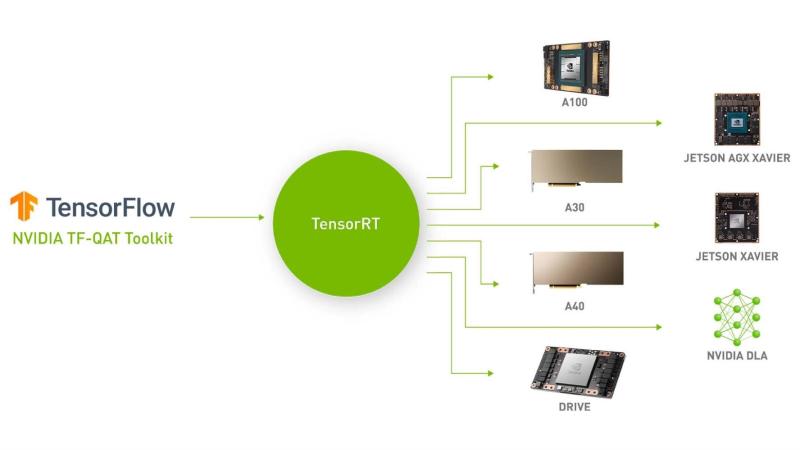
Who should use it?TensorRT is ideal for: - Deep Learning Engineers and Developers: Anyone responsible for deploying AI models into production and optimizing their performance.
- Companies Building AI-Powered Products/Services: Especially those requiring real-time or near real-time inference, such as autonomous vehicles, robotics, recommendation engines, natural language processing applications, and generative AI services (like LLMs).
- Cloud Service Providers and Data Centers: To maximize the utilization and efficiency of their NVIDIA GPU infrastructure.
- Startups: Looking to achieve high performance with limited resources and gain a competitive edge in AI-driven markets.
- Edge AI Deployments: Where computational resources, memory, and power are often highly constrained (e.g., smart cameras, IoT devices).
- Organizations Using Large Models: Such as large language models (LLMs) or complex computer vision models, where optimization is critical due to their size and computational demands.
|