Uvicorn, Gunicorn: Proving Your Production Prowess

CK CK 3776 
Created at  
395 0 0

If you've heard of uvicorn, you know Docker. If you've heard of gunicorn, you've served at a production level. Do you agree?


uvicorn vs. gunicorn: The Core Difference

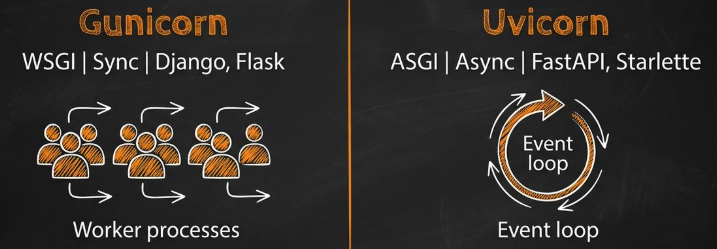
  • uvicorn: An HTTP server primarily designed for Ruby applications (using the Rack interface). It's known for its robust preforking worker model, where a master process manages multiple worker processes, each capable of handling one request at a time. Its design prioritizes stability and simplicity, often used behind a reverse proxy like Nginx.
  • gunicorn (Green uvicorn): A Python Web Server Gateway Interface (WSGI) HTTP server. Gunicorn is explicitly a Python port of uvicorn's worker model philosophy. It also employs a preforking worker model, managing multiple Python worker processes to handle concurrent requests for Python web applications (Flask, Django, etc.).

Uvicorn, Gunicorn: Proving Your Production Prowess

The fundamental difference lies in the language ecosystem they serve: uvicorn is for Ruby applications, and gunicorn is for Python applications, although they share a very similar architectural philosophy of using a preforking worker model for robust and concurrent request handling.
Uvicorn, Gunicorn: Proving Your Production Prowess


Why Use a Lightweight Development Server (like Flask's or Django's built-in server) in Development?

The question "why do we need uvicorn in development mode?" implies using a simpler, single-process server similar to uvicorn's philosophical simplicity but adapted for development, rather than uvicorn itself (which is for Ruby). In the context of Python, this refers to the built-in development servers provided by frameworks like Flask (flask run) or Django (python manage.py runserver). These servers are preferred for development for several key reasons:

1. Automatic Reloading (Hot Reloading): Development servers typically monitor code changes and automatically reload the application. This provides immediate feedback, significantly speeding up the development cycle without requiring manual server restarts for every code modification.
2. Debugging Friendliness: Running in a single process (and often a single thread) makes it much easier to use debuggers, set breakpoints, and step through code execution without the complexities of multiple concurrent processes.
3. Simplicity and Ease of Use: They require minimal to no configuration to get started. A simple command is usually sufficient to launch the server and begin testing.
4. Detailed Error Information: Development servers often provide verbose error messages and stack traces directly in the browser or console, which is invaluable for identifying and fixing bugs quickly.
5. Resource Efficiency: For local development, where only one developer is usually interacting with the application, a single-process server is perfectly adequate and consumes fewer system resources.
6. No Need for Production Features: In development, high performance, scalability, and robust security features (like SSL termination) are not priorities. Development servers are designed for functionality and convenience, not production-grade reliability.


Why Use gunicorn in Production?

gunicorn is specifically designed for production environments for Python WSGI applications due to its robustness, performance, and stability:


1. Robust Worker Model (Preforking):

  • Concurrency: gunicorn forks multiple worker processes (configurable). Each worker can handle one request at a time, allowing the application to process many requests concurrently, significantly improving throughput and responsiveness under load.
  • Isolation: If one worker process encounters an unrecoverable error and crashes, the other workers continue to serve requests. The master process detects the crash and can gracefully replace the faulty worker, maintaining application availability.
  • Resource Management: Workers can be configured to restart periodically (e.g., after a certain number of requests) to prevent long-running memory leaks or resource exhaustion, further enhancing stability.

2. Performance: gunicorn is a lean and fast HTTP server optimized for serving Python WSGI applications. It efficiently handles HTTP connections and passes requests to your Python code.
3. Stability and Reliability: Built for continuous operation, gunicorn is designed to run reliably for extended periods without requiring manual intervention, crucial for production systems.
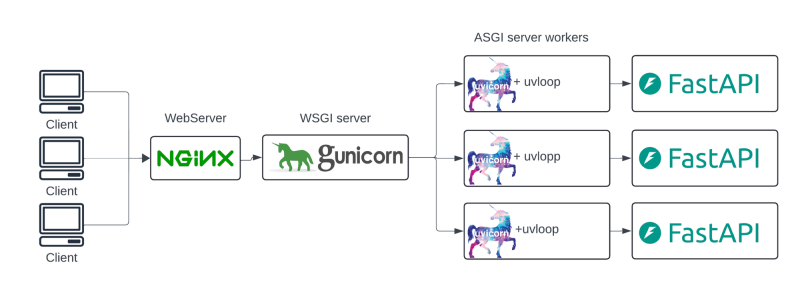
4. Integration with Reverse Proxies: gunicorn is often deployed behind a more full-featured reverse proxy server like Nginx or Apache. This setup allows the reverse proxy to handle:

  • Static file serving
  • SSL/TLS termination
  • Load balancing across multiple Gunicorn instances
  • DDoS protection and other security measures

gunicorn can then focus solely on executing the Python application code, leading to a highly optimized and secure architecture.
5. Configurability: gunicorn offers various worker types (synchronous, gevent, async, tornado) to cater to different application needs and concurrency models, along with extensive configuration options for fine-tuning performance and resource usage.
6. Security: While gunicorn itself isn't a full-fledged web server, it is significantly more secure and stable than development servers, which may inadvertently expose debugging information or lack hardening against common web vulnerabilities.
 

Uvicorn, Gunicorn: Proving Your Production Prowess

Tags Application Deployment Docker FAST API Gunicorn Production Server Python WSGI Server Management Uvicorn Web Server Facebook X
Comments 0
Similar posts
  1. Why Kubernetes? Core Features and Microservice Orchestration Strategies
    568
  2. Dynamic DNS Made Easy: Building a Python-Based Solution
    793
  3. Power of Containerized Deployment with AWS ECS
    10,594
  4. How to Set Up and Deploy Containerized Applications with AWS ECS
    10,671
  5. A basic HTTP server based in Node.js
    535
  6. Node.js-based Web Server supporting multiple path
    594
  7. "502 Bad Gateway" Error easy to happen at the combination of nginx and node.js in AWS Elastic Beanstalk
    10,485
  8. The Ultimate Data Engineering Roadmap
    1,069
  9. When you face 504 Gateway Timeout while you wait a response from Bedrock in Fast API
    531
  10. A Python Code to get the Server Instance ID for Remote Management
    358
  1. A shell script that activates a Python virtual environment and then runs a specific Python script
    740
  2. Learning about Python Multiprocessing Technique
    590
  3. Simple Example to get the total number of records in BigQuery with Python
    665
  4. Using BigQuery in Python
    407
  5. Python Web Programming based on Django from the Scratch
    366
  6. Flink with Python: Core Concepts, Kafka Integration, and Architectural Trade-offs
    183
  7. How do I determine the client IP type in Python - IPv4 or IPv6
    758
  8. Predicting Buyer Preferences with PyTorch: A Deep Learning Approach
    1,228
  9. PyTorch example to Forcast Stock Price based on 10 days Dataset
    651
  10. Implementing a Versatile DNS Server in Python: Handling A, AAAA, CNAME, and TXT Records
    1,067
  11. Dynamic DNS Made Easy: Building a Python-Based Solution
    793
  12. Milvus & FAISS: Decoding Their ML Synergy
    275
  13. Save clustering result (aka dictionary) in JSON and Reuse loaded result
    375
  14. Forecasting with Linear Regression and KNN Regression in Python
    919
  15. Forecasting the Weather with PyTorch: A Beginner's Guide to Temperature Prediction
    1,427
  16. Mastering Model Persistence: Saving and Loading Trained Machine Learning Models in Python
    1,152
  17. Harnessing the Power of Random Forest Algorithm in Python
    656
  18. Understanding and Implementing K-Nearest Neighbors (KNN) Algorithm in Python
    629
  19. Mastering Random Forest Regression: A Comprehensive Guide with Python Examples
    1,090
  20. Simple Python Clustering Example based on the high school students' score
    339
  21. Getting Started with PyTorch: A Beginner's Guide to Building Your First Neural Network
    797
  22. Memory Problems with Python Arrays? Discover Dask Array
    321
  23. Python Implementation of Linear Regression
    835
  24. Mastering Supervised Machine Learning with Python: A Comprehensive Guide
    1,053
  25. Mastering AI: A Beginner's Guide to Python Programming and Beyond
    1,031
Recently updated
  1. Why SPF and DKIM Are Essential for Linux Email Servers?
    5
  2. How do I create animated background for Google Meet?
    19,014
  3. MaxMind GeoLite2 vs. DB-IP Lite vs. ip-api.com: Choosing the Right Free IP Geolocation Solution
    193
  4. Meet Valkey: Why Redis Changed Its License, Why Valkey is Better, and How to Use It as a Drop-in Replacement
    75
  5. How Rogue Web Scrapers Are Stealing My Content and Destroying My Server
    151
  6. Array of arguments passed to script in PHP
    83
  7. Invalid Auction Storms in Ad Tech
    91
  8. Building MRC-Compliant Instrumentation in Ad Tech: Implementation Steps and Key Challenges
    194
  9. The Two Clocks of Ad Server Architecture
    61
  10. Frequency Cap Architecture Overview
    505
  11. Collecting Proof-of-Play from 100,000 Screens
    139
  12. Vector Search in Relational Databases (RDBs): Trends & Usage Environments
    276
  13. What is RedisVL?
    102
  14. Designing a Skill Registry Architecture: Minimize Token Usage and Maximize AI Performance
    219
  15. TPU & GPU Cluster Management Tools
    229
  16. The Concept of Scaffolding in AI Agents
    217
  17. Beyond Static Pipelines: Architecting LLM Multi-Agent Systems for Autonomous Workflow Orchestration
    568
  18. AI-DLC vs. AI-SDLC: Model-Centric vs. System-Centric AI Development
    246
  19. Fine-Tuning Open-Weight LLMs: Training, Licensing, and Deploying Custom Models with Ollama
    321
  20. Inside the Next-Generation Streaming Architecture: Ultra-Low Latency, SGAI, and AI Codecs
    196
  21. Machine Learning: Training vs. Ranking
    200
  22. The Continuous Learning Machine: Designing a Loop That Actually Turns
    212
  23. The Next-Gen Low-Latency Standards: LL-HLS & MoQ
    188
  24. Designing a Data Curation System Around a Vector Database
    213
  25. Extracting Context from Live Video: The Architecture Got Simpler When We Stopped Building Features
    228
  26. The New Ad Stack Behind Live Sports Streaming: Inside SGAI, EABN, and the Standards Race to Fix Live Monetization
    646
  27. Designing MLOps Architectures to Handle Seasonal Data Drift in EV Fleet Models
    181
  28. From 15 to 40+ FPS: Accelerating PyTorch Object Detection on Automotive ECUs
    203
  29. Understanding Data Lineage
    251
  30. System Requirements and Architecture: Intelligent Priority-Based Scheduler
    159