| I wanted to have a logic to get the unique server instance ID in Python, and below is what I use at the moment. Overall Goal and Format Logic1. Deterministic and Stable ID: The primary goal is to create an instance_id that is consistent for a given machine across restarts and, as much as possible, unique to that specific machine. This is crucial for logging, monitoring, and identifying specific instances of the application.
2. Format -: - Readability & Context: The
os_name prefix provides immediate context about the environment (e.g., linux-amazonlinux2023, mac-sequoia). This is more user-friendly than just a raw UUID. - Uniqueness: The
machine_uuid portion is intended to provide the unique identifier for the machine itself.
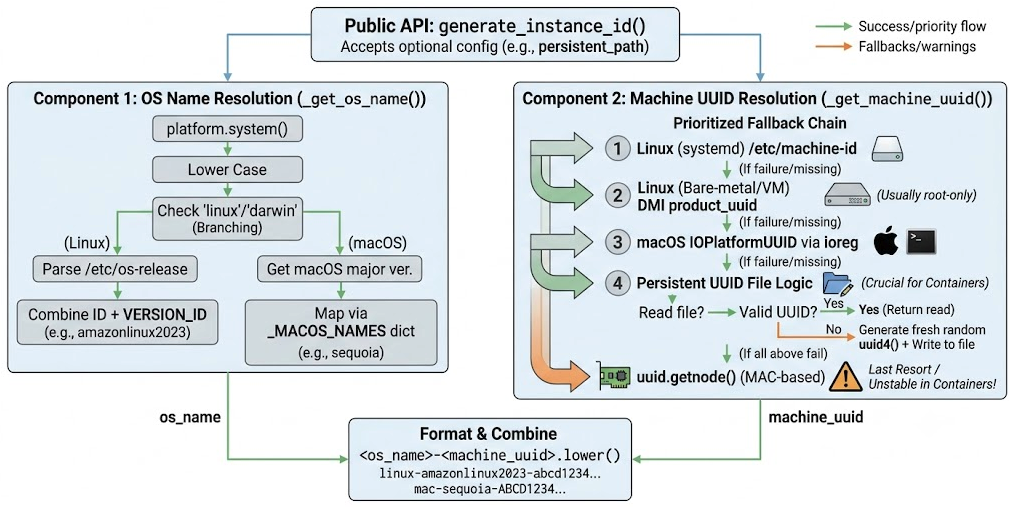
_get_os_name() Logic (Determining the OS part)
This function focuses on providing a detailed, human-readable identifier for the operating system. 1. platform.system().lower(): - Logic: Uses Python's standard
platform module to get the generic OS name (e.g., "Linux", "Darwin"). Converts it to lowercase for consistency. - Purpose: This is the initial broad categorization of the OS.
2. OS-Specific Branching: - Logic: Checks if the system is "linux" or "darwin" (macOS).
- Purpose: Different operating systems have different ways of identifying their specific distribution or version names. This branching allows for specialized logic for each.
_get_linux_distro() (for Linux systems):- Core Logic: Parses
/etc/os-release, a standard file on most modern Linux distributions (especially systemd-based ones) that contains detailed OS information. - Robust File Access: Checks
os_release.exists() to prevent errors if the file isn't present. - Key-Value Parsing: Reads the file line by line, splitting at
= to extract key=value pairs. It strips whitespace and quotes (.strip().strip('"')) for clean data. - Prioritization: Looks for
ID (e.g., "amazonlinux", "centos") and VERSION_ID (e.g., "2023", "7.0"). - Combination: Prefers to combine
ID and VERSION_ID (e.g., amazonlinux2023, centos7.0) for a more specific identifier. If VERSION_ID is missing, it falls back to just ID. - Fallback: Returns "unknown" if
/etc/os-release doesn't exist or parsing fails to yield useful IDs. - Purpose: To get a more granular and stable Linux distribution identifier than just "linux".
_get_macos_name() (for macOS systems):- Core Logic: Maps the macOS major version number to its marketing name (e.g., 15 -> "sequoia").
- Version Extraction: Uses
platform.mac_ver()[0] to get the version string (e.g., "15.0.0"). - Major Version Parsing: Extracts the first component as the major version (
int(ver.split(".")[0])). Includes try-except for ValueError or IndexError to handle malformed version strings gracefully. - Static Mapping: Uses the
_MACOS_NAMES dictionary to look up the marketing name. - Fallback: If a major version isn't in the predefined map, it generates a generic name like "macos16". Returns "unknown" if the version cannot be determined.
- Purpose: To provide a more descriptive and user-friendly macOS name (like "sequoia") instead of just a version number (like "darwin" or "15").
_get_machine_uuid() Logic (Determining the Machine UUID part)
This is the most complex part, implementing a prioritized fallback chain to find the most stable and reliable machine identifier, as described in the docstring's “Resolution order.” 1. OS-Specific Prioritization: - Logic: It first checks the OS (
platform.system().lower()) and then attempts OS-specific methods in a defined order. - Purpose: Different OSes provide different best-practice ways to identify a machine.
2. Linux Specific UUID Sources (Prioritized Order): _read_machine_id_file() (Highest Priority on Linux):- Target:
/etc/machine-id. - Logic: Checks if the file exists. If so, it reads the 32-character hexadecimal string, validates its length (must be at least 32), and formats it into a standard UUID string (e.g.,
xxxxxxxx-xxxx-xxxx-xxxx-xxxxxxxxxxxx). - Robustness: Handles
OSError if the file cannot be read. - Rationale: This is the most stable and widely available machine ID on modern Linux systems (systemd-based). It's designed to be stable across reboots.
_read_dmi_product_uuid() (Second Priority on Linux):- Target:
/sys/class/dmi/id/product_uuid. - Logic: Checks for existence and reads the DMI (Desktop Management Interface) product UUID. This is typically a UUID embedded in the system firmware for bare-metal machines or provided by the hypervisor for VMs.
- Robustness: Handles
PermissionError and OSError as this file often requires root privileges to read. - Rationale: A good fallback for bare-metal servers and some VMs, but can be less accessible (permissions) or sometimes not present.
3. macOS Specific UUID Sources (Prioritized Order): _read_macos_platform_uuid() (Highest Priority on macOS):- Target:
IOPlatformUUID obtained via the ioreg command. - Logic: Executes
ioreg -rd1 -c IOPlatformExpertDevice as a subprocess. This command queries the I/O Registry for hardware information. - Output Parsing: Scans the command's output for the line containing "IOPlatformUUID" and then extracts the UUID string from within the quotes.
- Robustness: Catches
subprocess.TimeoutExpired, FileNotFoundError, and OSError to handle issues with command execution. - Rationale: This is the standard, stable way to get a unique hardware identifier on macOS.
4. Persistent UUID File Logic (Universal Fallback, Crucial for Containers): _read_or_create_persistent_uuid(path):- Logic: This function is a critical fallback, especially for containerized environments (like Docker) where host-level
/etc/machine-id or DMI data might not be available or mounted. - "Read-then-Create" Pattern:
- Read First: If the
path (e.g., data/instance-id) exists, it attempts to read the UUID from it. - Validation: It tries to parse the read value as a
uuid.UUID. If the file contains an invalid UUID, it logs a warning and proceeds to generate a new one, ensuring data integrity. - Return Existing: If a valid UUID is read, it's returned, ensuring stability across restarts.
- Create New: If the file doesn't exist or contains an invalid UUID:
- Generates a fresh random UUID using
uuid.uuid4(). - Directory Creation: Ensures the parent directory (
path.parent) exists using mkdir(parents=True, exist_ok=True) before attempting to write the file. This makes the function robust against missing directories. - Writes the newly generated UUID to the file.
- Logs an informational message about the creation.
- Robustness: Catches
OSError during file operations (read/write/mkdir) and logs a warning, returning None if the persistent file cannot be used. - Purpose: Guarantees a stable
instance_id for stateless (from the host perspective) environments like Docker containers, by persisting a randomly generated UUID within the container's data volume (if mounted and writable).
5. uuid.getnode() (Last-Resort Fallback): - Logic: If all other methods fail to yield a UUID (no system files, no DMI, no
ioreg, and no persistent file or writable data directory), this function uses Python's uuid.getnode(). This typically derives a UUID from the MAC address of a network interface. - Warning Log: A
logger.warning is explicitly included. - Rationale:
- Unstable in Containers: As noted in the docstring, this is highly unstable in Docker because
veth (virtual Ethernet) MAC addresses are often regenerated on every docker run, leading to a different instance_id each time, defeating determinism. - *Provides something: Despite its instability in some contexts, it always provides a* UUID, preventing the program from crashing if no other identifier can be found. It's a "better than nothing" solution, but with a clear indication of its limitations.
generate_instance_id() (Public API Logic)
1. Orchestration: This is the main entry point for the module.
2. Composition: It simply calls _get_os_name() and _get_machine_uuid() to get the two components.
3. Formatting: It then combines them using an f-string: f"{_get_os_name()}-{_get_machine_uuid(persistent_path).lower()}".
4. Lowercasing UUID: The .lower() call on the machine_uuid ensures a consistent case for the UUID part, which is generally a good practice for identifiers.
5. Configurable Persistent Path: persistent_path: Path | None = DEFAULT_PERSISTENT_PATH allows the caller to either use the default path (data/instance-id), specify a different path, or explicitly disable persistent storage by passing None. In summary, the code demonstrates a robust and well-thought-out strategy for generating a deterministic instance ID by: - Prioritizing reliable, system-level identifiers.
- Implementing OS-specific methods.
- Providing a critical persistent file fallback for containerized environments.
- Including a last-resort fallback with a clear warning about its limitations.
- Structuring the ID for both uniqueness and human readability.
# ━━━━━━━━━━━━━━━━━━━━━━━━━━━━━━━━━━━━━━━━━━━━━━━━━━━━━━━━━━━━
#  instance_id.py
#  Author : Chun Kang <ck@ckii.com>
# ━━━━━━━━━━━━━━━━━━━━━━━━━━━━━━━━━━━━━━━━━━━━━━━━━━━━━━━━━━━━

"""Auto-generate a deterministic instance_id from OS identity.

Format: ``<os_name>-<machine_uuid>``

Examples::

    linux-amazonlinux2023-abcd1234-5678-...
    linux-centos7.0-abcd1234-5678-...
    mac-sequoia-ABCD1234-5678-...

Resolution order for the machine UUID portion:

1. ``/etc/machine-id`` (Linux, systemd) — stable across reboots.
2. ``/sys/class/dmi/id/product_uuid`` (Linux bare-metal / VMs, usually root-only).
3. ``IOPlatformUUID`` via ``ioreg`` (macOS).
4. A persistent UUID file (default ``data/instance-id``). Created with a fresh
   random UUID on first miss, then read back on every subsequent start. This is
   the path that keeps container IDs stable across restarts when no host
   machine-id is available.
5. ``uuid.getnode()`` as a last-resort, logged-as-warning fallback — this
   produces the ``00000000-0000-0000-0000-<mac>`` pattern, which is unstable
   in Docker because veth MACs change on every ``docker run``.
"""

from __future__ import annotations

import logging
import platform
import subprocess
import uuid
from pathlib import Path

logger = logging.getLogger(__name__)

_MACOS_NAMES: dict[int, str] = {
    11: "bigsur",
    12: "monterey",
    13: "ventura",
    14: "sonoma",
    15: "sequoia",
    16: "tahoe",
}

DEFAULT_PERSISTENT_PATH = Path("data/instance-id")


def _get_os_name() -> str:
    """Return a short OS identifier like ``linux-amazonlinux2023`` or ``mac-sequoia``."""
    system = platform.system().lower()

    if system == "linux":
        return f"linux-{_get_linux_distro()}"
    if system == "darwin":
        return f"mac-{_get_macos_name()}"
    return system


def _get_linux_distro() -> str:
    """Parse /etc/os-release for distro ID and version."""
    os_release = Path("/etc/os-release")
    if not os_release.exists():
        return "unknown"

    info: dict[str, str] = {}
    for line in os_release.read_text().splitlines():
        if "=" in line:
            key, _, val = line.partition("=")
            info[key.strip()] = val.strip().strip('"')

    distro_id = info.get("ID", "unknown")
    version_id = info.get("VERSION_ID", "")

    if version_id:
        return f"{distro_id}{version_id}"
    return distro_id


def _get_macos_name() -> str:
    """Map macOS version to its marketing name."""
    ver = platform.mac_ver()[0]
    if not ver:
        return "unknown"
    try:
        major = int(ver.split(".")[0])
    except (ValueError, IndexError):
        return "unknown"
    return _MACOS_NAMES.get(major, f"macos{major}")


def _read_machine_id_file() -> str | None:
    """Read /etc/machine-id and format as UUID. Returns None if unusable."""
    machine_id_path = Path("/etc/machine-id")
    if not machine_id_path.exists():
        return None
    try:
        hex_id = machine_id_path.read_text().strip()
    except OSError:
        return None
    if len(hex_id) < 32:
        return None
    return f"{hex_id[:8]}-{hex_id[8:12]}-{hex_id[12:16]}-{hex_id[16:20]}-{hex_id[20:32]}"


def _read_dmi_product_uuid() -> str | None:
    """Read /sys/class/dmi/id/product_uuid (Linux bare-metal/VM). Usually root-only."""
    dmi_path = Path("/sys/class/dmi/id/product_uuid")
    if not dmi_path.exists():
        return None
    try:
        value = dmi_path.read_text().strip().lower()
    except (PermissionError, OSError):
        return None
    return value or None


def _read_macos_platform_uuid() -> str | None:
    """Call ioreg to retrieve IOPlatformUUID on macOS."""
    try:
        result = subprocess.run(
            ["ioreg", "-rd1", "-c", "IOPlatformExpertDevice"],
            capture_output=True, text=True, timeout=5, check=False,
        )
    except (subprocess.TimeoutExpired, FileNotFoundError, OSError):
        return None
    for line in result.stdout.splitlines():
        if "IOPlatformUUID" in line:
            parts = line.split('"')
            if len(parts) >= 4:
                return parts[3]
    return None


def _read_or_create_persistent_uuid(path: Path) -> str | None:
    """Read a random UUID from ``path``, creating it on first call.

    Returns None only if both read and create fail (e.g. unwritable directory).
    """
    try:
        if path.exists():
            value = path.read_text().strip()
            if value:
                try:
                    return str(uuid.UUID(value))
                except ValueError:
                    logger.warning("invalid UUID in %s, regenerating", path)
        new_uuid = str(uuid.uuid4())
        path.parent.mkdir(parents=True, exist_ok=True)
        path.write_text(new_uuid)
        logger.info("generated persistent instance_id UUID at %s", path)
        return new_uuid
    except OSError as exc:
        logger.warning("cannot use persistent instance_id file %s: %s", path, exc)
        return None


def _get_machine_uuid(persistent_path: Path | None = None) -> str:
    """Resolve the machine UUID by walking the fallback chain."""
    system = platform.system().lower()

    if system == "linux":
        value = _read_machine_id_file()
        if value:
            return value
        value = _read_dmi_product_uuid()
        if value:
            return value

    if system == "darwin":
        value = _read_macos_platform_uuid()
        if value:
            return value

    if persistent_path is not None:
        value = _read_or_create_persistent_uuid(persistent_path)
        if value:
            return value

    logger.warning(
        "falling back to MAC-based instance UUID; this is unstable in containers — "
        "mount /etc/machine-id, set ODX_INSTANCE_ID, or ensure the data volume is writable"
    )
    return str(uuid.UUID(int=uuid.getnode()))


def generate_instance_id(persistent_path: Path | None = DEFAULT_PERSISTENT_PATH) -> str:
    """Generate a deterministic instance_id from OS identity.

    Returns ``<os_name>-<machine_uuid>``,
    e.g. ``mac-sequoia-ABCD1234-5678-90AB-CDEF-1234567890AB``.
    """
    return f"{_get_os_name()}-{_get_machine_uuid(persistent_path).lower()}"
|