| Combining Milvus, an open-source vector database, with Large Language Models (LLMs) is not only practical but has become a prevalent and highly effective strategy for building advanced AI applications. The core idea is to leverage Milvus's ability to store, index, and retrieve high-dimensional vector embeddings, which represent the semantic meaning of data, to augment the capabilities of LLMs, primarily in providing relevant, up-to-date, and domain-specific context. 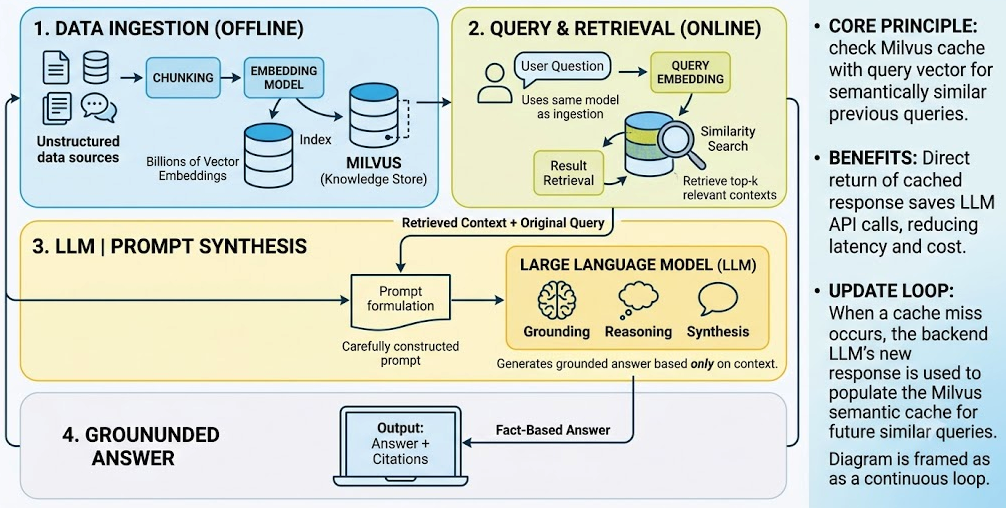
Why Combine Milvus and LLMs?Integrating Milvus with LLMs provides several significant advantages that address common limitations of standalone LLMs: - Enhanced Contextual Understanding: LLMs, while powerful, have a limited context window. Milvus allows an LLM to access and incorporate vast amounts of external, relevant information beyond its training data or immediate prompt.
- Reduced Hallucination: By grounding the LLM's responses in factual, retrieved data from Milvus, the tendency for LLMs to "hallucinate" or generate factually incorrect information is significantly mitigated.
- Improved Factual Accuracy and Reliability: Responses are based on verifiable data stored in Milvus, making them more accurate, trustworthy, and auditable, especially crucial for enterprise applications.
- Handling Large and Dynamic Datasets: Milvus can efficiently manage billions of vector embeddings, enabling LLMs to operate over extremely large and constantly updated private or proprietary datasets without retraining.
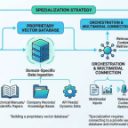
- Domain-Specific Expertise: LLMs are general-purpose. Milvus allows them to be specialized for specific domains (e.g., legal documents, medical research, internal company knowledge bases) by providing context from curated domain-specific data.
- Personalization and Customization: Context can be tailored based on individual user profiles or preferences stored and retrieved from Milvus, leading to more personalized LLM outputs.
- Cost-Effectiveness and Efficiency: Instead of fine-tuning or retraining LLMs (which is expensive and time-consuming) for new information, simply updating the Milvus knowledge base allows the LLM to access the latest data. This also reduces the need for very long context windows in LLMs, which can be computationally expensive.
- Explainability: In some RAG architectures, the retrieved source documents from Milvus can be provided alongside the LLM's answer, offering transparency and explainability.
LLMs cannot 'directly' recognize Milvus to read and write data. This is because a Large Language Model (LLM) is essentially just a 'brain' (a processing unit); it lacks the 'hands and feet' to log into an external program like Milvus on its own.
An LLM cannot 'directly' interact with Milvus to read or write data. In essence, an LLM acts strictly as a 'brain' (a computational engine) and does not possess the operational 'hands and feet' required to independently connect to and navigate an external application like Milvus."
Services like Google's Gemini and OpenAI's ChatGPT generate answers by internally integrating massive systems, such as Milvus or Google's in-house developed vector databases.
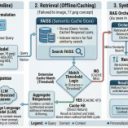
How Milvus and LLMs Can Be Combined (Practical Architectures)The most common and impactful method for combining Milvus and LLMs is through Retrieval-Augmented Generation (RAG). 1. Retrieval-Augmented Generation (RAG):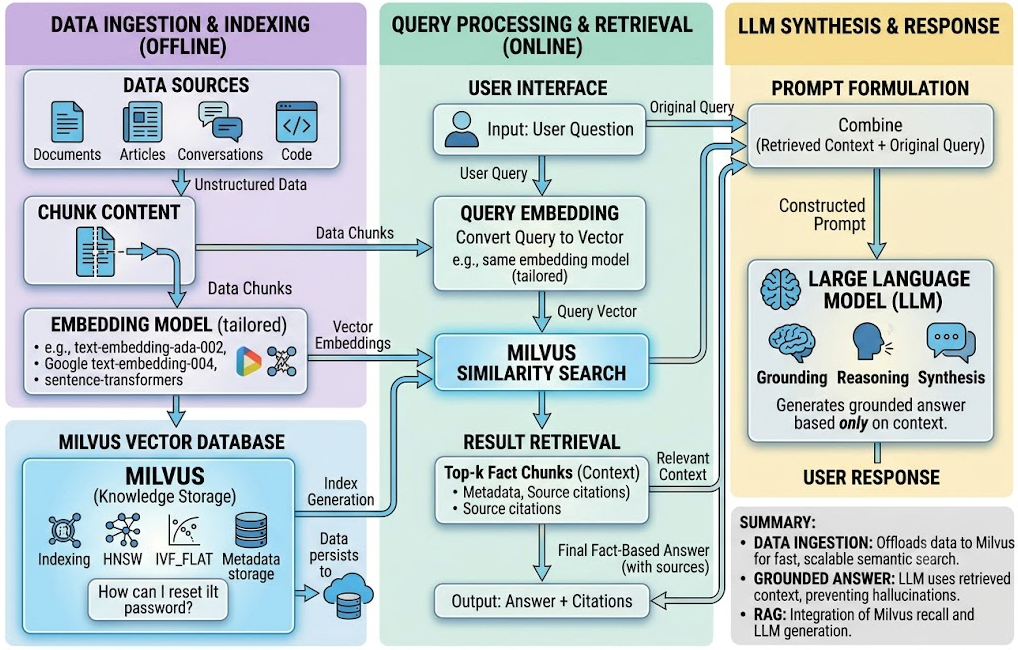
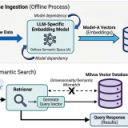
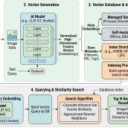
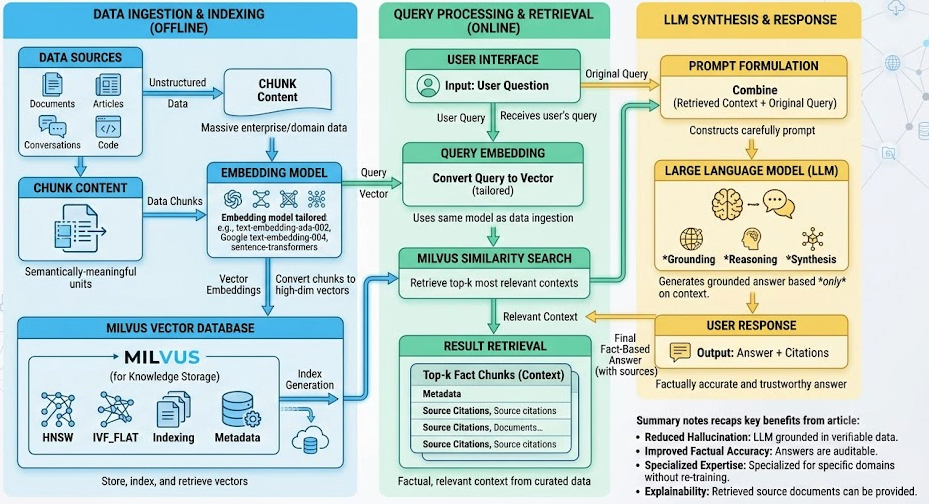
- Data Ingestion and Embedding:
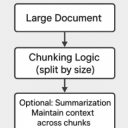
- Unstructured or semi-structured data (documents, articles, conversations, code, etc.) is chunked into smaller, semantically meaningful units.
- Each chunk is then transformed into a high-dimensional vector embedding using an embedding model (e.g., OpenAI's
text-embedding-ada-002, Google's text-embedding-004, or open-source models like sentence-transformers). - These vector embeddings, along with their original text content or metadata, are inserted into Milvus. Milvus indexes these vectors for efficient similarity search.
- Query Processing:
- When a user asks a question, the query itself is also converted into a vector embedding using the same embedding model.
- This query vector is then sent to Milvus to perform a similarity search. Milvus retrieves the top-k most relevant data chunks (vectors) based on their semantic similarity to the query.
- LLM Synthesis:
- The retrieved text chunks (the "context") are then combined with the original user query and fed into a Large Language Model (LLM) as part of a carefully constructed prompt.
- The LLM uses this provided context to generate a more accurate, relevant, and grounded answer, rather than relying solely on its internal training knowledge.
The Simple Mulvus Query ExampleLet's say we want to retrieve the FirstName, LastName, and Email of all customers who live in "California" and have spent more than $500, ordered by their last name. SELECT FirstName, LastName, Email
FROM Customers
WHERE State = 'CA' AND TotalSpend > 500.00
ORDER BY LastName ASC;
In simple terms, this Mulvus query asks the database:
"Show me the first name, last name, and email for all customers who are from California and have spent over $500, and please sort that list by their last name from A to Z." 2. Semantic Caching: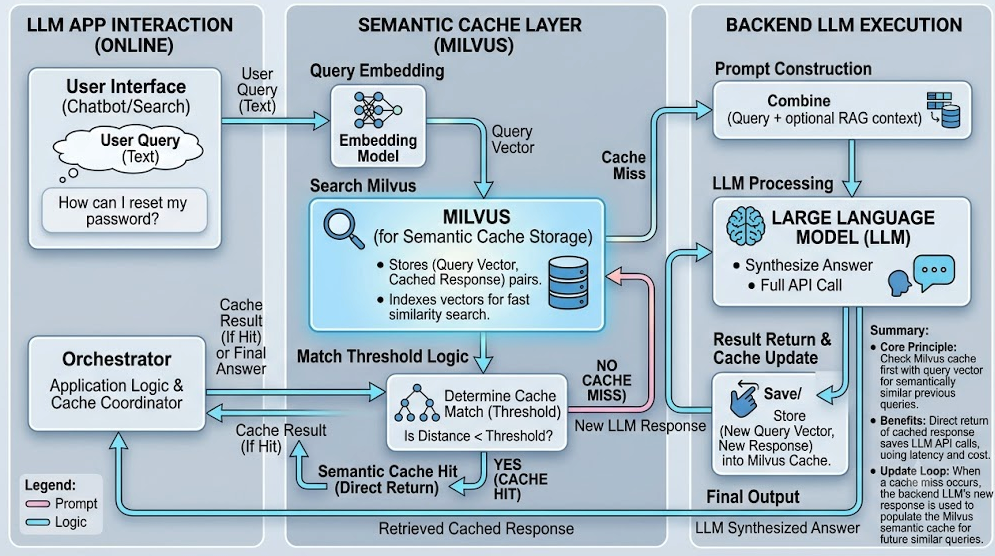
- Milvus can act as a semantic cache for LLM queries. Before sending a new query to an LLM, its embedding can be searched in Milvus.
- If a sufficiently similar query has been processed before, and its LLM response cached, Milvus can retrieve the cached response directly, saving LLM API calls and reducing latency.
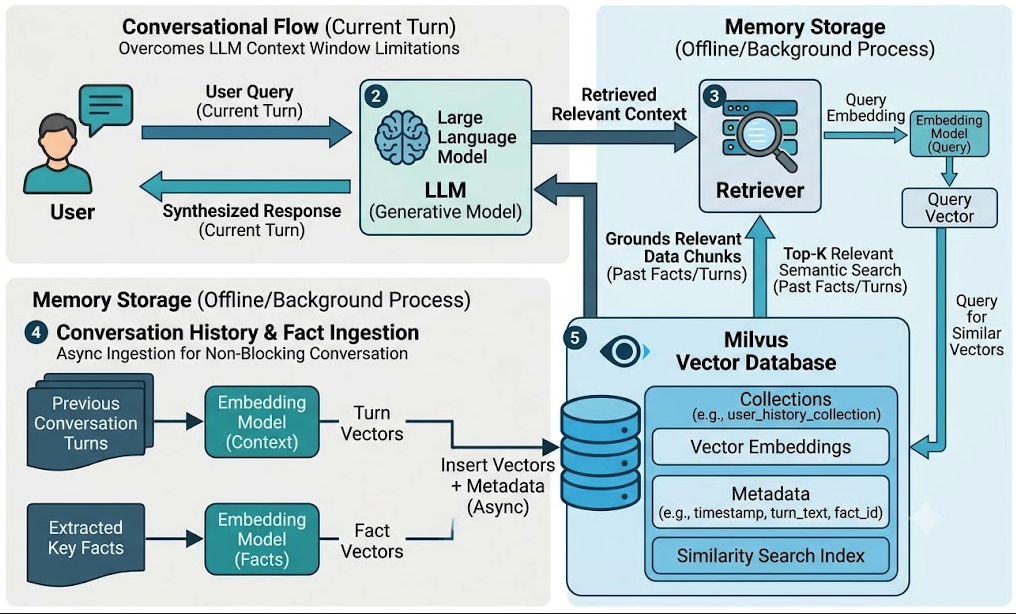
3. Long-Term Memory for Conversational AI:- In ongoing conversations, Milvus can store embeddings of past turns or key facts.
- When a new query arrives, Milvus retrieves relevant past context, allowing the LLM to maintain a consistent and informed conversation across many turns, overcoming its limited immediate context window.
Note that Mulvus does not exclusively keep information instantly; while much of its processing involves transient data that is not permanently stored, it also possesses mechanisms for the secure and long-term archival of critical information, ensuring that specific data points are retained beyond immediate operational needs. Example Code - Top-K Similarity Searchimport openai
from pymilvus import MilvusClient
# =====================================================================
# 1. Initialization and Connection
# =====================================================================
# Initialize the Milvus client
milvus_client = MilvusClient("http://localhost:19530")
COLLECTION_NAME = "article_embeddings"
# Load the existing collection into memory (Required before searching)
milvus_client.load_collection(collection_name=COLLECTION_NAME)
# =====================================================================
# 2. Process User's Natural Language Query
# =====================================================================
# The user enters a query in natural language (plain text)
user_query = "Find articles about the latest artificial intelligence trends."
# Convert the natural language text into a vector embedding using an embedding model.
# CRITICAL: This must be the EXACT SAME model used when storing the articles.
openai_response = openai.Embedding.create(
input=user_query,
model="text-embedding-3-small"
)
# Extract the resulting high-dimensional numerical vector (list of floats)
query_vector = openai_response['data'][0]['embedding']
# =====================================================================
# 3. Execute Vector Similarity Search in Milvus
# =====================================================================
# Pass the numerical vector to Milvus to find the top-K closest matches
search_results = milvus_client.search(
collection_name=COLLECTION_NAME,
data=[query_vector], # Milvus expects a list of vectors
anns_field="embedding", # The name of the vector field in your DB
limit=5, # Top-K: Number of closest results to return
output_fields=["title", "publication_date"] # Metadata fields to retrieve
)
# =====================================================================
# 4. Display the Search Results
# =====================================================================
print(f"Top 5 matches for query: '{user_query}'\n")
for hit in search_results[0]:
print(f"Article ID: {hit.id}")
print(f"Similarity Score (Cosine): {hit.distance:.4f}")
if hit.entity:
print(f"Title: {hit.entity.get('title')}")
print(f"Published Date: {hit.entity.get('publication_date')}")
print("-" * 40)
Key Concepts Explained:- No
random.uniform: Instead of generating dummy numbers, it uses openai.Embedding.create to turn real human language into real semantic numbers. - No
CollectionSchema: It assumes the database is already running and populated, so it directly jumps to load_collection() and search().
Milvus only understands vectors (sets of numbers)Milvus exclusively processes numerical vectors because its core function is to operate as a specialized vector database, optimized for efficient storage, indexing, and similarity search of high-dimensional embeddings. These vector embeddings are numerical representations that capture the semantic meaning and features of various data types, allowing Milvus to perform rapid mathematical comparisons and distance calculations to find similar items, rather than directly interpreting human-readable text or complex objects. Many LLMs have a feature to convert natural text into numerical embeddingsMany models within the broader landscape of large language models (LLMs) are indeed designed to convert natural text into numerical embeddings, a fundamental capability for tasks like semantic search, similarity matching, and retrieval-augmented generation. Yes, Gemini 1.5 Flash, part of the Gemini family of models, is certainly capable of performing this very function, allowing users to generate high-quality vector representations directly from text inputs. Embedding Vector Result for "I am hungry" (Example) [
-0.01249764, 0.03158912, -0.00512648, 0.04128941, -0.02158911,
0.00894125, -0.01358941, 0.05214891, -0.00314894, 0.01158941,
...
# (Omitted: Total of 1,536 numbers representing coordinates that the computer understands)
...
-0.00784152, 0.01958412, -0.03418941, 0.01248915, -0.00214891
]
4. Content Moderation and Filtering:- Embeddings of known inappropriate content can be stored in Milvus. New user-generated content can be embedded and checked against Milvus to flag or filter out similar content.
5. Personalized Recommendations:- User preferences or item descriptions can be embedded and stored in Milvus.
- When a user interacts with a system, their current query or behavior can be embedded, and Milvus can retrieve semantically similar items or relevant recommendations to inform an LLM for personalized suggestions.
Practical Use CasesEnterprise Search and Q&A Systems: Employees can ask natural language questions about internal documents (HR policies, technical manuals, sales reports), and the system, powered by Milvus and an LLM, provides precise answers grounded in company data. 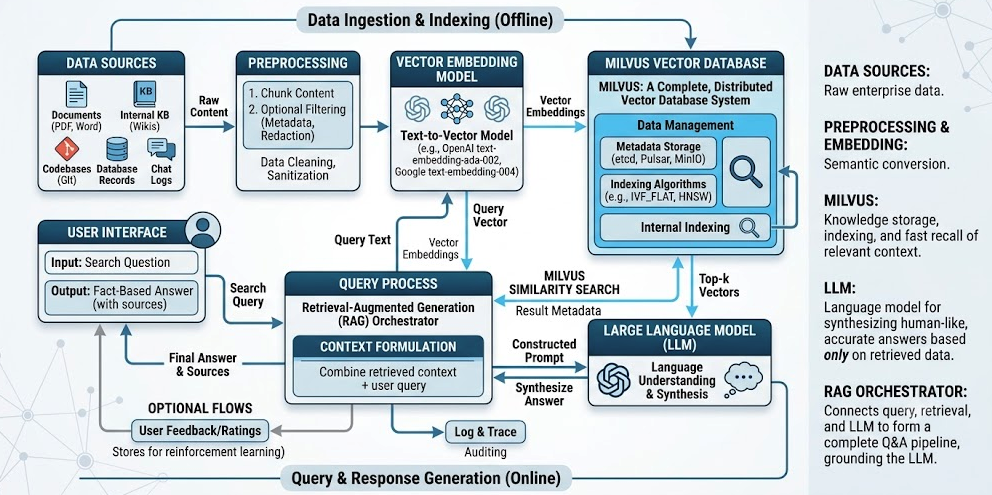
Customer Support Chatbots: Chatbots can provide detailed, accurate answers to customer queries by retrieving product information, FAQs, or troubleshooting guides from a Milvus-powered knowledge base. 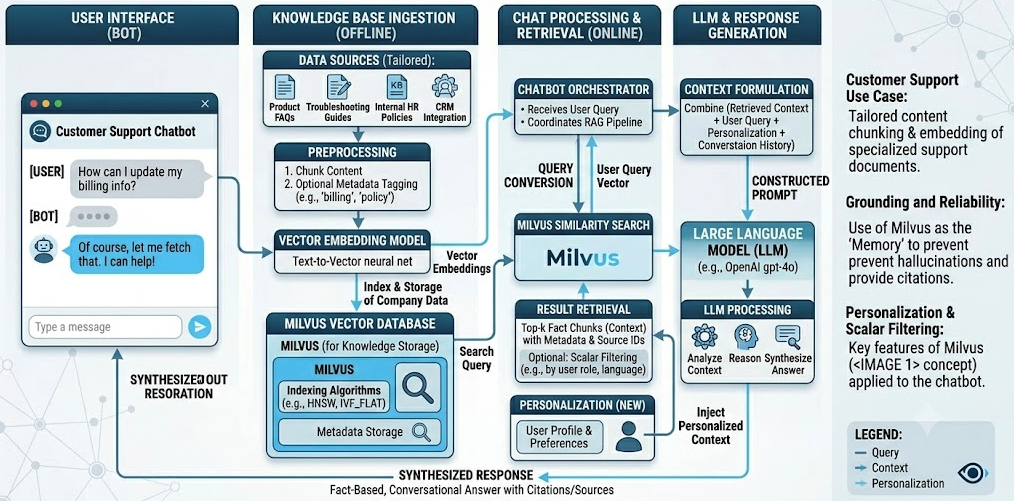
Knowledge Management Systems: Creating interactive systems where users can explore and query large datasets of research papers, legal texts, or educational materials. 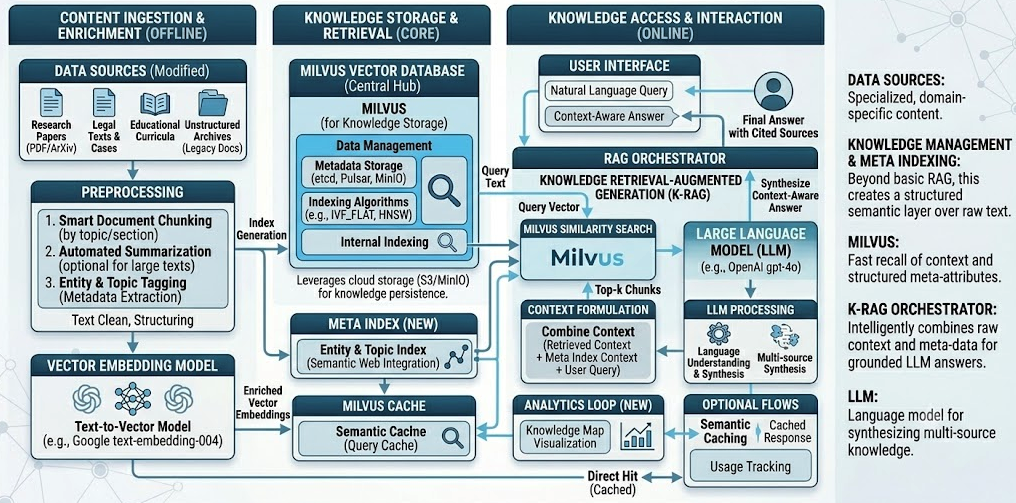
Content Creation and Summarization: LLMs can generate summaries or new content based on context retrieved from a Milvus index of relevant articles or research papers. 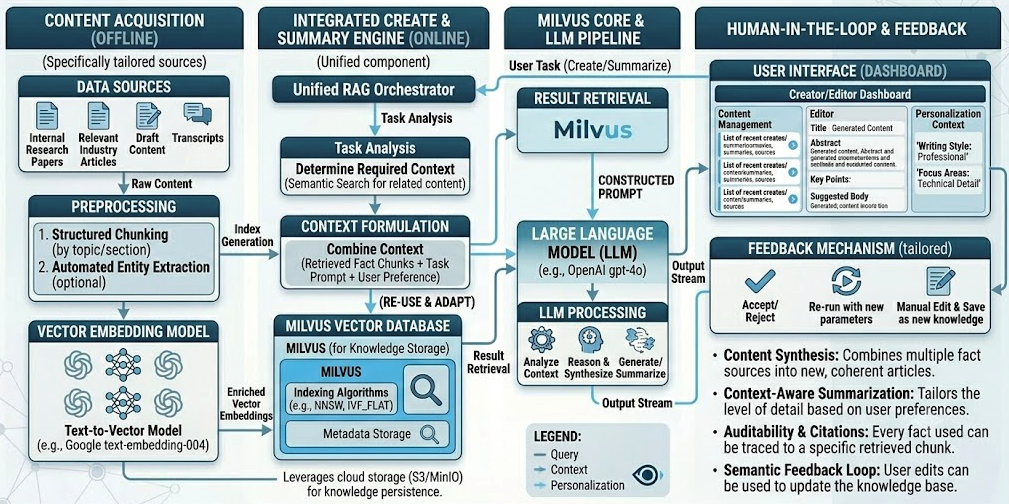
Code Generation and Explanation: Milvus can store embeddings of internal codebases, documentation, or best practices. LLMs can then use this context to generate more accurate code, explain existing code, or suggest improvements. 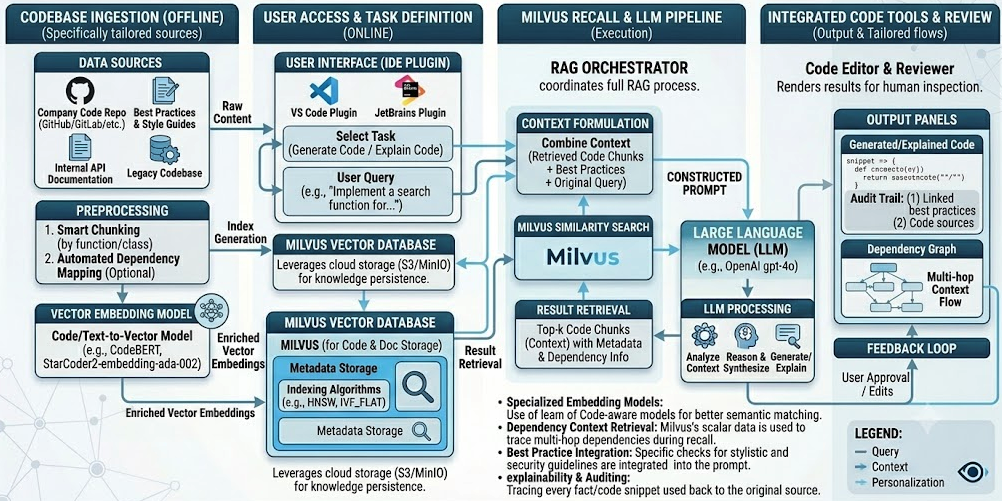
ConclusionThe combination of Milvus and LLMs is not only practical but represents a fundamental architectural pattern for building intelligent applications that require access to dynamic, proprietary, or vast amounts of external knowledge. By offloading the knowledge management and retrieval to Milvus, LLMs can focus on their core strength of language understanding and generation, leading to more powerful, accurate, and versatile AI solutions. |