Flink with Python: Core Concepts, Kafka Integration, and Architectural Trade-offs
CK 3788 Created at
19300
Apache Flink is primarily written in Java and Scala. The core runtime, APIs, and connectors are implemented in these JVM-based languages.
Flink Architecture for Python Usage
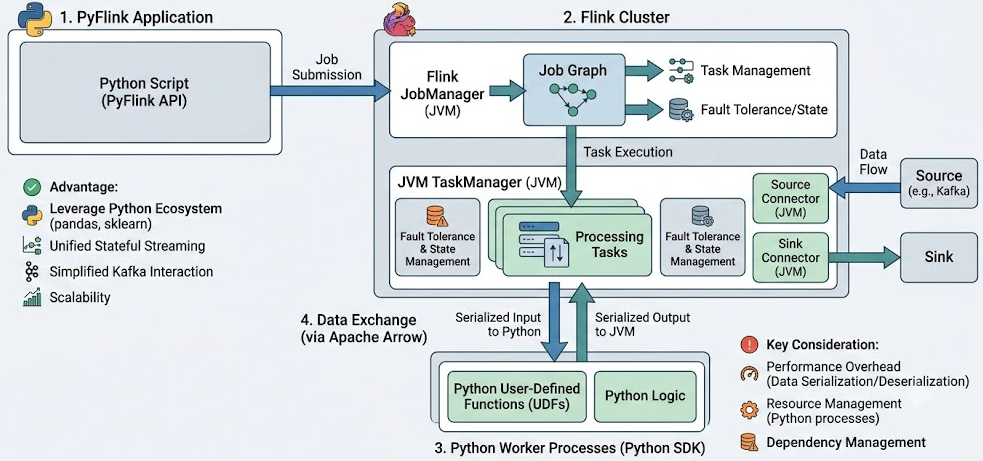
When using Flink with Python (PyFlink), the architecture involves an interaction between the JVM-based Flink runtime and Python processes.
1. PyFlink API: Developers write their stream or batch processing jobs using the PyFlink API, which is a Python wrapper around Flink's core functionalities. This includes defining data sources, transformations (like map, filter, join), and sinks. 2. Job Submission: The Python script is submitted to a Flink cluster. The PyFlink client translates the Python API calls into a Flink job graph, which is then managed and executed by the Flink JobManager. 3. JVM TaskManagers: The Flink cluster's TaskManagers (which are JVM processes) are responsible for executing the tasks of the job graph. 4. Python Worker Processes: For tasks that involve Python User-Defined Functions (UDFs) or other Python-specific logic, the Flink TaskManager launches a separate Python worker process (often managed via a Python SDK worker). 5. Data Exchange: Data is exchanged between the JVM (Flink TaskManager) and the Python worker process. This data transfer is optimized using technologies like Apache Arrow to minimize serialization/deserialization overhead.
Input data is serialized from the JVM to the Python process.
The Python UDF executes on the data.
Output data is serialized from the Python process back to the JVM.
6. Execution Flow: The Flink runtime in the JVM orchestrates the entire job, including scheduling tasks, managing state, ensuring fault tolerance, and coordinating with the Python worker processes as needed.
In essence, PyFlink provides a Pythonic interface, but the heavy lifting of distributed execution, state management, and fault tolerance is still handled by Flink's battle-tested JVM runtime.
Flink with Kafka and Python Architecture
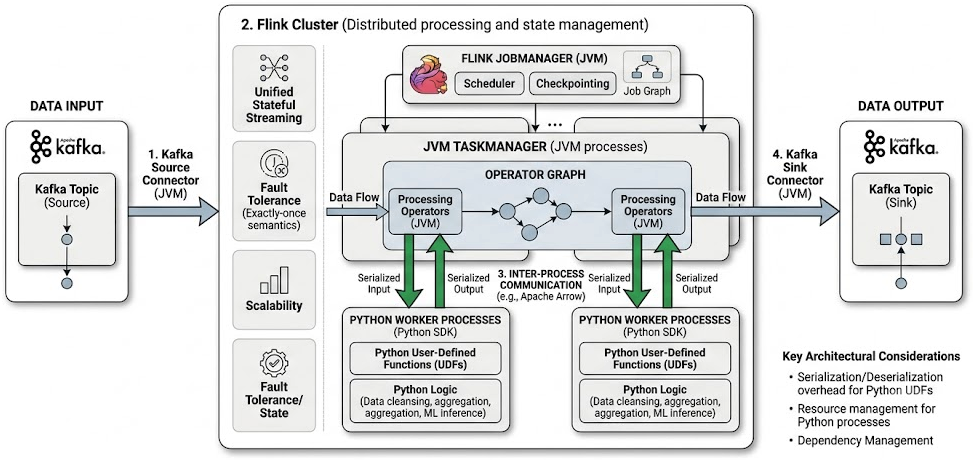
When integrating Flink with Kafka using Python, the architecture combines the PyFlink model with Flink's native Kafka connectors.
1. Kafka Cluster: Serves as the high-throughput, fault-tolerant message broker for ingesting and outputting data streams. 2. Flink Kafka Connector (JVM-based): Flink provides robust, built-in Kafka connectors (implemented in Java/Scala) that serve as sources to read data from Kafka topics and sinks to write data to Kafka topics. These connectors handle deserialization/serialization of Kafka messages to Flink's internal data types. 3. PyFlink Application:
The PyFlink application defines the Flink job, specifying the Kafka source (using add_source or from_kafka with KafkaSourceDescriptor), the series of transformations, and the Kafka sink (using add_sink or to_kafka with KafkaSinkDescriptor).
User-defined logic (e.g., data cleansing, aggregation, machine learning inference) is implemented in Python UDFs.
4. Data Flow:
Source: The Flink Kafka Connector (running within a JVM TaskManager) reads messages from the specified Kafka topic(s).
Processing (Python UDFs): If the Flink job includes Python UDFs, the data records obtained from Kafka are passed from the Flink TaskManager (JVM) to the Python worker process. The Python UDFs process these records.
Processing (Flink Operators): Other non-Python specific transformations might be executed directly by Flink's JVM operators.
Sink: After processing, the resulting data stream is passed back to the Flink Kafka Connector (JVM) to be serialized and written to an output Kafka topic.
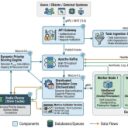
Architecture Diagram (Conceptual):
Advantages (Pros):
Leverage Python Ecosystem: Gain access to the rich set of Python libraries for data analysis, machine learning (e.g., pandas, NumPy, scikit-learn, TensorFlow, PyTorch), and custom business logic.
Developer Productivity: Python's ease of use and rapid development capabilities can accelerate the creation of stream processing applications.
Unified Streaming Platform: Benefit from Flink's robust capabilities—stateful processing, exactly-once semantics, fault tolerance, and high throughput—while expressing application logic in Python.
Simplified Kafka Interaction: Flink's native Kafka connectors abstract away the complexities of interacting with Kafka directly, allowing developers to focus on data transformation logic rather than low-level client details.
Scalability: Inherits Flink's inherent ability to scale processing across a distributed cluster.
Disadvantages (Cons):
Performance Overhead: Data serialization and deserialization between the JVM (Flink) and Python processes introduce some overhead, even with optimizations like Apache Arrow. This can be a bottleneck for extremely high-throughput or low-latency applications that are heavily reliant on Python UDFs.
Resource Consumption: Running separate Python worker processes alongside JVM TaskManagers can increase the overall memory and CPU footprint of the Flink cluster.
Debugging Complexity: Debugging issues that span across the JVM and Python boundaries can be more challenging than debugging within a single language environment.
Feature Parity: While PyFlink is constantly improving, the Python API might occasionally lag behind the Java/Scala APIs in terms of immediate access to the absolute latest Flink features or highly specialized connectors.
Dependency Management: Managing Python dependencies and environments for UDFs on a distributed Flink cluster can add complexity to deployment and maintenance.
Python Libraries for Kafka Integration with Flink-like Performance
When aiming for Flink-like performance in Python for Kafka-based stream processing, you're looking for libraries that offer high throughput, low latency, and often scalability through distributed processing. While pure Python might not always match the raw JVM-based performance of Flink for every single operation, several options leverage C-bindings, asynchronous programming, or distributed frameworks to achieve impressive results.
1. Low-Level Kafka Clients (Foundational)
These libraries provide the core client functionality to interact with Kafka brokers efficiently. Building higher-level stream processing on top of these is common.
confluent-kafka-python
Description: The official Python client for Apache Kafka developed by Confluent. It's a thin wrapper around librdkafka, a highly optimized C library, making it exceptionally fast and robust.
Performance Aspect: Its C-binding allows it to achieve very high throughput and low latency, often matching or exceeding other language clients. It's the go-to choice for performance-critical applications.
Features: Supports all modern Kafka features (producer, consumer, consumer groups, transactions, exactly-once semantics, SASL, SSL, schema registry integration via confluent_kafka.schema_registry).
kafka-python
Description: A pure Python client for Apache Kafka. It's often easier to get started with for simpler use cases due to its pure Python nature, meaning no C-compiler or librdkafka dependency is needed.
Performance Aspect: While perfectly fine for many applications, its pure Python implementation generally means it won't reach the same absolute peak throughput as confluent-kafka-python for extremely high volumes, especially for CPU-bound serialization/deserialization tasks.
Features: Provides basic producer and consumer functionality, supports consumer groups, and common Kafka protocol versions.
These frameworks provide higher-level abstractions for building complex stream processing applications, closer to what Flink offers.
PyFlink
Description: This is the official Python API for Apache Flink itself. Instead of trying to replicate Flink's performance in Python, you are directly using Flink with Python as your programming language.
Performance Aspect: You get the full power and distributed processing capabilities of Apache Flink, which is a state-of-the-art stream processing engine known for its high performance, fault tolerance, and low latency. The Python API translates your code into Flink's execution graph.
Features: Supports DataStream API (for unbound streams) and Table API/SQL (for declarative processing), stateful computations, windowing, exactly-once semantics, integration with various data sources/sinks including Kafka. Ideal for enterprise-grade, large-scale stream processing.
PySpark Structured Streaming
Description: The Python API for Apache Spark's Structured Streaming. Spark is another industry-leading distributed processing framework, and Structured Streaming provides a high-level API for continuous processing of data streams.
Performance Aspect: Highly performant and scalable, leveraging Spark's distributed execution engine. While often micro-batch oriented (processing data in small, continuous batches), it achieves near real-time latency and very high throughput for many use cases.
Features: Supports fault-tolerant, scalable stream processing with DataFrame/Dataset API, integration with Kafka, HDFS, S3, etc., rich set of transformations, stateful operations, and flexible deployment options.
Faust
Description: A Python stream processing library inspired by Kafka Streams (Java), built on confluent-kafka-python and asyncio. It aims to provide a Flask-like developer experience for building real-time applications and microservices.
Performance Aspect: By leveraging confluent-kafka-python's C-bindings and Python's asyncio for concurrent I/O, Faust can achieve very high performance for single-node or horizontally scaled stream processing. It's suitable for building event-driven microservices that react to Kafka messages.
Features: Provides stream processing primitives (map, filter, group by, join), state stores (RocksDB backend for persistent state), agents (similar to actors), and a robust error handling mechanism. It's excellent for building Pythonic, reactive services around Kafka.
Streamz
Description: A lightweight library for building pipelines that process data in a streaming fashion. It can connect to Kafka and integrate with Dask for parallel and distributed computation.
Performance Aspect: When combined with Dask, Streamz can achieve distributed processing and scalability. It's not a full-fledged stream processor like Flink but provides a flexible way to build data pipelines with good performance for Python-centric workflows.
Features: Functional API for stream transformations, integration with various data sources/sinks, ability to scale computation using Dask collections (Dask Dataframes, Dask Arrays), allowing for efficient out-of-core and parallel processing.
3. Other Considerations for High Performance in Python
Achieving Flink-like performance in Python also depends on architectural choices and leveraging Python's strengths.
Asynchronous Programming (asyncio)
Description: Python's built-in framework for writing concurrent code using the async/await syntax.
Performance Aspect: Crucial for high-performance I/O-bound tasks like reading from/writing to Kafka. Libraries like Faust and high-performance applications built directly on confluent-kafka-python often use asyncio to handle many concurrent Kafka messages efficiently without blocking.
Distributed Computing with Dask
Description: Dask provides parallel computing tools that extend the Python ecosystem (NumPy, Pandas, Scikit-learn) to distributed environments.
Performance Aspect: While not a stream processor itself, Dask can be used to process large Kafka datasets in parallel, either by reading static Kafka topics into Dask DataFrames/Bags or by integrating with Streamz for true streaming computations. It offers flexibility and scalability for complex data workflows.
By combining the strengths of these libraries and architectural patterns, Python can be used to build highly performant and scalable Kafka-based stream processing applications, approaching the capabilities traditionally associated with frameworks like Apache Flink.