Rust - System Programming Language invented by Graydon Hoare

CK CK 3788 
Created at
Updated at  
281 0 0

Rust is a systems programming language focused on memory safety, performance, and concurrency, invented by Graydon Hoare at Mozilla Research and developed since roughly 2006. Its syntax is expressive yet similar to C++ and influenced by functional languages, emphasizing explicit memory management with ownership and borrowing to prevent data races and dangling pointers without garbage collection. Rust excels in areas requiring performance and reliability, such as operating systems, embedded systems, game development, and web servers.

Rust is available on a wide range of platforms, including:

  • Operating Systems: Windows, macOS, Linux (various distributions), BSD variants, and others. It's highly portable.
  • Embedded Systems: Rust is increasingly popular for embedded development, targeting microcontrollers and other resource-constrained devices. Specific support depends on the microcontroller architecture (e.g., ARM Cortex-M, RISC-V).
  • WebAssembly (Wasm): Rust can compile to WebAssembly, allowing it to run in web browsers.
  • Cloud Platforms: Rust is supported on all major cloud providers (AWS, Azure, Google Cloud) and often used for serverless functions and other backend services.

Essentially, if you have a reasonably modern operating system or a supported embedded environment, there's a good chance you can use Rust. The exact level of support (e.g., features, libraries) can vary slightly depending on the specific platform.
 

Here are a few simple Rust code examples, demonstrating different aspects of the language:
 

1. Hello, world!
This is the quintessential first program in any language:
 

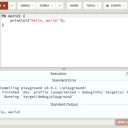
fn main()
{
	println!("Hello, world!");
}

This code defines a main function, which is the entry point of the program. println! is a macro that prints text to the console.
 

2. Variables and Data Types:
This example shows how to declare variables with different data types:

fn main()
{
	let x: i32 = 10;		// Integer
	let y: f64 = 3.14;	// Floating-point number
	let z: bool = true;       // Boolean
	let name: &str = "Rust"; // String slice (immutable)
	println!("Integer: {}, Float: {}, Boolean: {}, String: {}", x, y, z, name);
}

Rust is statically typed, meaning you must specify the data type of a variable. &str is a string slice, which is a reference to a string literal (immutable).
 

3. Functions:
This demonstrates a simple function that adds two numbers:

fn add(a: i32, b: i32) -> i32 { a + b }

fn main()
{
	let sum = add(5, 3);
	println!("Sum: {}", sum);
}

The add function takes two i32 arguments and returns an i32. The -> i32 specifies the return type. Note that Rust can infer the return type if it's obvious, but it's good practice to be explicit.
 

4. Control Flow (if/else):
This example shows a simple if/else statement:

fn main() {
	let number = 7;
	if number < 5 {
		println!("Number is less than 5");
	} else if number == 5 {
		println!("Number is 5");
	} else {
		println!("Number is greater than 5");
	}
}

This code checks the value of number and prints a different message based on the condition.
These are just basic examples. Rust is a powerful language with many more features, including ownership, borrowing, generics, and more. These examples provide a starting point to explore the language further. Remember to compile and run these examples using a Rust compiler (like rustc).
 

Tags Concurrent Programming Rust Rust Example System Programming Language Facebook X
Comments 0
Similar posts
  1. How do I setup Rust development environment?
    369
  2. Rust Thread Example
    346
  3. Rust Code Testing Environment without installing anything on your computer
    326
  4. Arrays and Slices in Rust
    341
  5. Why America's Biggest Tech Companies Are Betting on Rust?
    290
  1. Rust Attributes for conditional compilation, crate, lints, mark functions, macros
    317
  2. Rust Package Management Tool - cargo
    307
  3. Rust compilation unit - Crates
    254
  4. Rust Modules - Visivility, Struct Visibility, Use Declaration, super and self, File Hierarchy
    1,908
  5. Rust functions - Methods, Closures, Capturing
    1,208
  6. Rust Flow of Control - if/else, loop. while, for and range, match, if let, let-else, while let
    339
  7. Rust Expressions
    933
  8. Rust Conversion - From, Into, TryFrom, TryInto
    1,320
  9. gRPC library for Rust
    345
  10. Rust Data Type Operations - Casting, Literals, Inference, Aliasing
    326
  11. Variable Bindings in Rust
    975
  12. Rust Custom Data Types - struct, enum, use, constants
    299
  13. Tuples in Rust - a collection of values of different types
    298
  14. Literals and operators in Rust
    299
  15. Rust Data Type - What is mutable?
    256
Recently updated
  1. Google OAuth Token Expiration: Causes and Solutions
    28
  2. Why 100% SEO Guarantees Better User Engagement and How to Achieve It in Your Service
    55
  3. Why SPF and DKIM Are Essential for Linux Email Servers?
    49
  4. How do I create animated background for Google Meet?
    22,829
  5. MaxMind GeoLite2 vs. DB-IP Lite vs. ip-api.com: Choosing the Right Free IP Geolocation Solution
    271
  6. Meet Valkey: Why Redis Changed Its License, Why Valkey is Better, and How to Use It as a Drop-in Replacement
    103
  7. How Rogue Web Scrapers Are Stealing My Content and Destroying My Server
    168
  8. Array of arguments passed to script in PHP
    97
  9. Invalid Auction Storms in Ad Tech
    106
  10. Building MRC-Compliant Instrumentation in Ad Tech: Implementation Steps and Key Challenges
    207
  11. The Two Clocks of Ad Server Architecture
    77
  12. Frequency Cap Architecture Overview
    526
  13. Collecting Proof-of-Play from 100,000 Screens
    152
  14. Vector Search in Relational Databases (RDBs): Trends & Usage Environments
    302
  15. What is RedisVL?
    114
  16. Designing a Skill Registry Architecture: Minimize Token Usage and Maximize AI Performance
    246
  17. TPU & GPU Cluster Management Tools
    257
  18. The Concept of Scaffolding in AI Agents
    244
  19. Beyond Static Pipelines: Architecting LLM Multi-Agent Systems for Autonomous Workflow Orchestration
    596
  20. AI-DLC vs. AI-SDLC: Model-Centric vs. System-Centric AI Development
    267
  21. Fine-Tuning Open-Weight LLMs: Training, Licensing, and Deploying Custom Models with Ollama
    353
  22. Inside the Next-Generation Streaming Architecture: Ultra-Low Latency, SGAI, and AI Codecs
    206
  23. Machine Learning: Training vs. Ranking
    229
  24. The Continuous Learning Machine: Designing a Loop That Actually Turns
    228
  25. The Next-Gen Low-Latency Standards: LL-HLS & MoQ
    202
  26. Designing a Data Curation System Around a Vector Database
    230
  27. Extracting Context from Live Video: The Architecture Got Simpler When We Stopped Building Features
    263
  28. The New Ad Stack Behind Live Sports Streaming: Inside SGAI, EABN, and the Standards Race to Fix Live Monetization
    671
  29. Designing MLOps Architectures to Handle Seasonal Data Drift in EV Fleet Models
    200
  30. From 15 to 40+ FPS: Accelerating PyTorch Object Detection on Automotive ECUs
    232