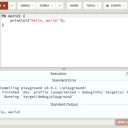
| Rust provides type safety via static typing. Variable bindings can be type annotated when declared. However, in most cases, the compiler will be able to infer the type of the variable from the context, heavily reducing the annotation burden. Values (like literals) can be bound to variables, using the let binding. fn main() {
let an_integer = 1u32;
let a_boolean = true;
let unit = ();
// copy `an_integer` into `copied_integer`
let copied_integer = an_integer;
println!("An integer: {:?}", copied_integer);
println!("A boolean: {:?}", a_boolean);
println!("Meet the unit value: {:?}", unit);
// The compiler warns about unused variable bindings; these warnings can
// be silenced by prefixing the variable name with an underscore
let _unused_variable = 3u32;
let noisy_unused_variable = 2u32;
// FIXME ^ Prefix with an underscore to suppress the warning
// Please note that warnings may not be shown in a browser
}
MutabilityVariable bindings are immutable by default, but this can be overridden using the mut modifier. fn main() {
let _immutable_binding = 1;
let mut mutable_binding = 1;
println!("Before mutation: {}", mutable_binding);
// Ok
mutable_binding += 1;
println!("After mutation: {}", mutable_binding);
// Error! Cannot assign a new value to an immutable variable
_immutable_binding += 1;
}
The compiler will throw a detailed diagnostic about mutability errors. Scope and ShadowingVariable bindings have a scope, and are constrained to live in a block. A block is a collection of statements enclosed by braces {}. fn main() {
// This binding lives in the main function
let long_lived_binding = 1;
// This is a block, and has a smaller scope than the main function
{
// This binding only exists in this block
let short_lived_binding = 2;
println!("inner short: {}", short_lived_binding);
}
// End of the block
// Error! `short_lived_binding` doesn't exist in this scope
println!("outer short: {}", short_lived_binding);
// FIXME ^ Comment out this line
println!("outer long: {}", long_lived_binding);
}
Also, variable shadowing is allowed. fn main() {
let shadowed_binding = 1;
{
println!("before being shadowed: {}", shadowed_binding);
// This binding *shadows* the outer one
let shadowed_binding = "abc";
println!("shadowed in inner block: {}", shadowed_binding);
}
println!("outside inner block: {}", shadowed_binding);
// This binding *shadows* the previous binding
let shadowed_binding = 2;
println!("shadowed in outer block: {}", shadowed_binding);
}
Declare firstIt's possible to declare variable bindings first, and initialize them later. However, this form is seldom used, as it may lead to the use of uninitialized variables. fn main() {
// Declare a variable binding
let a_binding;
{
let x = 2;
// Initialize the binding
a_binding = x * x;
}
println!("a binding: {}", a_binding);
let another_binding;
// Error! Use of uninitialized binding
println!("another binding: {}", another_binding);
// FIXME ^ Comment out this line
another_binding = 1;
println!("another binding: {}", another_binding);
}
The compiler forbids use of uninitialized variables, as this would lead to undefined behavior. FreezingWhen data is bound by the same name immutably, it also freezes. Frozen data can't be modified until the immutable binding goes out of scope: fn main() {
let mut _mutable_integer = 7i32;
{
// Shadowing by immutable `_mutable_integer`
let _mutable_integer = _mutable_integer;
// Error! `_mutable_integer` is frozen in this scope
_mutable_integer = 50;
// FIXME ^ Comment out this line
// `_mutable_integer` goes out of scope
}
// Ok! `_mutable_integer` is not frozen in this scope
_mutable_integer = 3;
}
|