CUDA.zip

CUDA versus OpenCL

CUDA versus OpenCL

581

CUDA and OpenCL are both parallel computing platforms for GPUs,but CUDA is proprietary to NVIDIA,offering tighter integration and potentially better performance on NVIDIA hardware,while OpenCL is an open standard supported by a wider range of hardware vend...

Rust-GPU-tools for interacting with various GPU APIs

Rust-GPU-tools for interacting with various GPU APIs

755

Rust-GPU-tools is a collection of crates providing Rust bindings and utilities for interacting with various GPU APIs,including CUDA,Vulkan,and OpenCL.While it offers support for OpenCL through the ocl crate,it's not a strict dependency; you can use other p...

GPU & LLM Cluster Infrastructure & Task Scheduling Architecture

GPU & LLM Cluster Infrastructure & Task Scheduling Architecture

252

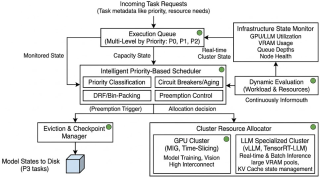
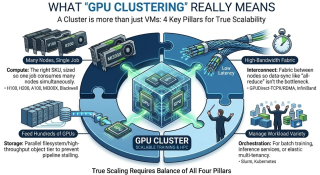
Designing a robust system infrastructure for allocating GPU and LLM clusters requires an optimized task management approach to address severe resource limitations.Because these computational clusters operate under strict hardware constraints,the infrastruc...

Microsoft AutoGen: Next-Generation Multi-Agent Framework

Microsoft AutoGen: Next-Generation Multi-Agent Framework

314

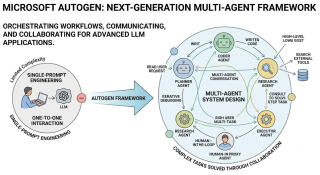
Microsoft AutoGen is an open-source framework designed to simplify the development of advanced Large Language Model (LLM) applications.Its core paradigm relies on multi-agent conversation,where multiple specialized agents communicate,collaborate,and orches...

Autonomous Vehicle Machine Learning (AV ML): An Architectural Review

Autonomous Vehicle Machine Learning (AV ML): An Architectural Review

417

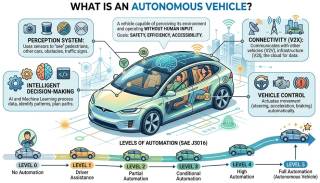
What is AV ML?Autonomous Vehicle (AV): Refers to self-driving cars or vehicles capable of perceiving their environment and operating without human input.The ultimate goal of AVs is to enhance safety,efficiency,and accessibility in transportation.Machine Le...

Is a Used M1 or M2 MacBook Pro a Smart Buy Over M4?

Is a Used M1 or M2 MacBook Pro a Smart Buy Over M4?

295

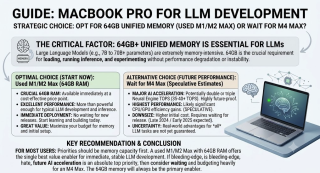
You are contemplating purchasing a MacBook Pro primarily for LLM development.Your core consideration is whether to opt for a cost-effective,used M1 or M2 MacBook Pro with 64GB of unified memory,rather than waiting for or investing in a new M4 model.Your ra...

Arm Kernel DNNs: Powering Efficient AI at the Edge

Arm Kernel DNNs: Powering Efficient AI at the Edge

227

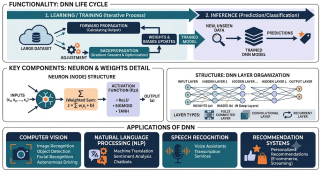
The core mission is to develop kernel-level implementations for a variety of Deep Neural Network (DNN) models,specifically targeting Arm architectures.The primary goals are to optimize these implementations for maximum power efficiency and performance,cruc...

Milvus and LLM Integration - Very Smart Approach!

Milvus and LLM Integration - Very Smart Approach!

301

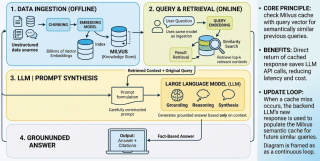
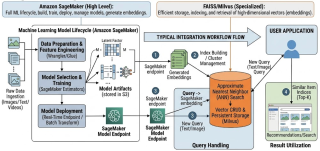
Combining Milvus,an open-source vector database,with Large Language Models (LLMs) is not only practical but has become a prevalent and highly effective strategy for building advanced AI applications.The core idea is to leverage Milvus's ability to store,in...

Learn SLM if you have interent in the next after LLM

Learn SLM if you have interent in the next after LLM

4911

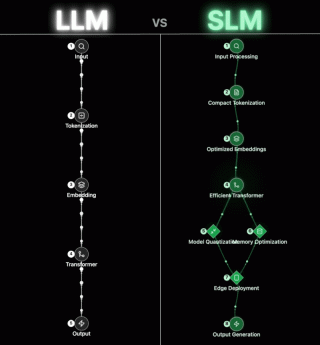
Both SLMs (Small Language Models) and LLMs (Large Language Models) are types of language models,but they differ primarily in size (number of parameters) and consequently,in their capabilities and scope.LLMs,with their massive parameter counts,possess a wid...

Technical Hierarchy of AI Agents

Technical Hierarchy of AI Agents

822

Below is from Aurimas Griciūnas showing hierarchical layers for AI Agents.Sometimes 𝗔𝗜 𝗔𝗴𝗲𝗻𝘁𝘀 might seem simple from the outside.They are not 👇There are many moving pieces that production ready Agentic Systems rely on. I like to split the 𝗛𝗶𝗲𝗿...

Difference between CPU and GPU - Why GPU is faster than CPU?

Difference between CPU and GPU - Why GPU is faster than CPU?

808

CPUs (Central Processing Units) are designed for general-purpose tasks,prioritizing sequential processing and complex instructions,while GPUs (Graphics Processing Units) are specialized for parallel processing of many simpler instructions simultaneously.GP...

Predicting Buyer Preferences with PyTorch: A Deep Learning Approach

Predicting Buyer Preferences with PyTorch: A Deep Learning Approach

1,233

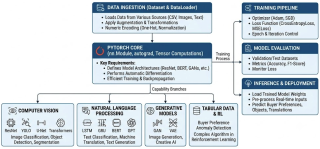
PyTorch is an open-source machine learning library predominantly used for building and training deep learning models.It provides a flexible,Python-based framework that enables researchers and developers to easily construct neural networks,perform tensor co...

PyTorch example to Forcast Stock Price based on 10 days Dataset

652

This code starts by creating synthetic stock price data, then it proceeds to define a simple linear neural network model. The model is trained on the synthetic data, and finally, it attempts to predict the stock price for the next day based on the last 10 ...

Getting Started with FAISS: A CentOS 7 Installation Guide

Getting Started with FAISS: A CentOS 7 Installation Guide

284

What is FAISS?FAISS (Facebook AI Similarity Search) is a library developed by Facebook AI Research for efficient similarity search and clustering of dense vectors.It provides algorithms that search for points in a set of vectors that are closest to a given...

TikTok's Recommendation System - Monolith

TikTok's Recommendation System - Monolith

297

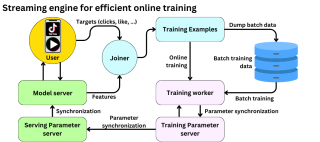
Monolith is ByteDance’s deep-learning recommendation system (described in a 2022 paper) that powers TikTok’s “For You” feed.It is a large-scale,two-stage (retrieval → ranking) deep-learning engine,purpose-built for the dynamic,sparse,and constantly sh...

Image Embeddings for Vector Databases

Image Embeddings for Vector Databases

253

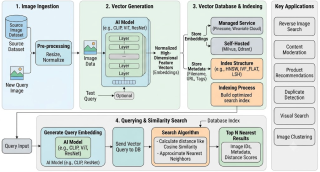
Image embeddings are numerical representations (vectors) of images that capture their semantic meaning and visual characteristics.Instead of storing raw pixel data,an embedding transforms an image into a high-dimensional vector where images with similar co...

NVIDIA CUDA library which can be integrated with C/C++

376

The NVIDIA CUDA library is a parallel computing platform and programming model that allows software developers to use NVIDIA GPUs for general-purpose processing – an approach known as GPGPU.It provides a C / C++ API,including header files and libraries,en...

YouTube's Recommendation System

YouTube's Recommendation System

265

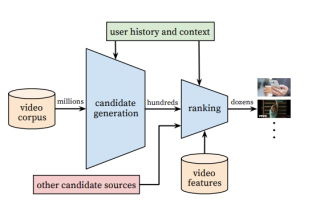
YouTube’s recommendation system is the archetypal two-stage deep-learning recommender.The influential 2016 paper (“Deep Neural Networks for YouTube Recommendations”) split the problem into Candidate Generation (narrow millions of videos down to hundreds...

Wide & Deep / DeepFM for Recommendation Service (aka Ranking Service)

Wide & Deep / DeepFM for Recommendation Service (aka Ranking Service)

260

Wide & Deep and DeepFM are ranking models built to do two things at once: memorize frequent,specific feature combinations and generalize to combinations never (or rarely) seen in training.They are the canonical “deep ranking” architectures that score a s...

Two-Tower Model for Recommendation Service having a Very Large Catalog

Two-Tower Model for Recommendation Service having a Very Large Catalog

269

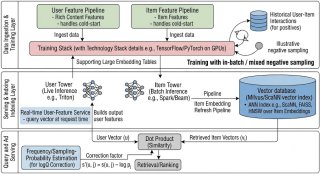
The Two-Tower model (also called a dual-encoder) is the workhorse of large-scale candidate generation (retrieval).It encodes users and items into the same embedding space using two separate neural networks — a user tower and an item tower — and measures ...

Mastering AI: A Beginner's Guide to Python Programming and Beyond

Mastering AI: A Beginner's Guide to Python Programming and Beyond

1,037

AI stands for Artificial Intelligence.It refers to the simulation of human intelligence processes by machines,especially computer systems.These processes include learning (the acquisition of information and rules for using the information),reasoning (using...