Data Science.zip

Predicting Buyer Preferences with PyTorch: A Deep Learning Approach

Predicting Buyer Preferences with PyTorch: A Deep Learning Approach

1,228

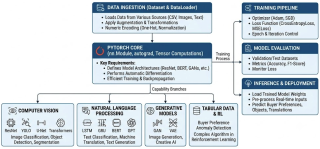
PyTorch is an open-source machine learning library predominantly used for building and training deep learning models.It provides a flexible,Python-based framework that enables researchers and developers to easily construct neural networks,perform tensor co...
Hybrid Methods for Recommendation Service

Hybrid Methods for Recommendation Service

211

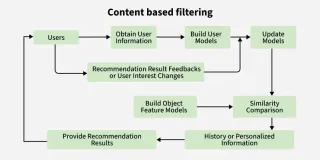
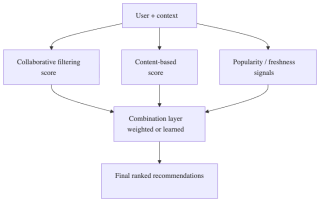
Hybrid recommendation systems combine two or more techniques — most commonly content-based and collaborative filtering — so that each method’s strengths offset the others’ weaknesses.The motivating observation: collaborative filtering is powerful but s...

PyTorch example to Forcast Stock Price based on 10 days Dataset

651

This code starts by creating synthetic stock price data, then it proceeds to define a simple linear neural network model. The model is trained on the synthetic data, and finally, it attempts to predict the stock price for the next day based on the last 10 ...

AI-DLC vs. AI-SDLC: Model-Centric vs. System-Centric AI Development

AI-DLC vs. AI-SDLC: Model-Centric vs. System-Centric AI Development

246

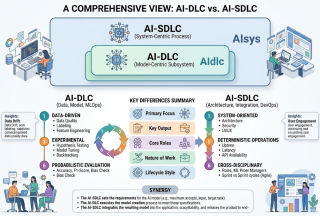
While AI-DLC (AI Development Life Cycle) and AI-SDLC (AI Software Development Life Cycle) sound similar,they represent different scopes in the development of intelligent software solutions::AI-DLC (AI Development Life Cycle): Focuses specifically on the mo...

Why AI-DLC is the New Paradigm for Development?

Why AI-DLC is the New Paradigm for Development?

322

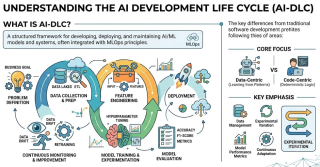
What is AI-DLC?The AI Development Life Cycle (AI-DLC),often integrated with MLOps (Machine Learning Operations) principles,is a structured framework for developing,deploying,and maintaining Artificial Intelligence and Machine Learning models and systems.It...

Autonomous Vehicle Machine Learning (AV ML): An Architectural Review

Autonomous Vehicle Machine Learning (AV ML): An Architectural Review

386

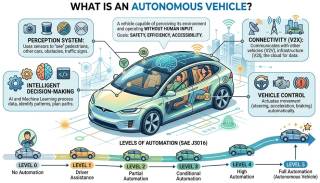
What is AV ML?Autonomous Vehicle (AV): Refers to self-driving cars or vehicles capable of perceiving their environment and operating without human input.The ultimate goal of AVs is to enhance safety,efficiency,and accessibility in transportation.Machine Le...

Building a Video Content Recommendation System with Amazon SageMaker

Building a Video Content Recommendation System with Amazon SageMaker

518

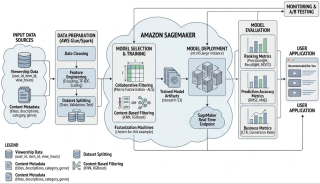
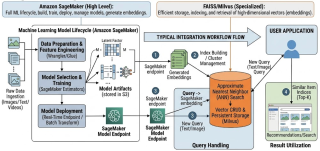
This article outlines a practical approach to building a video recommendation system using Amazon SageMaker,leveraging video viewership data and content metadata.We'll cover data preparation,model selection,training,deployment,and inference. What is the ma...

TikTok's Recommendation System - Monolith

TikTok's Recommendation System - Monolith

284

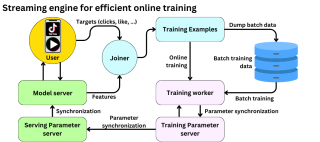
Monolith is ByteDance’s deep-learning recommendation system (described in a 2022 paper) that powers TikTok’s “For You” feed.It is a large-scale,two-stage (retrieval → ranking) deep-learning engine,purpose-built for the dynamic,sparse,and constantly sh...

Image Embeddings for Vector Databases

Image Embeddings for Vector Databases

239

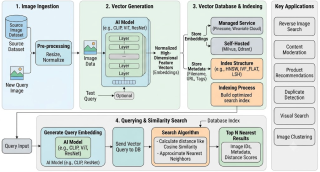
Image embeddings are numerical representations (vectors) of images that capture their semantic meaning and visual characteristics.Instead of storing raw pixel data,an embedding transforms an image into a high-dimensional vector where images with similar co...

Forecasting with Linear Regression and KNN Regression in Python

919

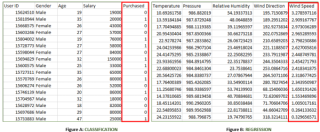
In the realm of machine learning,making accurate predictions based on historical data is a common and crucial task.Two popular methods for tackling such problems are Linear Regression and K-Nearest Neighbors (KNN) Regression.Both come with their unique str...

Checkout service architecture in AWS for e-commerce website

Checkout service architecture in AWS for e-commerce website

11,005

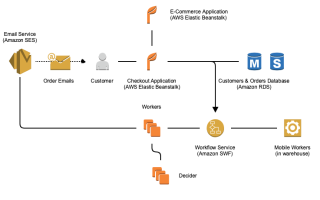
Checkout in e-commerce refers to the final stage of an online purchase process where a customer provides their shipping and payment information,reviews their order,and confirms the transaction.It's the point where the customer formally commits to buying th...

YouTube's Recommendation System

YouTube's Recommendation System

257

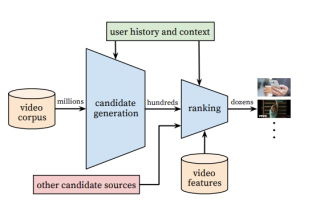
YouTube’s recommendation system is the archetypal two-stage deep-learning recommender.The influential 2016 paper (“Deep Neural Networks for YouTube Recommendations”) split the problem into Candidate Generation (narrow millions of videos down to hundreds...

Harnessing the Power of Random Forest Algorithm in Python

656

In the vast landscape of machine learning algorithms,there exists a powerful ensemble method known as Random Forest.It's highly regarded for its robustness and versatility,making it a popular choice for both classification and regression tasks.In this blog...

Wide & Deep / DeepFM for Recommendation Service (aka Ranking Service)

Wide & Deep / DeepFM for Recommendation Service (aka Ranking Service)

245

Wide & Deep and DeepFM are ranking models built to do two things at once: memorize frequent,specific feature combinations and generalize to combinations never (or rarely) seen in training.They are the canonical “deep ranking” architectures that score a s...

Two-Tower Model for Recommendation Service having a Very Large Catalog

Two-Tower Model for Recommendation Service having a Very Large Catalog

253

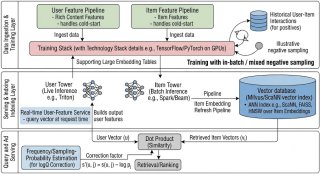
The Two-Tower model (also called a dual-encoder) is the workhorse of large-scale candidate generation (retrieval).It encodes users and items into the same embedding space using two separate neural networks — a user tower and an item tower — and measures ...

Model-Based CF: Matrix Factorization for Recommendation Service

Model-Based CF: Matrix Factorization for Recommendation Service

177

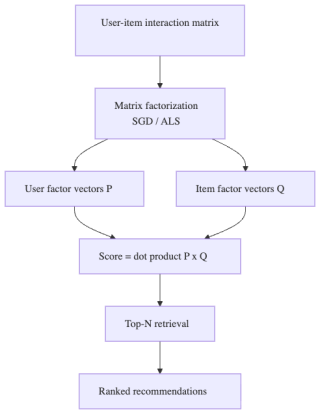
Model-Based Collaborative Filtering replaces the on-demand similarity lookups of memory-based CF with a compact learned model.The dominant family is Matrix Factorization (MF): the large,sparse user–item interaction matrix R (dimensions m × n) is decompos...

Memory-Based Collaborative Filtering for Recommendation Service

Memory-Based Collaborative Filtering for Recommendation Service

185

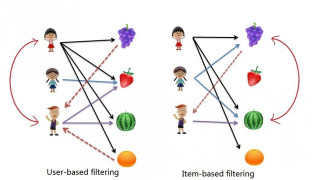
Memory-Based Collaborative Filtering (CF) makes recommendations from patterns of agreement across many users,without using any item content features.It is “memory-based” because it operates directly on the stored user–item interaction matrix at predicti...

Mastering AI: A Beginner's Guide to Python Programming and Beyond

Mastering AI: A Beginner's Guide to Python Programming and Beyond

1,031

AI stands for Artificial Intelligence.It refers to the simulation of human intelligence processes by machines,especially computer systems.These processes include learning (the acquisition of information and rules for using the information),reasoning (using...