Ranking Models.zip

Neural Collaborative Filtering (NCF) for Recommendation Service

Neural Collaborative Filtering (NCF) for Recommendation Service

248

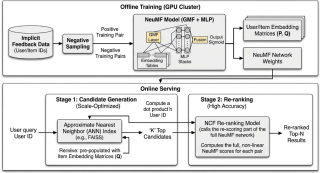
Neural Collaborative Filtering (NCF) generalizes matrix factorization by replacing the fixed dot product with a learned neural interaction function.Where MF assumes that a user’s affinity for an item is a simple inner product of two latent vectors,NCF let...
Wide & Deep / DeepFM for Recommendation Service (aka Ranking Service)

Wide & Deep / DeepFM for Recommendation Service (aka Ranking Service)

260

Wide & Deep and DeepFM are ranking models built to do two things at once: memorize frequent,specific feature combinations and generalize to combinations never (or rarely) seen in training.They are the canonical “deep ranking” architectures that score a s...

Hybrid Methods for Recommendation Service

Hybrid Methods for Recommendation Service

220

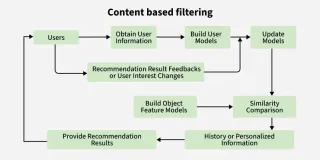
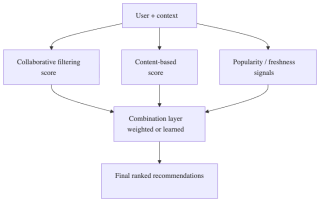
Hybrid recommendation systems combine two or more techniques — most commonly content-based and collaborative filtering — so that each method’s strengths offset the others’ weaknesses.The motivating observation: collaborative filtering is powerful but s...

Autonomous Vehicle Machine Learning (AV ML): An Architectural Review

Autonomous Vehicle Machine Learning (AV ML): An Architectural Review

417

What is AV ML?Autonomous Vehicle (AV): Refers to self-driving cars or vehicles capable of perceiving their environment and operating without human input.The ultimate goal of AVs is to enhance safety,efficiency,and accessibility in transportation.Machine Le...

Building a Video Content Recommendation System with Amazon SageMaker

Building a Video Content Recommendation System with Amazon SageMaker

526

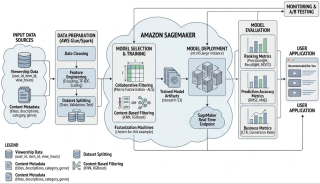
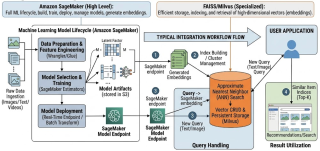
This article outlines a practical approach to building a video recommendation system using Amazon SageMaker,leveraging video viewership data and content metadata.We'll cover data preparation,model selection,training,deployment,and inference. What is the ma...

Predicting Buyer Preferences with PyTorch: A Deep Learning Approach

Predicting Buyer Preferences with PyTorch: A Deep Learning Approach

1,233

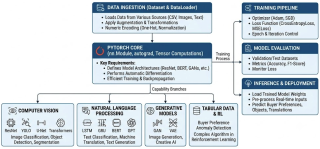
PyTorch is an open-source machine learning library predominantly used for building and training deep learning models.It provides a flexible,Python-based framework that enables researchers and developers to easily construct neural networks,perform tensor co...

PyTorch example to Forcast Stock Price based on 10 days Dataset

651

This code starts by creating synthetic stock price data, then it proceeds to define a simple linear neural network model. The model is trained on the synthetic data, and finally, it attempts to predict the stock price for the next day based on the last 10 ...

TikTok's Recommendation System - Monolith

TikTok's Recommendation System - Monolith

297

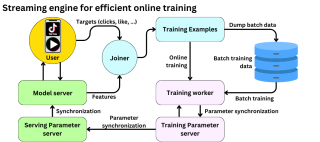
Monolith is ByteDance’s deep-learning recommendation system (described in a 2022 paper) that powers TikTok’s “For You” feed.It is a large-scale,two-stage (retrieval → ranking) deep-learning engine,purpose-built for the dynamic,sparse,and constantly sh...

Image Embeddings for Vector Databases

Image Embeddings for Vector Databases

253

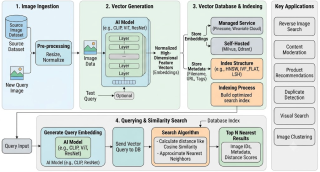
Image embeddings are numerical representations (vectors) of images that capture their semantic meaning and visual characteristics.Instead of storing raw pixel data,an embedding transforms an image into a high-dimensional vector where images with similar co...

Forecasting with Linear Regression and KNN Regression in Python

928

In the realm of machine learning,making accurate predictions based on historical data is a common and crucial task.Two popular methods for tackling such problems are Linear Regression and K-Nearest Neighbors (KNN) Regression.Both come with their unique str...

YouTube's Recommendation System

YouTube's Recommendation System

265

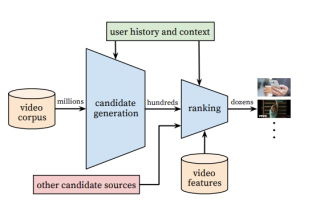
YouTube’s recommendation system is the archetypal two-stage deep-learning recommender.The influential 2016 paper (“Deep Neural Networks for YouTube Recommendations”) split the problem into Candidate Generation (narrow millions of videos down to hundreds...

Two-Tower Model for Recommendation Service having a Very Large Catalog

Two-Tower Model for Recommendation Service having a Very Large Catalog

269

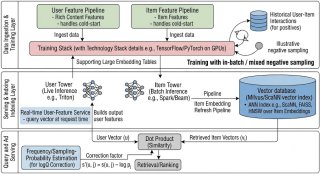
The Two-Tower model (also called a dual-encoder) is the workhorse of large-scale candidate generation (retrieval).It encodes users and items into the same embedding space using two separate neural networks — a user tower and an item tower — and measures ...

Model-Based CF: Matrix Factorization for Recommendation Service

Model-Based CF: Matrix Factorization for Recommendation Service

184

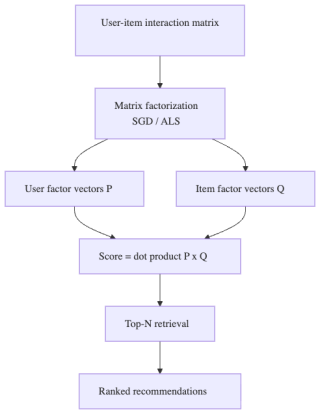
Model-Based Collaborative Filtering replaces the on-demand similarity lookups of memory-based CF with a compact learned model.The dominant family is Matrix Factorization (MF): the large,sparse user–item interaction matrix R (dimensions m × n) is decompos...

Memory-Based Collaborative Filtering for Recommendation Service

Memory-Based Collaborative Filtering for Recommendation Service

198

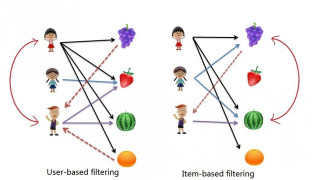
Memory-Based Collaborative Filtering (CF) makes recommendations from patterns of agreement across many users,without using any item content features.It is “memory-based” because it operates directly on the stored user–item interaction matrix at predicti...

Common Recommendation Service Architecture

Common Recommendation Service Architecture

537

Almost every large-scale recommendation service — TikTok,YouTube,Amazon,Netflix,Spotify — is built on the same architectural skeleton,regardless of which specific model it uses.Understanding this skeleton is more valuable than memorizing any single algor...

Mastering AI: A Beginner's Guide to Python Programming and Beyond

Mastering AI: A Beginner's Guide to Python Programming and Beyond

1,037

AI stands for Artificial Intelligence.It refers to the simulation of human intelligence processes by machines,especially computer systems.These processes include learning (the acquisition of information and rules for using the information),reasoning (using...