CSAI vs SSAI

CK CK 3788 
Created at
Updated at  
577 0 0

CSAI vs SSAI

What is CSAI (Client-Side Ad Insertion) ?

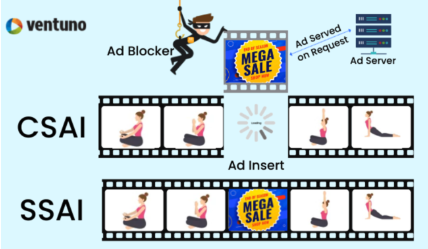
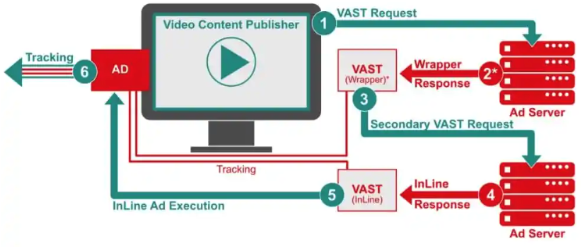
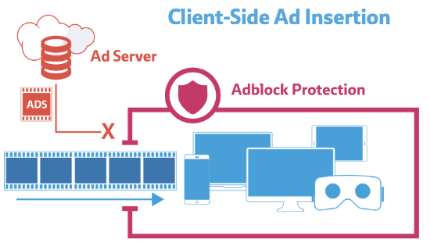
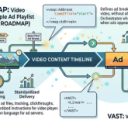
In a CSAI flow, advertisements are managed and added to the end-user’s device. From a delivery point-of-view, content and ads are separated; the player plays content and advertisements independently of each other. The player will switch between the two as needed. Client-Side Ad insertion is specified via the IAB (Interactive Advertising Bureau) standards:

  • VAST (ad metadata)

  • VMAP (ad timing)

  • VPAID/SIMID (interactive ads) and

  • OMID (view-ability measurements)

A compliant player supports all ad solutions that adhere to these standards, making it easier to switch to another provider.

CSAI systems with a different flow can then be added on an individual basis. Alternative implementations, for instance, Google IMA, can also be added in parallel.
 

CSAI vs SSAI
Reference: https://ottverse.com/csai-vs-ssai-client-side-server-side-ad-insertion/


CSAI vs SSAI

Reference: https://bitmovin.com/csai-vs-ssai-client-side-server-side-ad-insertion/


What is SSAI (Server-Side Ad Insertion) ?

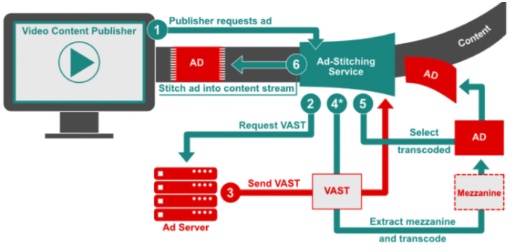
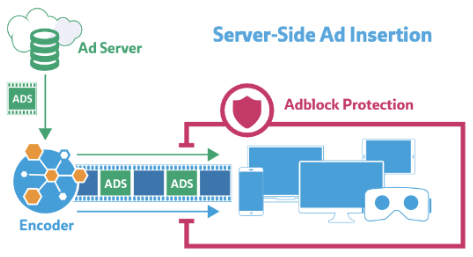
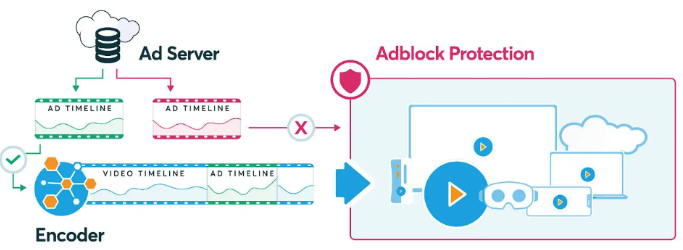
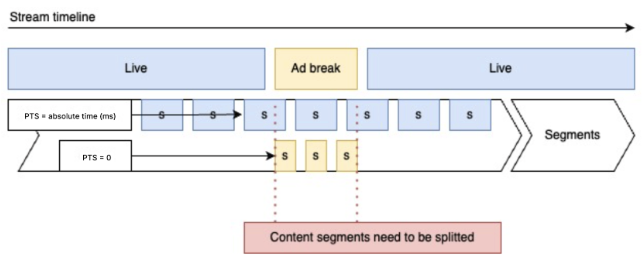
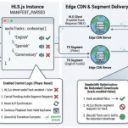
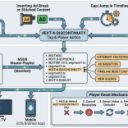
In an SSAI flow, advertisements are directly stitched to the streaming manifest on the server side at the last moment. The content and advertisements are closely related to each other, allowing smoother playback and transitions. This way of working is comparable to traditional linear television. The main difference between broadcast advertising and SSAI is that the latter allows advertisements to be targeted towards individual end-users.

Server-side ad insertion is only partly standardized. SCTE-35 markers are a popular technique to signal the encoder and packager where ads are allowed to be inserted. It was, however, never intended to be used for streaming clients. As a result, SCTE-35 is often only used to inform SSAI providers where ads should be placed. How they place those ads and how they provide the relevant metadata for tracking ad progress is not standardized. This metadata is needed to build a CSAI-like experience: showing a click-through, giving an indication about duration, and current time. Some common strategies include:

  • Fetching metadata from the SSAI provider’s backend

  • Adding timed cues via ID3/EMSG

  • Parsing custom tags from the streaming manifest

  • Integrating with a proprietary library

A video player pre-integrated with multiple SSAI vendors improves the interoperability between all of them.
 

CSAI vs SSAI

Reference: https://ottverse.com/csai-vs-ssai-client-side-server-side-ad-insertion/


CSAI vs SSAI

Reference: https://bitmovin.com/csai-vs-ssai-client-side-server-side-ad-insertion/


CSAI vs SSAI

Reference: https://ottverse.com/csai-vs-ssai-client-side-server-side-ad-insertion/


CSAI vs SSAI


Conclusion

Generally speaking, in conclusion, SSAI may be more expensive than CSAI, but it also results in much more ad impressions. Ad blockers may be less effective against this type of advertising.

  • This is due to the tighter integration between content and advertisements and the increased complexity overall. These additional costs have to be subtracted from the Cost Per Mille (CPM) pay-out. The higher cost of SSAI, however, can be easily countered by the fact that it provides a much higher fill rate.

Tags AD Marker Ad Blocker CPM CSAI Client-Side Ad Insertion Cost Per Mile OMID SIMID SSAI Server-Side Ad Insertion VAST VMAP VPAID Facebook X
Comments 0
Similar posts
  1. Ad Marker: SCTE-35 Message Encoder based in Python
    797
  2. Ad marker: SCTE-35 enhanced
    575
  3. FFmpeg compile option to support SCTE-35
    839
  4. A Deep Dive Into Internet Advertising Ecosystem on Video Streaming Industry
    646
  5. What is VAST? What is VMAP? How VAST/VMAP works?
    897
  6. IAS IP Blocklist: Causes, Resolution, and Detection Strategies
    190
  7. The New Ad Stack Behind Live Sports Streaming: Inside SGAI, EABN, and the Standards Race to Fix Live Monetization
    656
  8. OpenRTB vs. VAST: Your Essential Guide to Video Ad Tech
    274
  1. Inside the Next-Generation Streaming Architecture: Ultra-Low Latency, SGAI, and AI Codecs
    202
  2. The Next-Gen Low-Latency Standards: LL-HLS & MoQ
    195
  3. From SDI to MXL: Inside the Cloud-Native Infrastructure Powering Next-Gen Live Broadcast
    570
  4. Smooth switching with EXT-X-DISCONTINUITY in HLS
    432
  5. Disabling Audio Tracks in HLS.js
    376
  6. A Deep Dive Into Internet Advertising Ecosystem on Video Streaming Industry
    646
  7. When to use #EXT-X-DISCONTINUITY in HLS?
    1,428
  8. A prefect Apache server settings to avoid CORS error for HLS
    604
  9. CloudFront Settings for Dynamic HLS Streaming
    650
  10. SafeFrame is a web standard developed by IAB
    508
  11. Ad Marker: SCTE-35 Message Encoder based in Python
    797
  12. Ad marker: SCTE-35 enhanced
    575
  13. FFmpeg compile options based on configure
    1,111
  14. Script checking internet restriction with FFmpeg
    684
  15. FFmpeg compile option to support SCTE-35
    839
  16. HTTP Proxy when your URL access is blocked with FFmpeg
    1,897
  17. Limit Maximum Resolution in HLS.js
    664
  18. Magic line when HLS video manifest is mixed with encrypted / unencrypted video chunks
    1,461
  19. Recovering a crashed HLS.js player
    1,279
  20. How do I create animated background for Google Meet?
    20,613
  21. Secure HLS encoding using AES-128 encryption with FFmpeg
    1,131
  22. Machine Learning Models for Ad Detection from a Video Stream
    188
  23. Unlock Flawless HLS Audio Sync: The Power of #EXT-X-INDEPENDENT-SEGMENTS
    375
  24. NVIDIA CUDA library which can be integrated with C/C++
    376
  25. Approaches to Scene Detection in Video Processing
    645
Recently updated
  1. Why 100% SEO Guarantees Better User Engagement and How to Achieve It in Your Service
    40
  2. Why SPF and DKIM Are Essential for Linux Email Servers?
    34
  3. How do I create animated background for Google Meet?
    20,613
  4. MaxMind GeoLite2 vs. DB-IP Lite vs. ip-api.com: Choosing the Right Free IP Geolocation Solution
    244
  5. Meet Valkey: Why Redis Changed Its License, Why Valkey is Better, and How to Use It as a Drop-in Replacement
    94
  6. How Rogue Web Scrapers Are Stealing My Content and Destroying My Server
    157
  7. Array of arguments passed to script in PHP
    90
  8. Invalid Auction Storms in Ad Tech
    98
  9. Building MRC-Compliant Instrumentation in Ad Tech: Implementation Steps and Key Challenges
    202
  10. The Two Clocks of Ad Server Architecture
    70
  11. Frequency Cap Architecture Overview
    514
  12. Collecting Proof-of-Play from 100,000 Screens
    146
  13. Vector Search in Relational Databases (RDBs): Trends & Usage Environments
    287
  14. What is RedisVL?
    109
  15. Designing a Skill Registry Architecture: Minimize Token Usage and Maximize AI Performance
    230
  16. TPU & GPU Cluster Management Tools
    244
  17. The Concept of Scaffolding in AI Agents
    233
  18. Beyond Static Pipelines: Architecting LLM Multi-Agent Systems for Autonomous Workflow Orchestration
    583
  19. AI-DLC vs. AI-SDLC: Model-Centric vs. System-Centric AI Development
    258
  20. Fine-Tuning Open-Weight LLMs: Training, Licensing, and Deploying Custom Models with Ollama
    339
  21. Inside the Next-Generation Streaming Architecture: Ultra-Low Latency, SGAI, and AI Codecs
    202
  22. Machine Learning: Training vs. Ranking
    221
  23. The Continuous Learning Machine: Designing a Loop That Actually Turns
    222
  24. The Next-Gen Low-Latency Standards: LL-HLS & MoQ
    195
  25. Designing a Data Curation System Around a Vector Database
    220
  26. Extracting Context from Live Video: The Architecture Got Simpler When We Stopped Building Features
    256
  27. The New Ad Stack Behind Live Sports Streaming: Inside SGAI, EABN, and the Standards Race to Fix Live Monetization
    656
  28. Designing MLOps Architectures to Handle Seasonal Data Drift in EV Fleet Models
    195
  29. From 15 to 40+ FPS: Accelerating PyTorch Object Detection on Automotive ECUs
    217
  30. Understanding Data Lineage
    260