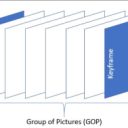
Media Segment Independence in HLSThe #EXT-X-INDEPENDENT-SEGMENTS tag in HLS (HTTP Live Streaming) plays a critical role in ensuring smooth and reliable video playback, particularly in managing audio-visual synchronization, especially during adaptive bitrate (ABR) switching and seeking operations. Understanding Independent Segments and Audio SyncThe #EXT-X-INDEPENDENT-SEGMENTS tag signals that every media segment in the HLS stream is entirely self-contained. This means: - Video: Each video segment must begin with a decoder-independent frame, typically an Instantaneous Decoding Refresh (IDR) frame for H.264/H.265 or a key frame for other codecs. An IDR frame ensures that all subsequent frames within that segment can be decoded without needing reference frames from any previous segment.
- Audio: Similarly, audio segments must start with complete, independently decodable audio frames.
Power in Terms of Audio Sync:
The power of this declaration for audio synchronization lies in its guarantee for seamless transitions. When a player switches between different quality renditions (ABR), or when a user seeks to a new point in the stream, the player can immediately begin decoding the new segment without relying on any data from previous segments, which might belong to a different rendition or be unavailable due to a seek operation. 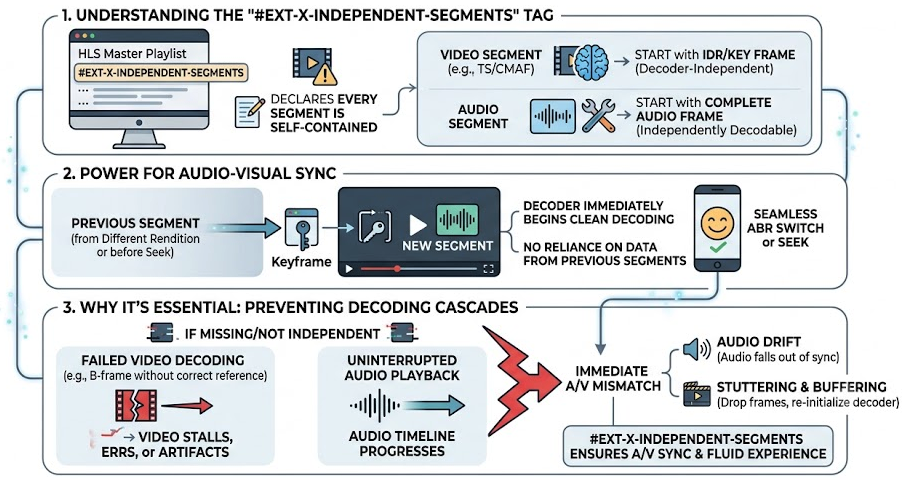
If segments are not independent, a switch or seek could lead to a decoder being unable to reconstruct frames correctly. For example, if a new video segment starts with a B-frame that references a P-frame from the previous segment (which is now from a different bitrate rendition or not loaded), the video decoder will fail to produce valid output. When the video stream experiences errors, glitches, or pauses due to these decoding failures, the audio stream often continues playing uninterrupted. This immediate mismatch causes: - Audio Drift: The audio timeline progresses while the video stalls or shows artifacts, causing the audio to fall out of sync with the video.
- Stuttering and Buffering: The player might have to drop frames, re-initialize the decoder, or re-buffer, leading to an interrupted and poor user experience, often with noticeable audio sync issues upon recovery.
By ensuring independence, #EXT-X-INDEPENDENT-SEGMENTS allows the player to start both video and audio decoding cleanly at any segment boundary, preventing these cascade failures and maintaining A/V synchronization. Importance of Independent SegmentsThe importance of #EXT-X-INDEPENDENT-SEGMENTS cannot be overstated for modern adaptive streaming: - Seamless Adaptive Bitrate (ABR) Switching: This is the primary reason. It allows players to smoothly switch between different video qualities (e.g., 720p to 1080p) mid-stream without glitches, freezes, or decoding errors. Without it, ABR switching would be highly problematic, leading to a poor user experience.
- Reliable Seeking: Users can jump to any point in the video that aligns with a segment boundary and expect immediate, clean playback without artifacts.
- Robustness and Error Recovery: If a network interruption or download error causes a segment to be missed or corrupted, the player can recover and start playing from the next available independent segment without needing to process the missing data, minimizing the impact on playback.
- Improved User Experience: Ultimately, it contributes to a fluid, high-quality viewing experience with minimal buffering, artifacts, and consistent audio-video synchronization.
How to Use Independent SegmentsUsing #EXT-X-INDEPENDENT-SEGMENTS involves both declaring it in the playlist and ensuring the underlying media segments adhere to its implications: 1. Declaration in Master Playlist: The tag is placed in the HLS Master Playlist (the .m3u8 file that lists all available renditions). It's a global declaration for all media playlists and segments referenced within that master playlist. #EXTM3U
#EXT-X-VERSION:6
#EXT-X-INDEPENDENT-SEGMENTS
#EXT-X-STREAM-INF:BANDWIDTH=1280000,AVERAGE-BANDWIDTH=1000000,RESOLUTION=640x360,CODECS="avc1.4d401e,mp4a.40.2"
path/to/media_360p.m3u8
#EXT-X-STREAM-INF:BANDWIDTH=2560000,AVERAGE-BANDWIDTH=2000000,RESOLUTION=1280x720,CODECS="avc1.4d4028,mp4a.40.2"
path/to/media_720p.m3u8
2. Encoder Configuration: This is the most crucial step. Your video encoder must be configured to output keyframes (IDR frames for H.264/H.265) at regular intervals that correspond to your desired segment duration. Every segment must start with such a keyframe. - For example, if your segments are 2 seconds long, your encoder should generate an IDR frame at least every 2 seconds.
- For audio, ensure the segment boundaries align with complete audio frames and that decoding can start at the beginning of any segment.
3. Media Segmenter: The tool used to segment your encoded media into HLS segments must respect these keyframe boundaries, cutting the media precisely at the start of each IDR frame. What Happens If You Miss It?If you omit the #EXT-X-INDEPENDENT-SEGMENTS tag, or if the tag is present but the underlying media segments are not actually independent, you will encounter significant playback issues: - Severe ABR Switching Artifacts: When the player attempts to switch between renditions, the video decoder will likely fail to process the new segment correctly. This will result in:
- Frozen frames or video stuttering.
- Green screens, blockiness, or heavily corrupted video.
- Noticeable audio/video desynchronization as the audio continues to play while the video struggles to recover.
- Broken Seeking: Seeking to an arbitrary point may result in artifacts, frozen video, or a complete failure to play until the player can locate a true IDR frame further down the timeline.
- Increased Latency: Players might need to buffer more data or wait longer to find a safe point to switch or start playback, increasing perceived latency.
- Reduced Player Compatibility: Some HLS players may be more forgiving, but others will strictly adhere to the HLS specification and may simply fail to play the stream correctly, or experience frequent errors.
- Poor User Experience: The cumulative effect of these issues is a highly frustrating viewing experience, characterized by visual glitches, audio drift, and playback interruptions.
In essence, while the #EXT-X-INDEPENDENT-SEGMENTS tag is just one line in a playlist, it represents a fundamental architectural requirement for robust and high-quality adaptive streaming. Its absence or misapplication severely degrades the playback experience, particularly impacting audio-video synchronization during common streaming operations. |