Machine Learning Models for Ad Detection from a Video Stream
CK 3788 Created at
19000
Ad detection from a video stream involves identifying and segmenting promotional content within a larger video sequence. This process is crucial for various applications, including content monitoring, ad verification, automated content moderation, enhancing user experience by allowing ad skipping, and generating dynamic ad insertion opportunities.
Challenges in Ad Detection
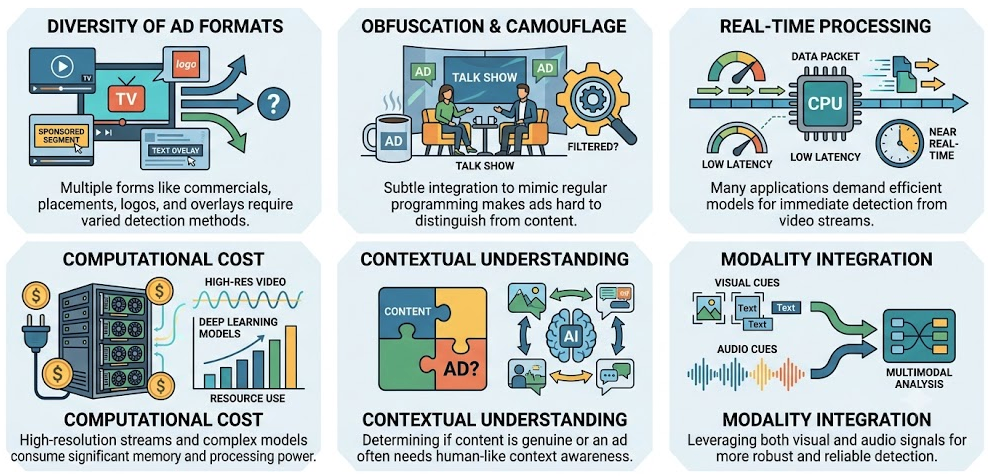
Ad detection presents significant challenges primarily due to the vast diversity of ad formats, encompassing everything from traditional commercials to subtle product placements and text overlays, which advertisers frequently obfuscate or camouflage within organic content. This complexity is exacerbated by the demand for real-time processing and the high computational cost involved in analyzing high-resolution video streams with intricate deep learning models. Furthermore, effective ad detection critically requires a nuanced contextual understanding to differentiate genuine content from advertisements, necessitating sophisticated multimodal analysis that integrates both visual and audio cues.
Key Features for Ad Detection
Effective ad detection typically relies on analyzing a combination of visual, audio, and temporal features:
Visual Features
Logos and Brand Elements: Detecting specific brand logos or product imagery.
Text Overlays: Presence of promotional text, slogans, or calls to action.
Scene Changes & Shot Dynamics: Abrupt cuts, fast-paced editing, or specific camera movements often associated with commercials.
Black/Color Frames: Short segments of black, white, or static color frames sometimes used as transitions to/from ads.
Aspect Ratio Changes: Some ads may use a different aspect ratio than the main content.
Visual Style/Content: Specific aesthetics, graphics, or content patterns common in advertising.
Audio Features
Speech Patterns: Fast-paced speech, specific intonations, or sales-oriented language.
Jingles and Music: Distinctive advertising jingles or background music.
Silence/Loudness Changes: Sudden increases in volume or prolonged silence.
Sound Effects: Specific sound effects often used in advertisements.
Audio Signature: Unique acoustic characteristics that differentiate ads from regular programming.
Temporal Features
Duration: Ads typically fall within specific duration ranges.
Repetition: Recurring visual or audio segments, characteristic of ad breaks.
Sequence of Events: A specific order of visual and audio cues that signifies an ad segment.
Machine Learning Models for Ad Detection
The best ML models for ad detection typically leverage deep learning due to its ability to automatically learn complex features from raw video and audio data.
Model Category
Strengths
Weaknesses
Best Use Case
Computational Cost
Real-time Capability
2D CNN + RNN/LSTM Hybrid
- Excellent for capturing frame-level visual features (CNN) - Good for modeling temporal dependencies (RNN/LSTM) - Mature and widely adopted.
- May struggle with subtle spatio-temporal cues like motion - RNNs can be slow for very long sequences.
Identifying ad segments based on sequences of visual and audio cues.
Medium
Moderate to Good
3D CNNs (e.g., C3D, I3D)
- Directly learn spatio-temporal features from video clips - Effective for motion-based ad detection.
- High computational cost and memory usage due to 3D convolutions - Requires large video datasets for training.
Detecting ads with distinct motion patterns or scene dynamics.
High
Moderate
Transformer-based Models
- Excellent for long-range temporal dependencies and multimodal fusion - Captures complex relationships between frames/modalities - State-of-the-art for many video tasks.
- Extremely high computational cost and memory for long sequences - Data-hungry, requires vast amounts of labeled data.
Advanced, highly accurate ad detection requiring deep contextual understanding.
Very High
Poor to Moderate
Object Detection Models (e.g., YOLO, SSD)
- Highly effective for detecting specific visual elements like logos, text, or products within frames - Real-time performance for object localization.
- Focuses only on static visual elements - Does not inherently understand temporal context or audio cues.
Detecting branded content, product placements, or text overlays.
Medium
Good
Multimodal Fusion Networks
- Combines visual and audio information for robust detection - More resilient to camouflage or single-modality obfuscation.
- Increased model complexity and training difficulty - Requires careful synchronization of modalities.
Comprehensive ad detection where both visual and audio cues are important.
High
Moderate
Proposed Architecture for Ad Detection from Video Stream
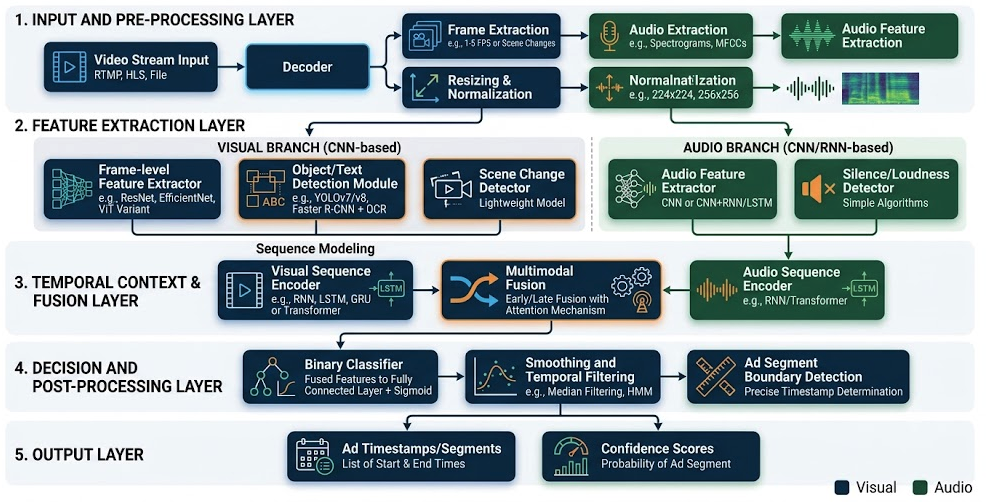
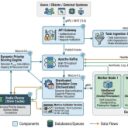
A robust ad detection system from a video stream typically involves a multi-stage, multimodal deep learning architecture.
1. Input and Pre-processing Layer
Video Stream Input: Raw video stream (e.g., RTMP, HLS, file).
Frame Extraction: Sample frames at a regular interval (e.g., 1-5 FPS) or on scene changes.
Audio Extraction: Extract audio track from the video stream.
Resizing & Normalization: Resize frames to a consistent resolution (e.g., 224x224, 256x256) and normalize pixel values.
Audio Feature Extraction: Convert raw audio into spectrograms, Mel-frequency cepstral coefficients (MFCCs), or other relevant features.
2. Feature Extraction Layer
This layer processes the pre-processed visual and audio data independently to extract rich, high-level features.
Object/Text Detection Module: Integrate models like YOLOv7/v8 or Faster R-CNN for real-time detection of specific objects (e.g., logos, products) and an OCR (Optical Character Recognition) module to extract and analyze text overlays (e.g., brand names, slogans).
Scene Change Detector: A lightweight model to identify abrupt cuts or transitions, which can be indicators of ad breaks.
Audio Branch (CNN/RNN-based):
Audio Feature Extractor: A CNN or a combination of CNN and RNN/LSTM processes audio features (e.g., spectrograms) to identify audio patterns specific to ads (jingles, speech characteristics, sudden volume changes).
Silence/Loudness Detector: Simple algorithms to detect prolonged silence or sudden volume spikes.
3. Temporal Context & Fusion Layer
This is the core of multimodal ad detection, where features from different modalities are combined and processed over time.
Sequence Modeling:
Visual Sequence Encoder: The sequence of frame-level features (and object/text detection outputs) from the Visual Branch is fed into a Recurrent Neural Network (RNN, LSTM, GRU) or a Transformer encoder to capture temporal dependencies and context.
Audio Sequence Encoder: Similarly, the sequence of audio features from the Audio Branch is processed by another RNN/Transformer.
Multimodal Fusion:
Early/Late Fusion: Features from the visual and audio sequence encoders are combined. This can be done by simple concatenation, or more complex attention-based fusion mechanisms that learn to weigh the importance of each modality over time.
4. Decision and Post-processing Layer
Binary Classifier: The fused temporal features are fed into a final classification layer (e.g., a fully connected layer with a sigmoid activation) to predict whether the current segment is an "Ad" or "Not Ad."
Smoothing and Temporal Filtering: Apply post-processing techniques (e.g., median filtering, Hidden Markov Models) to smooth the classification output, eliminate short false positives/negatives, and refine ad segment boundaries. This helps in producing stable ad segments.
Ad Segment Boundary Detection: Algorithms to precisely determine the start and end timestamps of detected ad blocks.
5. Output
Ad Timestamps/Segments: A list of detected ad start and end times in the video stream.
Confidence Scores: The probability associated with each detected ad segment.
This architecture enables the system to leverage the strengths of various models, combining visual, audio, and temporal information for highly accurate and robust ad detection, capable of handling diverse and challenging ad formats.
Can OpenAI's CLIP be used for ad detection in video streams?
CLIP, developed by OpenAI, is a neural network trained on a massive dataset of image-text pairs. Its core capability lies in understanding the relationship between text and images. It learns to associate images with their most relevant textual descriptions and vice-versa. This allows CLIP to perform zero-shot classification, meaning it can classify images into categories it has never seen during training, simply by comparing the image to a set of text prompts (e.g., "a photo of a dog," "a photo of a cat").
CLIP's Strengths for Ad Recognition (Potential)
CLIP's ability to understand open-ended text prompts and its strong visual comprehension offer intriguing possibilities for ad recognition:
Zero-Shot Learning: It could potentially identify various types of ads without explicit prior training on those specific ad types. For instance, given prompts like "an advertisement for a car," "a product placement," or "a sponsored content banner," CLIP could attempt to match visual frames to these descriptions.
Text-Based Search: If you know what kind of ad you're looking for (e.g., "a Nike ad," "a Coca-Cola commercial"), you could use text prompts to guide the recognition process.
Semantic Understanding: CLIP can grasp the abstract concepts described in text, potentially recognizing ads that are visually diverse but semantically similar (e.g., different styles of food ads).
Limitations of CLIP for Video Stream Ad Recognition
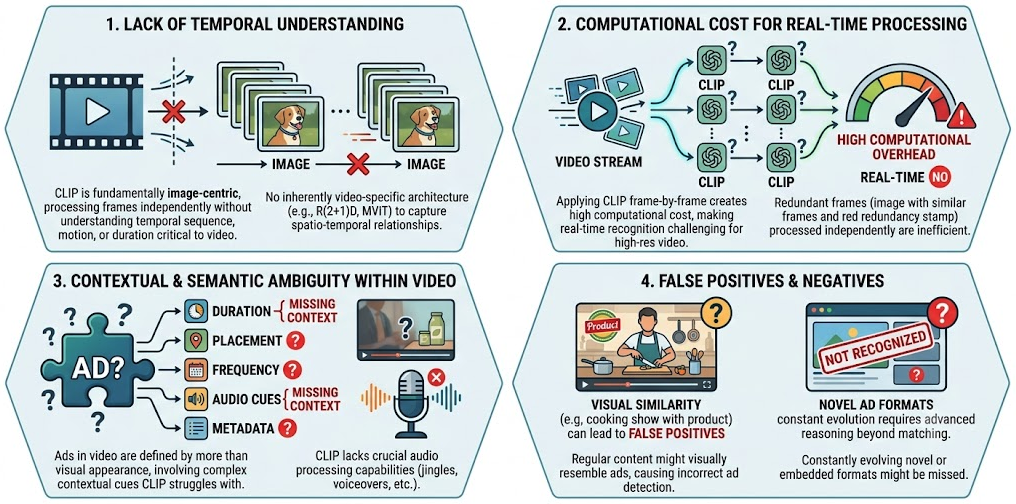
CLIP, while powerful for image-text understanding, faces significant hurdles when directly applied to video stream ad recognition due to its inherent limitations: it lacks temporal understanding, processing frames independently without grasping sequence, motion, or duration, and lacks video-specific architectures for spatio-temporal relationships. This frame-by-frame analysis also leads to a high computational cost, making real-time processing challenging and introducing redundancy, as many consecutive frames are similar. Furthermore, CLIP struggles with the contextual and semantic ambiguity of video ads, which often rely on duration, placement, audio cues, and subtle integrations that are beyond its image-focused scope and lack of audio processing capabilities. Consequently, it is prone to false positives from regular content visually resembling ads and false negatives with novel or embedded ad formats, as it relies solely on visual similarity without deeper video understanding.
How CLIP Could Be Used (with Modifications & Hybrid Approaches)
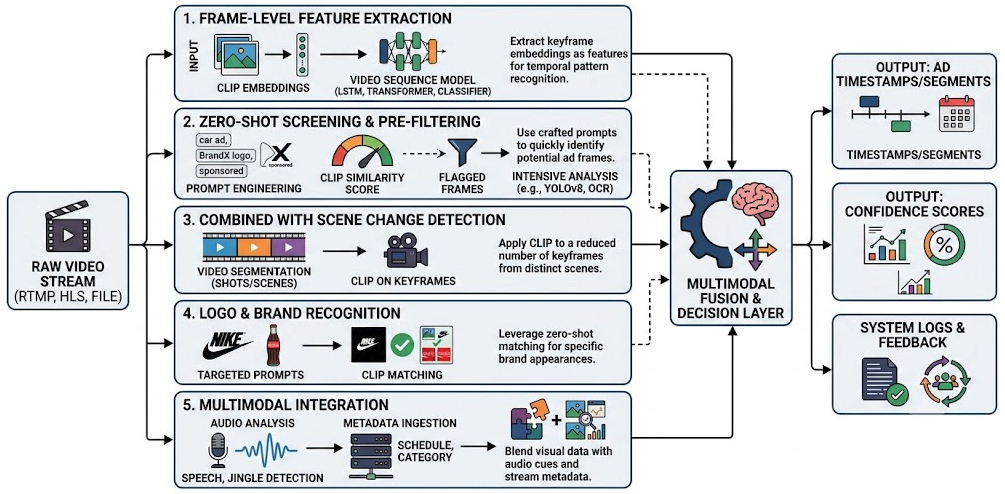
Despite its limitations, CLIP can be a valuable component in a larger ad recognition system for video streams, rather than a standalone solution:
1. Frame-Level Feature Extraction:
Embeddings as Input: You could extract CLIP image embeddings for keyframes or a selection of frames from the video.
Downstream Video Model: These frame embeddings can then serve as input features for a dedicated video-sequence model (e.g., an LSTM, Transformer, or a simpler classifier) that learns to recognize temporal patterns indicative of ads. This leverages CLIP's rich visual understanding while adding temporal reasoning.
2. Zero-Shot Screening/Pre-filtering:
Prompt Engineering: Use carefully crafted text prompts ("a car advertisement," "a logo for [BrandX]," "a sponsored message") to identify potentially ad-containing frames.
Confidence Scoring: Frames with high CLIP similarity scores to ad-related prompts could be flagged for further, more intensive analysis by other models.
3. Combined with Scene Change Detection:
Segment Video: First, segment the video into shots or scenes using scene change detection algorithms.
Analyze Keyframes: Apply CLIP to keyframes from these segments. This reduces the number of frames to process and focuses analysis on distinct visual changes.
4. Logo/Brand Recognition:
Targeted Prompts: CLIP is excellent for matching images to specific brands or logos if given appropriate text prompts (e.g., "Nike logo," "Coca-Cola bottle"). This can be used to identify brand appearances, which are often indicative of ads or product placements.
5. Multimodal Integration:
Audio Analysis: Integrate CLIP's visual analysis with audio processing models (e.g., for speech recognition, jingle detection, sound event classification). A segment with high visual ad similarity and an ad-like audio track would be a stronger candidate.
Metadata: Incorporate stream metadata (e.g., scheduled ad breaks, content category) into the overall decision-making process.
Alternative and Complementary Approaches
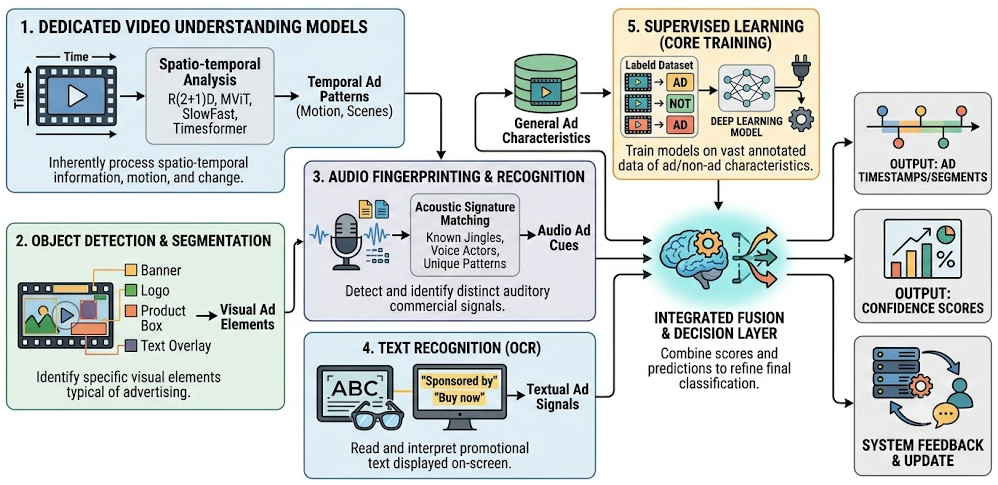
For robust ad recognition in video streams, effective strategies combine dedicated video understanding models such as R(2+1)D, MViT, or SlowFast to process spatio-temporal information and motion, alongside object detection and segmentation for identifying specific ad elements like banners, logos, product boxes, or text overlays. Additionally, audio fingerprinting and recognition help identify known ad jingles or unique audio patterns, while text recognition (OCR) captures on-screen textual indicators such as "Sponsored by." Ultimately, supervised learning, training models on large datasets of annotated video segments categorized as "ad" or "not ad," integrates these diverse approaches to capture a comprehensive range of ad characteristics.
Conclusion
It is not impossible to use CLIP for ad recognition in video streams, but it is not suitable as a standalone solution for robust, real-time, and comprehensive detection. Directly applying CLIP frame-by-frame would be computationally expensive and would miss crucial temporal, audio, and contextual cues inherent to video advertisements.
Instead, CLIP can serve as a powerful component or feature extractor within a more complex, multimodal system. By combining CLIP's strong zero-shot visual understanding with video-specific architectures, audio analysis, scene change detection, and other contextual information, a robust ad recognition system for video streams can be built.