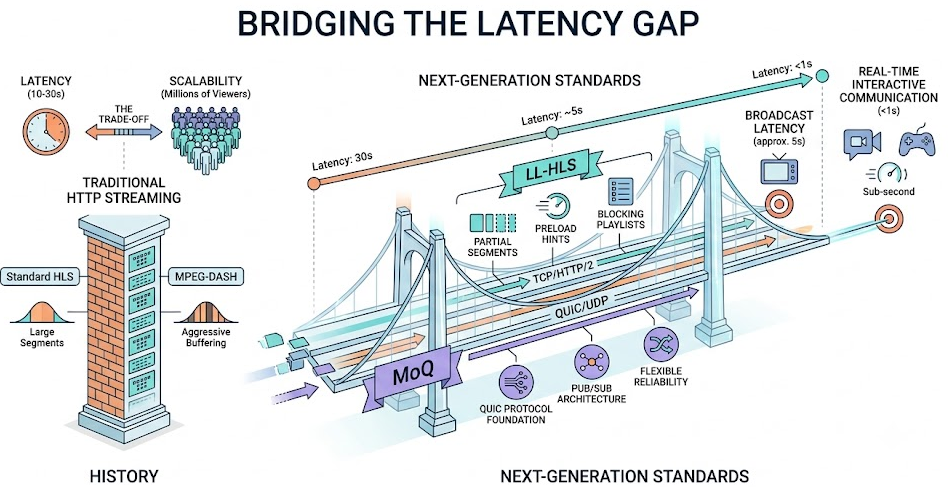
Live video streaming has historically faced a trade-off between latency (delay between capture and display) and scalability (ability to serve millions of concurrent viewers efficiently). Traditional HTTP-based protocols like Standard HLS and MPEG-DASH introduced 10 to 30 seconds of latency due to long segment sizes and aggressive buffering.
To bridge the gap between broadcast latency (around 5 seconds) and real-time interactive communication (<1 second), two primary next-generation standards have emerged: LL-HLS (Low-Latency HTTP Live Streaming) and MoQ (Media over QUIC).
1. Low-Latency HLS (LL-HLS)
Developed by Apple and introduced in 2019, LL-HLS is an extension of the ubiquitous HLS protocol. It reduces glass-to-glass latency to 1–3 seconds while maintaining backwards compatibility with traditional CDN infrastructures and standard HTTP delivery mechanisms.
Key Architectural Mechanisms
Partial Segments (Chunked Delivery): Instead of waiting for a full 2-to-6-second segment to finish encoding, LL-HLS breaks segments into smaller "parts" (e.g., 200–500 milliseconds) using CMAF (Common Media Application Format) chunks. Players can request and play these parts sequentially before the main segment is finalized.
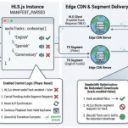
Preload Hints: The server uses the EXT-X-PRELOAD-HINT tag in the media playlist to inform the client about the URI of the next expected partial segment. This allows the client to issue a request before the data is even available, minimizing HTTP request-response round trips.
Blocking Playlist Reloads: Instead of the client polling the server repeatedly for playlist updates, the client requests an update for a segment that hasn't been generated yet. The server holds the request (blocks) until the data becomes available, returning it immediately.
Delta Playlists: To prevent the overhead of downloading full playlists continuously, LL-HLS allows clients to request only the changes (deltas) since the last playlist update using the EXT-X-SKIP tag.
Strengths & Limitations
Strengths:
Native support across the Apple ecosystem (iOS, macOS, tvOS, Safari).
Highly scalable using existing HTTP/2 and HTTP/3 CDN infrastructure.
Robust fallback to standard HLS for legacy devices.
Limitations:
High HTTP request volume per second due to small partial segment updates, which can increase CDN edge processing load.
Complex implementation logic on both client players and origin servers.
2. Media over QUIC (MoQ)
Media over QUIC (MoQ) is an emerging open standard actively being developed by the IETF (Internet Engineering Task Force). Built on top of QUIC and WebTransport, MoQ aims to provide a single, unified protocol capable of scaling from real-time interactive latency (<500 ms) up to mass-scale live distribution.
Key Architectural Mechanisms
QUIC Protocol Foundation: MoQ leverages QUIC’s native benefits, such as zero-RTT connection establishment, multiplexing without head-of-line blocking, and connection migration (e.g., seamless switching between Wi-Fi and Cellular).
Publish/Subscribe Architecture: MoQ operates on an object-based Pub/Sub model. Publishers push media objects (Tracks, Groups, and Objects) to QUIC-aware relays, and subscribers express interest in specific media tracks.
Flexible Transport Reliability: Unlike pure TCP (which forces strict delivery) or pure UDP (which drops packets blindly), MoQ allows developers to set priority and reliability policies per object. For example, audio can be delivered reliably, while non-reference video frames can be dropped if network congestion occurs.
Relay Hierarchy: MoQ introduces generic, media-unaware relays. These relays sit at the network edge, cache incoming QUIC objects, and distribute them to subscribers, combining the low latency of WebRTC with the caching efficiency of HTTP CDNs.
Strengths & Limitations
Strengths:
Sub-second latency capable of real-time interactions (e.g., live auctions, gaming, interactive sports).
Eliminates the strict boundary between WebRTC (low latency, poor scale) and HTTP streaming (high latency, high scale).
Reduced protocol overhead compared to repeated HTTP/2 or HTTP/3 request/response cycles.
Limitations:
Still an evolving draft specification within the IETF; implementations are currently custom or experimental.
Requires QUIC-native middleboxes and CDN relays capable of understanding MoQ object boundaries.
3. Technical Comparison
Feature
Low-Latency HLS (LL-HLS)
Media over QUIC (MoQ)
Governing Body
Apple Inc.
IETF (MoQ Working Group)
Target Latency
1 to 3 seconds
< 200 ms to 1 second
Underlying Protocol
HTTP/2, HTTP/3 (TCP/QUIC)
QUIC / WebTransport
Data Format
CMAF / fMP4 (Segments & Parts)
Media Objects (Groups/Tracks)
Delivery Model
Client Pull (via Blocking Requests)
Pub/Sub Push/Pull Hybrid
CDN Compatibility
High (Works with standard HTTP/2+ CDNs)
Medium/Emerging (Requires QUIC Relays)
Ecosystem Maturity
Production-ready (Widely Deployed)
Draft / Emerging Standard
4. Deployment Scenarios & Industry Outlook
When to Choose LL-HLS
Mass OTT Live Events: Ideal for premium live sports, concerts, and linear TV broadcasts where 2-second latency is sufficient to align with or beat traditional cable/satellite feeds.
Apple-Centric Workflows: Essential when targeting native iOS, iPadOS, and tvOS apps requiring built-in system player support.
Existing HTTP Infrastructure: Best for organizations that want to leverage current CDN contracts and standard HTTP caching strategies.
When to Choose MoQ
Interactive & Social Streaming: Critical for use cases requiring real-time engagement, such as live betting, esports, co-watching, remote production, and auction platforms.
Unified Streaming Pipelines: Suited for platforms seeking to replace fragmented stacks (e.g., using WebRTC for ingress/ingest and HLS for delivery) with a single, end-to-end QUIC-based architecture.
Next-Gen Web Architecture: Ideal for WebTransport-enabled web applications seeking ultra-low overhead audio/video routing.
Protocol Comparison Overview
Feature
Traditional Live HLS
Low-Latency HLS (LL-HLS)
Media over QUIC (MoQ)
Primary Developer
Apple
Apple
IETF Working Group
Transport Protocol
TCP (HTTP/1.1 or HTTP/2)
TCP (HTTP/2 or HTTP/3)
UDP (QUIC / WebTransport)
End-to-End Latency
15 – 30 seconds
2 – 5 seconds
Sub-second – 2 seconds
Delivery Model
Polling manifests, complete segment downloads
Push-like blocking requests, partial segments
Publish/Subscribe (PubSub) object model
Head-of-Line Blocking
Subject to TCP HoL blocking
Reduced, but bounded by TCP/HTTP setup
Completely eliminated (per-stream isolation)
CDN Compatibility
Native / Universal support
Requires HTTP/2+ and specific edge feature support
Requires QUIC/MoQ-aware relay nodes
Traditional Live HLS vs. Low-Latency HLS (LL-HLS)
1. Traditional Live HLS Overview
Standard HTTP Live Streaming (HLS) breaks a continuous video stream into discrete media files (segments), typically 2 to 10 seconds in length. The client repeatedly fetches an updated playlist (.m3u8 manifest file) to discover new segments and downloads them sequentially via standard HTTP GET requests.
High Latency Source: Latency builds up because the player must wait for an entire segment to be fully encoded, packaged, uploaded to the origin, updated in the playlist, and downloaded by the client before playback can start. Players typically buffer 3 complete segments to ensure stable playback, yielding 15 to 30 seconds of latency.
2. How LL-HLS Achieves Low Latency
Apple introduced LL-HLS (extension to the HLS specification) to reduce latency to 2–5 seconds while maintaining backward compatibility with standard HLS players.
LL-HLS achieves this through four primary mechanisms:
Partial Segments (Parts): Segments are divided into smaller chunks called Parts (e.g., 200–500ms duration). Players can request and play these parts before the parent segment is completely finished encoding.
Preload Hints: The server advertises the URI of the next anticipated partial segment in the playlist using the EXT-X-PRELOAD-HINT tag. This allows the client to issue an HTTP request for data that the server hasn’t fully finished generating yet.
Blocking Playlist Updates: Instead of forcing the client to repeatedly poll the manifest, the client sends a request for a playlist update that includes parameters specifying the exact segment/part it is waiting for. The server holds (blocks) the HTTP response until that specific partial segment is published.
Delta Playlists: To reduce the overhead of sending the entire manifest repeatedly over blocking requests, the server can send a "delta" manifest containing only the newly added parts and updates.
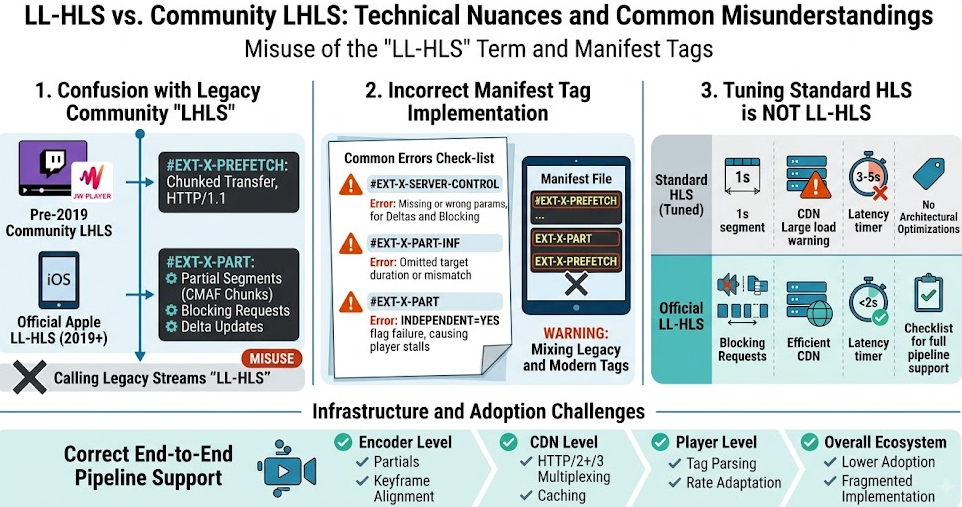
Misuse of the "LL-HLS" Term and Manifest Tags
The widespread confusion surrounding LL-HLS stems from technical complexity, historical specs, and partial vendor implementations.
1. Confusion with Legacy Community "LHLS"
Before Apple published its official LL-HLS specification in 2019, the streaming community created an open spec often referred to as Community LHLS (pioneered by Twitch, JW Player, and others).
Community LHLS relied heavily on HTTP/1.1 Chunked Transfer Encoding (#EXT-X-PREFETCH tags).
Apple LL-HLS replaced this concept with partial segments (#EXT-X-PART), blocking requests, and delta updates.
The Misuse: Many providers still label legacy chunked transfer streams as "LL-HLS," using outdated or unsupported tags.
2. Incorrect Manifest Tag Implementation
Apple's official LL-HLS specification requires a specific set of tags in the .m3u8 manifest file. Common implementation errors include:
#EXT-X-SERVER-CONTROL: Often missing or configured with invalid parameters. This tag tells the player how to request playlist deltas and handle blocking requests (e.g., HOLD-BACK, PART-HOLD-BACK).
#EXT-X-PART-INF: Specifies the target duration for partial segments. Vendors often omit this or supply values that do not match the actual chunk generation.
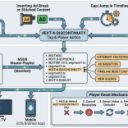
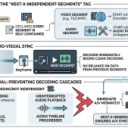
#EXT-X-PART: Represents individual partial segments. Vendors frequently fail to set the INDEPENDENT=YES flag correctly on keyframe chunks, causing players to stall during playback.
Mixing Legacy and Modern Tags: Manifests often improperly mix deprecated #EXT-X-PREFETCH tags with modern #EXT-X-PART tags, creating unpredictable behavior in video players.
3. Tuning Standard HLS and Calling It "LL-HLS"
A common industry practice is taking standard Live HLS, lowering the segment size to 1 second, and labeling it as "Low Latency."
While this reduces latency to ~3–5 seconds, it is not true LL-HLS.
It lacks the architectural optimizations (blocking requests, partial segments) required for sub-2-second latency and places an unsustainable HTTP request load on CDNs.
Infrastructure and Adoption Challenges
Implementing true LL-HLS correctly requires end-to-end support across the entire video pipeline:
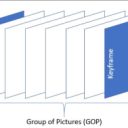
Encoder Level: Encoders must generate partial segments in real time with precise keyframe alignment.
CDN Level: Content Delivery Networks must support HTTP/2 or HTTP/3 multiplexing and correctly cache short-lived partial segments and blocking requests.
Player Level: Players (such as HLS.js, Video.js, or native iOS AVPlayer) must fully support the LL-HLS tag parsing logic to handle dynamic rate adaptation and delta updates without buffering.
Due to these strict requirements, full end-to-end adoption of official LL-HLS remains lower than advertised, leading to fragmented or incorrectly tagged implementations across the video streaming ecosystem.