Inside the Next-Generation Streaming Architecture: Ultra-Low Latency, SGAI, and AI Codecs
CK 3788 Created at
19800
The global streaming industry—dominated by giants like Disney+, Netflix, and FOX/Tubi—is undergoing a paradigm shift in its core technical infrastructure. As the subscription video-on-demand (SVOD) market matures, platforms are aggressively acquiring live sports rights (e.g., NFL, UEFA Champions League, WWE) and launching ad-supported tiers (AVOD/FAST). Consequently, engineering priorities have pivoted from the efficient delivery of pre-recorded Ultra-HD VOD content to massively scalable ultra-low latency live broadcasting and advanced ad monetization.
1. Core Technology Focus Areas
① Ultra-Low Latency Live Streaming
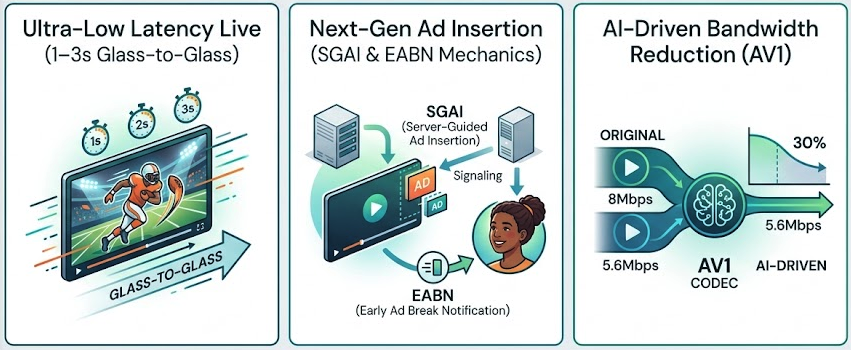
For massive concurrency events such as the Super Bowl or World Cup, reducing the latency gap between traditional linear broadcast (cable/satellite) and over-the-top (OTT) streaming to 1–3 seconds is critical.
The Traditional Latency Problem: Standard HTTP Live Streaming (HLS) and Dynamic Adaptive Streaming over HTTP (DASH) rely on video segment lengths of 2 to 6 seconds, leading to a cumulative end-to-end delay of 10 to 30 seconds. This creates the "spoiler effect," where viewers receive push notifications or hear neighbors cheering before witnessing the play on screen.
Engineering Solutions: Streaming services are abandoning large media segments in favor of partial segment chunks and real-time streaming protocols:
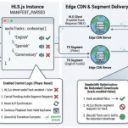
LL-HLS (Low-Latency HLS) & LL-DASH: Break 2-second segments into sub-chunk fragments (e.g., 200–500ms), delivering media bytes as soon as they are encoded.
Chunked Transfer Encoding: Allows origin servers to push partial video frames via HTTP/1.1 or HTTP/2 without waiting for the full segment file to complete.
② Next-Generation Personalized Ad Insertion (SGAI & EABN)
Traditional ad insertion models fail under live sports concurrency due to infrastructure strain or security vulnerabilities.
Limitations of Legacy Systems:
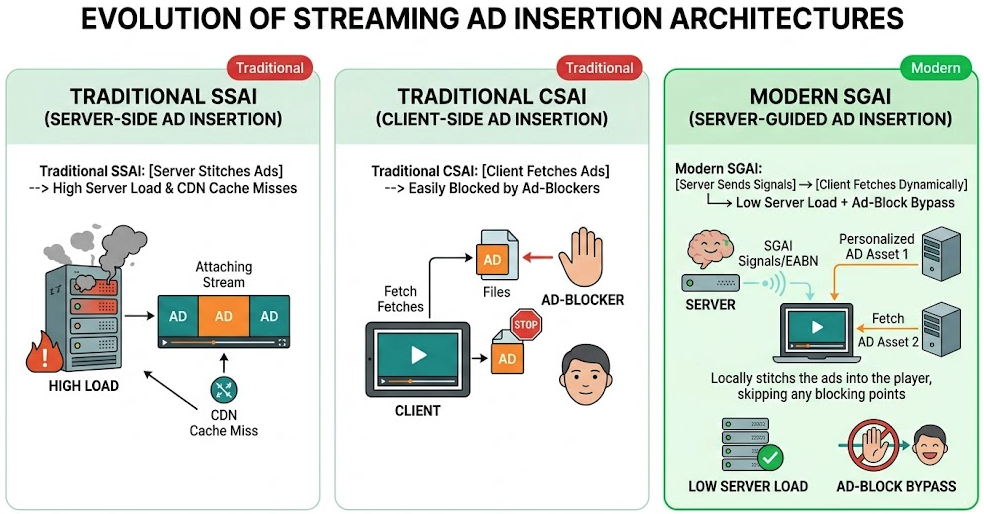
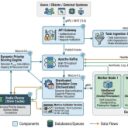
Server-Side Ad Insertion (SSAI): While resistant to ad-blockers, dynamically stitching unique video streams for tens of millions of concurrent users simultaneously spikes CDN origin costs and causes server bottlenecks during sudden ad breaks.
Client-Side Ad Insertion (CSAI): Shifts the processing to the user's device but is highly vulnerable to ad-blocking software and often results in jarring quality transitions between content and ads.
The Modern Solution: SGAI & EABN:
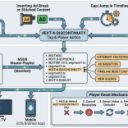
SGAI (Server-Guided Ad Insertion): The server sends lightweight signaling metadata directing the client on where and how to fetch personalized ads. The client performs the dynamic stitching locally. This preserves CDN cache efficiency, scales effortlessly across millions of viewers, and prevents traditional ad-blockers from identifying the ad streams.
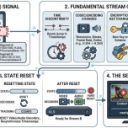
EABN (Early Ad Break Notification): Solves the unpredictability of live sports (e.g., sudden timeouts or injuries). EABN sends upstream signaling ahead of time so client player devices can pre-fetch targeted ad assets into memory prior to the broadcast breaking away.
③ AI-Driven Codecs and Dynamic Encoding
To offset rising CDN egress costs caused by surge live traffic, platforms are investing heavily in content-aware encoding and next-generation codecs to reduce bandwidth consumption by 20% to 30% without sacrificing visual fidelity.
Per-Title / Per-Shot Encoding: Rather than applying fixed bitrate ladders, machine learning models analyze video complexity frame-by-frame. Highly dynamic content (e.g., live action sports) receives optimized bitrates to prevent macroblocking, while low-motion scenes (e.g., studio commentary) are compressed aggressively.
Neural Network Super-Resolution: ML-driven upscaling on client devices allows platforms to stream at 1080p source bitrates while rendering near-4K visual quality on smart TVs, significantly reducing edge CDN bandwidth demands.
2. Platform-Specific Technical Leadership
Company
Key Technologies & Standards
Primary Objectives & Use Cases
Disney+
SGAI, MoQ, CTA-WAVE
Monetizing live sports on ESPN+ and AVOD tiers; standardizing low-latency media transport across living room TV devices.
Netflix
AV1, AOMedia
Pioneering open-source codec integration; deploying per-shot AI encoding across smart TVs, mobile platforms, and expanding live event infrastructure.
FOX / Tubi
LL-HLS, SGAI / EABN, SCTE-35
Processing 15M+ concurrent live viewers across Tubi (FAST) and FOX Sports; driving live dynamic ad insertion standards during scheduled and unscheduled breaks.
Architectural Focus by Platform
Disney+ (Disney Streaming Services): Operates high-concurrency environments combining ESPN+ live broadcasts with Disney+ AVOD. Disney actively leads standard groups like CTA-WAVE (Web Accessible Video Enablement) to ensure low-latency interoperability across diverse smart TV hardware, while migrating its ad-tech stack to SGAI to handle high-concurrency sports ad breaks seamlessly.
Netflix: As a founding member of the Alliance for Open Media (AOMedia), Netflix leads the industry in deploying the royalty-free AV1 codec. Netflix relies on advanced Per-Shot Encoding architectures to minimize global egress traffic costs while expanding its architecture to handle massive live concurrent events (e.g., live sports and real-time broadcasts).
FOX / Tubi: Leveraging Tubi’s FAST infrastructure and FOX Sports' high-profile live broadcasts, FOX specializes in processing legacy SCTE-35 linear cues into digital metadata triggers. By combining LL-HLS delivery with EABN, they maximize ad fill rates and real-time programmatic ad yields during dynamic live sports events.
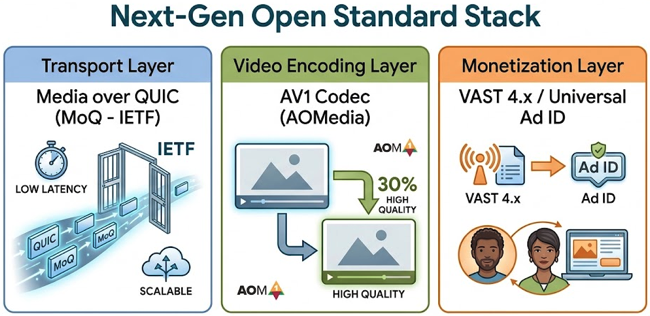
To prevent vendor lock-in and fragmenting device ecosystems, streaming platforms are rallying behind open standards governed by organizations like the IETF, DASH-IF, and AOMedia.
Technical Breakdown: MoQ is a unified transport protocol designed specifically for media, built on top of QUIC (which uses UDP).
Why It Matters: Traditional TCP-based streaming suffers from head-of-line blocking—if a single packet drops, the entire video buffer halts. WebRTC offers ultra-low latency but lacks scalability and CDN cacheability. MoQ combines the sub-second latency characteristics of WebRTC with the scalability and caching structures of traditional HTTP streaming, establishing a unified global standard for real-time sports distribution.
② AV1 (AOMedia Video 1)
Governing Body: Alliance for Open Media (AOMedia)
Technical Breakdown: An open-source, royalty-free video coding format designed to succeed H.264/AVC and compete directly with HEVC/H.265 and VVC.
Why It Matters: AV1 provides up to 30% better compression efficiency over HEVC without licensing fees. Backed by Netflix, Google, Amazon, and Meta, hardware decoding support for AV1 has become standard across modern mobile chipsets, smart TVs, and streaming devices.
③ VAST 4.x & Universal Ad ID
Governing Body: IAB Tech Lab
Technical Breakdown: The Video Ad Serving Template (VAST) version 4.x standardizes the communication protocol between video players and ad servers.
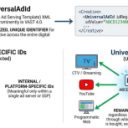
Why It Matters: VAST 4.x introduces strict separation between media stitching and ad-serving logic, natively supporting Universal Ad ID tracking. This enables cross-platform ad deduplication, prevents repeated ads during live streams, supports high-quality mezzanine file delivery, and ensures standardized viewability measurement across fragmented TV platforms.